
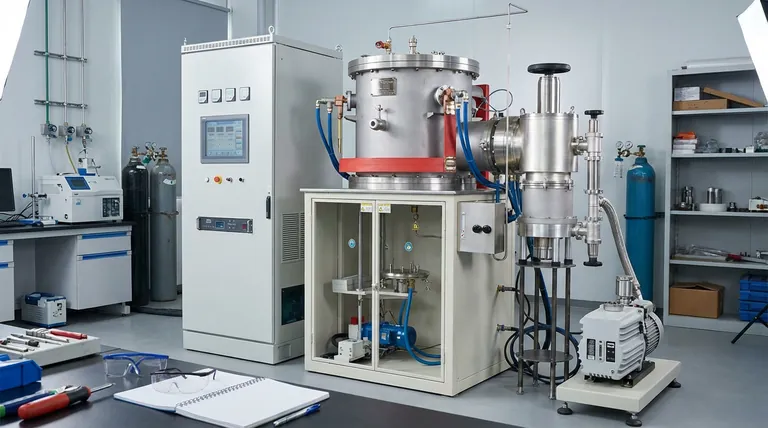
A high-vacuum ultra-high temperature annealing furnace is indispensable for this research because it is the only environment capable of purifying deformed tungsten without chemically destroying it. To study these crystals effectively, you must subject them to extreme heat treatment up to 2400°C to release trapped impurities, while simultaneously maintaining a vacuum to prevent the tungsten from oxidizing.
To study the true electronic structure of deformed tungsten, you must eliminate machining impurities trapped deep within the crystal lattice. This requires a dual approach: extreme heat to drive out contaminants and a high-vacuum environment to shield the metal from secondary oxidation.
The Critical Role of Extreme Heat
Target Temperature: 2400°C
Standard laboratory furnaces are insufficient for this material. You require a furnace capable of reaching 2400°C to activate the necessary physical changes within the tungsten crystal.
Thermal Desorption of Impurities
The primary goal of this extreme heat is thermal desorption. During the machining process of tungsten single crystals, impurity molecules—specifically water and oxygen—are introduced into the material.
Clearing Dislocation Centers
These impurities do not just sit on the surface; they become trapped in the dislocation centers of the crystal. Only temperatures approaching 2400°C provide the energy required to dislodge these molecules and eject them from the crystal lattice.
Why High Vacuum is Non-Negotiable
Preventing Secondary Oxidation
Tungsten is highly susceptible to oxidation at elevated temperatures. If you were to heat tungsten to 2400°C in the presence of air or even trace amounts of oxygen, the material would undergo secondary oxidation.
Shielding the Sample
The high-vacuum environment acts as a protective shield. It ensures that as the furnace heats up, there is no oxygen available to react with the tungsten, preserving the physical sample.
Ensuring Electronic Integrity
The ultimate goal is to study the deformed electronic structure of the crystal. If oxidation occurs, the electronic properties change fundamental, rendering the data useless. The vacuum ensures the structure you study is the tungsten itself, not a tungsten oxide layer.
The Operational Trade-offs
The Necessity of Stepped Heating
You cannot simply ramp to 2400°C instantly. The trade-off for high-fidelity data is the time required for a stepped heating cycle.
Balancing Time vs. Purity
This process is slow and methodical. It allows for the gradual release of impurities without thermally shocking the crystal, but it requires significant operational time and precise control compared to standard annealing methods.
Making the Right Choice for Your Goal
To ensure your research on deformed tungsten yields valid results, you must prioritize the environmental conditions of your heat treatment.
- If your primary focus is removing machining damage: Ensure your furnace can execute a stepped heating cycle up to 2400°C to fully desorb trapped water and oxygen.
- If your primary focus is preserving electronic structure: Verify that the vacuum system is rated for ultra-high vacuum levels to guarantee zero secondary oxidation during the heating phase.
By combining extreme thermal energy with a void of matter, you reveal the true nature of the material rather than its contaminants.
Summary Table:
| Feature | Requirement | Purpose in Tungsten Research |
|---|---|---|
| Peak Temperature | 2400°C | Enables thermal desorption of impurities from dislocation centers |
| Atmosphere | High Vacuum | Prevents secondary oxidation and preserves electronic integrity |
| Heating Method | Stepped Heating | Ensures gradual impurity release without thermal shock |
| Target Impurities | Water & Oxygen | Removes contaminants trapped during the machining process |
Elevate Your Materials Research with KINTEK Precision
Studying advanced materials like deformed tungsten requires equipment that can handle the extremes. Backed by expert R&D and world-class manufacturing, KINTEK offers high-performance Muffle, Tube, Rotary, Vacuum, and CVD systems tailored for ultra-high temperature applications.
Whether you need standard laboratory high-temp furnaces or a fully customizable solution designed for your unique research parameters, our team is ready to support your mission-critical heat treatments.
Ready to achieve unparalleled sample purity? Contact us today to discuss your project requirements.
References
- Sviatoslav Smolnik, E. G. Len. Effect of Deformation on the Electronic Properties of the W(110) Single Crystals Surface Before and After Different Types of Surface Treatment. DOI: 10.15407/mfint.45.09.1083
This article is also based on technical information from Kintek Furnace Knowledge Base .
Related Products
- 2200 ℃ Tungsten Vacuum Heat Treat and Sintering Furnace
- Molybdenum Vacuum Heat Treat Furnace
- Small Vacuum Heat Treat and Tungsten Wire Sintering Furnace
- 2200 ℃ Graphite Vacuum Heat Treat Furnace
- 1400℃ Controlled Inert Nitrogen Atmosphere Furnace
People Also Ask
- How does a tungsten-heated vacuum sintering furnace prepare (TbxY1-x)2O3 ceramics? Achieve 99%+ Density & Purity
- How do compaction pressure and vacuum sintering optimize porous ceramics? Maximize Density & Toughness
- What wear-resistance enhancements are achieved by powder coating? The Role of Vacuum Sintering Furnaces
- What role does a high-temperature vacuum sintering furnace play in the densification of WC-10(Ni, Ni/Co) alloys?
- What core role does a high-temperature vacuum sintering furnace play in Sm:YAG ceramics? Mastering Optical Clarity



















