
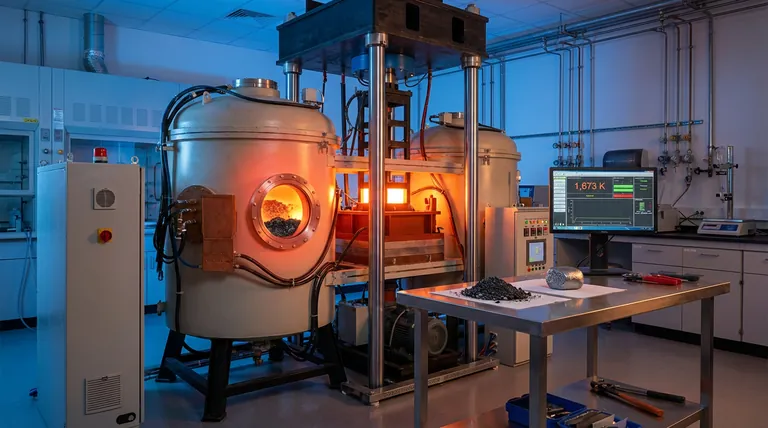
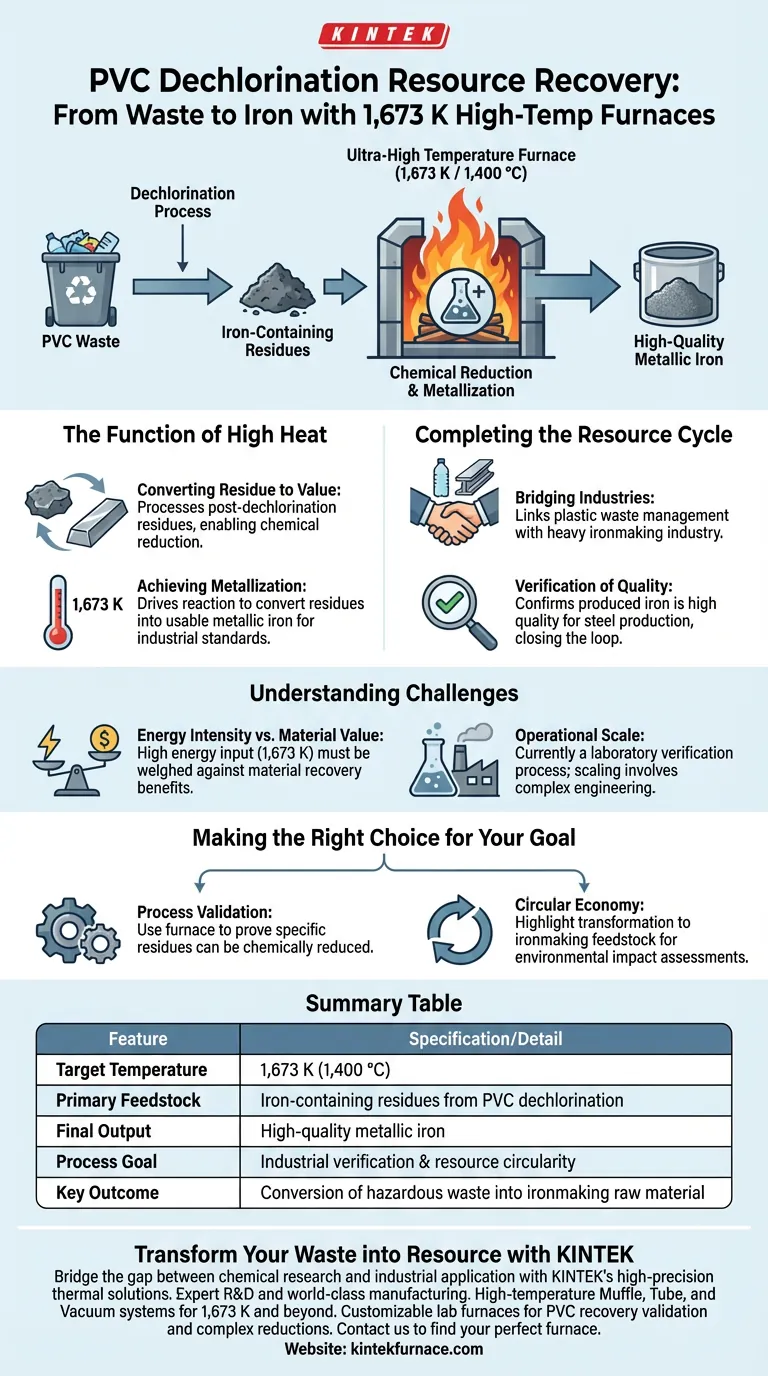
The ultra-high temperature furnace serves as a critical verification tool in the final stage of the PVC resource recovery cycle. Specifically, it functions to confirm the feasibility of converting iron-containing residues—which are byproducts left over after the dechlorination process—directly into usable metallic iron.
By subjecting post-dechlorination residues to extreme heat (1,673 K), this process demonstrates that hazardous plastic waste byproducts can be successfully transformed into high-quality raw materials for ironmaking, effectively closing the loop on resource utilization.
The Function of High Heat in Recovery
Converting Residue to Value
The primary purpose of the furnace is to process the iron-containing residues that remain after PVC has been dechlorinated.
Rather than treating this residue as secondary waste, the furnace creates an environment where chemical reduction can occur.
Achieving Metallization
Reaching a temperature of 1,673 K is necessary to drive the reaction that converts these chemical residues into metallic iron.
This high thermal threshold ensures the complete transformation of the material, verifying that the byproduct can meet the rigorous standards required for industrial application.
Completing the Resource Cycle
Bridging Plastic and Steel Industries
This application establishes a direct link between plastic waste management and heavy industry.
By validating that these residues can become feedstock for ironmaking, the process turns a disposal problem into a manufacturing solution.
Verification of Quality
The use of a laboratory furnace at this specific temperature is a proof-of-concept step.
It confirms that the iron produced from plastic waste residues is of sufficiently high quality to replace or supplement traditional raw materials in steel production.
Understanding the Challenges
Energy Intensity vs. Material Value
While the recovery of metallic iron is valuable, reaching 1,673 K requires significant energy input.
You must weigh the environmental benefit of material recovery against the energy cost of maintaining such high temperatures.
Operational Scale
The reference specifically notes the use of a laboratory furnace for verification.
This suggests that while the chemistry is sound, scaling this process to handle mass quantities of municipal PVC waste involves complex engineering logistics beyond the initial feasibility test.
Making the Right Choice for Your Goal
To determine how this technology fits into your resource recovery strategy, consider your primary objective:
- If your primary focus is process validation: Use the high-temperature furnace to prove that your specific dechlorination residues can be chemically reduced to metallic iron.
- If your primary focus is circular economy: Highlight the capability to transform plastic waste into ironmaking feedstock as a key metric for "closing the loop" in your environmental impact assessments.
This technology proves that with the right thermal treatment, even complex chemical residues can be reclaimed as valuable industrial assets.
Summary Table:
| Feature | Specification/Detail |
|---|---|
| Target Temperature | 1,673 K (1,400 °C) |
| Primary Feedstock | Iron-containing residues from PVC dechlorination |
| Final Output | High-quality metallic iron |
| Process Goal | Industrial verification & resource circularity |
| Key Outcome | Conversion of hazardous waste into ironmaking raw material |
Transform Your Waste into Resource with KINTEK
Bridge the gap between chemical research and industrial application with KINTEK’s high-precision thermal solutions. Backed by expert R&D and world-class manufacturing, KINTEK provides high-temperature Muffle, Tube, and Vacuum systems capable of reaching 1,673 K and beyond. Whether you are validating PVC recovery cycles or scaling complex chemical reductions, our customizable lab furnaces deliver the uniform heating and durability your project demands.
Ready to close the loop on your material recovery process? Contact us today to discuss your unique needs and find the perfect high-temp furnace for your laboratory.
Visual Guide
References
- Lan Hong, Lin-hai Ye. De-chlorination of poly(vinyl) chloride using Fe <sub>2</sub> O <sub>3</sub> and the improvement of chlorine fixing ratio in FeCl <sub>2</sub> by SiO <sub>2</sub> addition. DOI: 10.1515/htmp-2022-0299
This article is also based on technical information from Kintek Furnace Knowledge Base .
Related Products
- Laboratory Muffle Oven Furnace with Bottom Lifting
- 1700℃ High Temperature Muffle Oven Furnace for Laboratory
- 1700℃ High Temperature Laboratory Tube Furnace with Alumina Tube
- 1400℃ High Temperature Laboratory Tube Furnace with Alumina Tube
- 1700℃ Controlled Inert Nitrogen Atmosphere Furnace
People Also Ask
- Why is a high-temperature laboratory muffle furnace essential for the alkali fusion process in zeolite synthesis?
- What is the importance of the calcination process? Master High-Purity Calcium Phosphate Nanopowder Production
- Why is a high-temperature muffle furnace required for FeOx-MOx/TiO2? Engineering High-Performance Nanocomposites
- What function does a muffle furnace perform in Ba0.75Ca0.25TiO3 calcination? Ensure Phase Purity & Synthesis
- What are the primary functions of a high-temperature laboratory muffle furnace in the preparation of biosorbent materials?



















