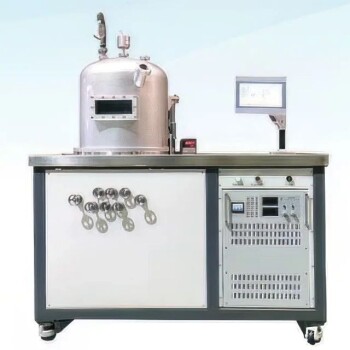
The requirement for a high vacuum magnetron sputtering system is driven by the absolute need for chemical purity. Specifically, it is necessary to eliminate uncontrolled atmospheric gases that would otherwise contaminate the deposition process and degrade material performance.
Core Insight: The presence of background gases like oxygen and nitrogen can chemically alter deposited layers, turning intended conductors into insulators. High vacuum systems prevent this by creating a pristine, "ultra-clean" environment where only the intended process gases (such as pure Argon) interact with the material.
The Role of Extreme Vacuum Levels
Reaching the Purity Threshold
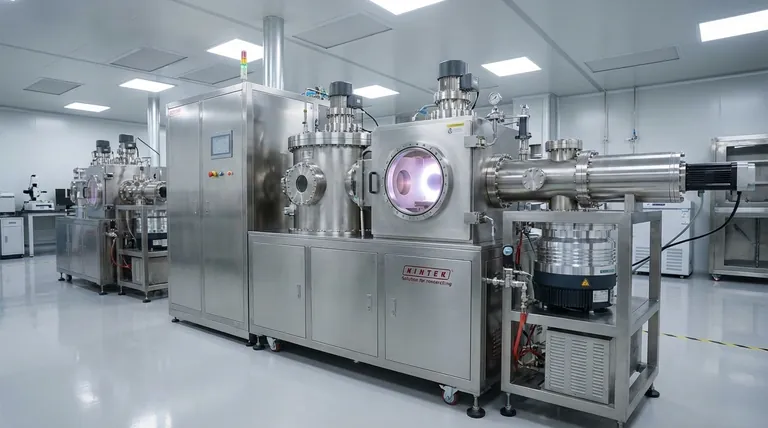
To achieve the necessary purity, the system cannot rely on standard pumps alone. It utilizes a combination of mechanical and molecular pumps.
This dual-stage pumping allows the chamber to reach extreme vacuum levels, specifically down to 5 × 10⁻⁴ Pa.
Creating a Controlled Atmosphere
Once this base pressure is achieved, the system introduces high-purity argon gas.
Because the background atmosphere has been evacuated, the argon plasma remains pure. This ensures that the sputtering process is driven solely by the intended mechanical bombardment, rather than unwanted chemical reactions with air.
Preventing Material Degradation
Minimizing Impurity Incorporation
The primary danger in sputtering is the incorporation of "impurity atoms," specifically oxygen and nitrogen, from the residual atmosphere.
If these atoms are present during deposition, they react with the target material. In the context of forming device layers, this uncontrolled reaction changes the fundamental properties of the film.
Ensuring Electrical Performance
The reference highlights that this high vacuum is critical for depositing top electrodes or conductive structural treatments.
By eliminating impurities, the system ensures the formation of high-purity conductive layers. This results in extremely low sheet resistance (less than 1 Ω/sq), which is essential for the efficient operation of the device.
Common Pitfalls to Avoid
Misinterpreting "Vacuum"
Not all vacuums are sufficient. A standard "rough" vacuum still contains enough oxygen to oxidize sensitive metal layers.
Using a system without molecular pumps creates a risk of high sheet resistance. If the pressure is not lowered to the 10⁻⁴ Pa range, you risk depositing a resistive oxide rather than a pure, conductive metal.
Making the Right Choice for Your Goal
When configuring your sputtering process for complex stacks involving porous dielectrics and electrodes:
- If your primary focus is Conductivity: Prioritize the base pressure (5 × 10⁻⁴ Pa) to ensure your top electrodes achieve sheet resistance below 1 Ω/sq.
- If your primary focus is Purity: Ensure the system uses molecular pumps to evacuate reactive nitrogen and oxygen before introducing Argon.
Ultimately, the high vacuum system acts as a barrier against chemical contamination, ensuring your deposited layers function exactly as designed.
Summary Table:
| Feature | High Vacuum Requirement | Impact on NiO Layers |
|---|---|---|
| Base Pressure | 5 × 10⁻⁴ Pa | Prevents contamination from residual atmospheric gases |
| Pumping System | Mechanical + Molecular Pumps | Reaches the purity threshold required for conductive layers |
| Process Gas | High-Purity Argon | Ensures sputtering occurs without unwanted chemical reactions |
| Sheet Resistance | < 1 Ω/sq | Achieved by eliminating oxygen and nitrogen impurities |
| Material Integrity | Ultra-clean environment | Maintains specific dielectric and conductive properties |
Elevate Your Thin Film Precision with KINTEK
Achieving the perfect porous nickel oxide layer requires absolute control over your deposition environment. KINTEK provides industry-leading high vacuum magnetron sputtering systems designed to eliminate impurities and deliver the extreme low sheet resistance your advanced applications demand.
Backed by expert R&D and world-class manufacturing, KINTEK offers a full suite of Muffle, Tube, Rotary, Vacuum, and CVD systems. Whether you are developing complex dielectric stacks or high-performance electrodes, our lab high-temp furnaces and sputtering solutions are fully customizable to meet your unique research and production needs.
Ready to ensure the purity and performance of your materials? Contact KINTEK Experts Today
Visual Guide

References
- Baichuan Zhang, Jihua Zhang. Novel 3D Capacitors: Integrating Porous Nickel-Structured and Through-Glass-Via-Fabricated Capacitors. DOI: 10.3390/nano15110819
This article is also based on technical information from Kintek Furnace Knowledge Base .
Related Products
- Ultra Vacuum Electrode Feedthrough Connector Flange Power Lead for High Precision Applications
- HFCVD Machine System Equipment for Drawing Die Nano Diamond Coating
- MPCVD Machine System Reactor Bell-jar Resonator for Lab and Diamond Growth
- RF PECVD System Radio Frequency Plasma Enhanced Chemical Vapor Deposition
- Cylindrical Resonator MPCVD Machine System for Lab Diamond Growth
People Also Ask
- Why is a high-precision vacuum sealing system necessary for CrSb? Ensure Pure Crystal Growth & Prevent Oxidation
- Why is an Ultra-High Vacuum (UHV) System Required for In2Se3? Achieving Atomic-Level Ferroelectric Clarity
- What is the function of quartz vacuum encapsulation in RhSeCl CVT? Mastering Pure Crystal Growth
- Why is vacuum sealing technology essential for K2In2As3 synthesis? Master High-Purity Solid-State Reactions
- What role do vacuum-sealed high-purity silica ampoules play in phase equilibrium experiments? Enhance Sample Integrity