
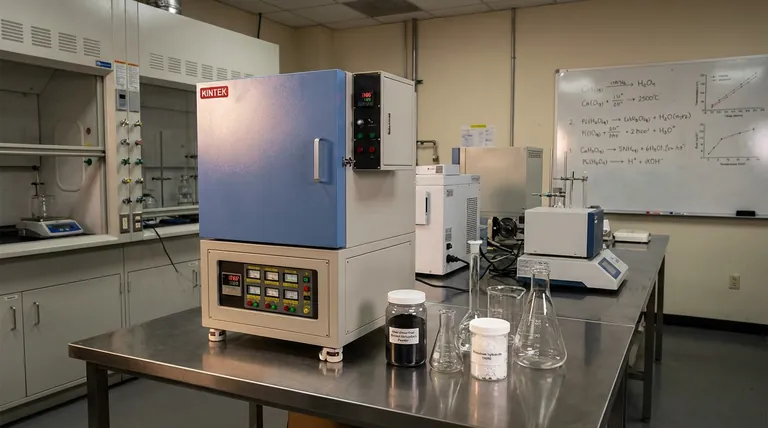
A high-temperature reaction furnace is critical for the activation of onion peel-derived bio-carbon because it drives the system to the specific thermal threshold required to melt potassium hydroxide (KOH). This melting allows the chemical to infiltrate the solid carbon matrix and initiate the etching process that creates porosity.
Core Takeaway The furnace provides the precise thermal energy needed to transform solid KOH into a liquid etching agent. This process chemically hollows out the bio-carbon, converting a dense material into a highly porous structure with the massive surface area required for advanced applications.
The Mechanism of Thermal Activation
Melting and Infiltration
The primary function of the furnace is to heat the mixture of bio-carbon and KOH to critical temperatures.
At ambient temperatures, KOH is solid and cannot penetrate the dense carbon structure. High heat melts the KOH, allowing it to flow and infiltrate the material's internal matrix.
Chemical Etching
Once the KOH is in a molten state within the carbon structure, the heat drives a chemical etching reaction.
This reaction selectively removes carbon atoms from the lattice structure. The furnace maintains the energy required to sustain this aggressive chemical attack on the carbon framework.
Structural Transformation and Benefits
Expansion of Pore Volume
The etching process significantly increases the volume of micropores and mesopores within the onion peel-derived carbon.
This transformation is not merely surface-level; it alters the internal architecture of the material. The result is a dramatic enhancement of the specific surface area.
Creation of Active Sites
The ultimate goal of this thermal processing is to prepare the carbon for future utility.
By maximizing surface area, the furnace ensures the material provides abundant active sites. These sites are essential for the subsequent deposition of functional materials, such as cobalt oxide nanoparticles.
Understanding the Trade-offs
Thermal Precision vs. Material Loss
While high temperatures are necessary for activation, the process involves an inherent trade-off regarding material yield.
The chemical etching process works by consuming carbon atoms. Therefore, the furnace must provide precise thermal control to maximize porosity without burning away too much of the carbon structure.
Atmosphere Control
Although the primary reference focuses on heat, the furnace also serves as a controlled vessel.
Just as with carbonization, maintaining a stable environment is crucial to ensure the etching occurs chemically via KOH, rather than through uncontrolled oxidation with air.
Making the Right Choice for Your Goal
To optimize your bio-carbon production, align your furnace parameters with your specific application requirements:
- If your primary focus is maximizing surface area: Ensure the furnace reaches the critical melting point of KOH to fully activate the etching process for deep micropore formation.
- If your primary focus is composite material development: Utilize the high-temperature activation to create the necessary active sites required for anchoring metal oxides like cobalt oxide.
The furnace is not just a heat source; it is the tool that dictates the final pore architecture of your material.
Summary Table:
| Process Stage | Action of Furnace | Material Transformation |
|---|---|---|
| Melting | Reaches KOH thermal threshold | Solid KOH becomes liquid to infiltrate carbon matrix |
| Chemical Etching | Sustains high-energy reactions | Selective carbon atom removal to create pore structures |
| Pore Expansion | Controlled thermal energy | Dramatic increase in micropore and mesopore volume |
| Activation | High-temp dwell time | Creation of active sites for nanoparticle deposition |
Elevate Your Material Research with KINTEK
Precise thermal control is the difference between successful activation and material loss. Backed by expert R&D and manufacturing, KINTEK offers a comprehensive range of Muffle, Tube, Rotary, Vacuum, and CVD systems, all customizable to meet the rigorous demands of bio-carbon activation and chemical etching.
Whether you are optimizing surface area for supercapacitors or developing advanced composites, our high-temperature furnaces provide the stability and precision your lab requires.
Ready to refine your carbon synthesis? Contact KINTEK today to find the perfect thermal solution for your unique research needs.
References
- Yunan Liu, Ali Reza Kamali. Cobalt Oxide-Decorated on Carbon Derived from Onion Skin Biomass for Li-Ion Storage Application. DOI: 10.3390/met14020191
This article is also based on technical information from Kintek Furnace Knowledge Base .
Related Products
- 1400℃ High Temperature Laboratory Tube Furnace with Alumina Tube
- 1700℃ Controlled Inert Nitrogen Atmosphere Furnace
- 2200 ℃ Tungsten Vacuum Heat Treat and Sintering Furnace
- High Temperature Muffle Oven Furnace for Laboratory Debinding and Pre Sintering
- 1700℃ High Temperature Laboratory Tube Furnace with Alumina Tube
People Also Ask
- How does zone-melting in tube furnaces synthesize bismuth micro-wires? Master Single-Crystal Thermoelectric Growth
- How are high-temp tube furnaces used to measure diffusion coefficients per Fick's law? Master Precision Annealing
- How do high-temperature laboratory tube furnaces ensure environmental stability? Precision Thermal Reduction Tips
- How are high-temperature laboratory tube furnaces applied in long-term vacuum homogenization heat treatments for intermetallic samples?
- How are high-temperature tube furnaces applied in testing ceramic-supported alloy membranes? Insights



















