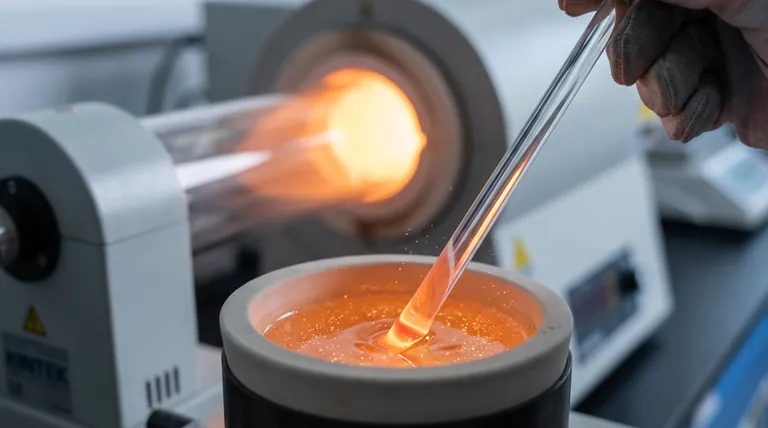
A high-purity quartz glass stirring rod is chosen for its unique ability to withstand high processing temperatures while maintaining strict chemical inertness. It provides the physical strength needed at approximately 650°C to mechanically disperse phosphor particles without introducing performance-degrading metal impurities into the glass melt.
Core Takeaway The quartz rod serves a dual purpose: it generates the mechanical shear force necessary to break particle agglomerates caused by Van der Waals forces, and it does so without contaminating the delicate chemical composition of the glass matrix.
The Critical Role of High-Purity Quartz
Eliminating Contamination Risks
The most immediate benefit of using high-purity quartz is the prevention of metal impurities. Standard metal stirring equipment often degrades or reacts with the melt at high temperatures, introducing contaminants that ruin the optical properties of the glass.
Thermal and Mechanical Stability
Processing molten glass requires tools that remain rigid under extreme heat. At the operating temperature of roughly 650°C, quartz glass maintains high physical strength.
This thermal stability ensures the rod does not soften or deform during the vigorous stirring process required for dispersion.
The Mechanics of Dispersion
Breaking Particle Agglomeration
Phosphor particles, such as YAG:Ce, naturally clump together due to Van der Waals forces. These attractive forces create agglomerates that prevent the phosphor from functioning efficiently.
The quartz rod introduces a mechanical shear force into the melt. This force effectively disrupts the Van der Waals attractions, breaking the clusters apart into individual particles.
Inducing Self-Stabilization
By applying this shear force, the stirring process induces a self-stabilization mode for the particles. This allows the phosphor to remain suspended rather than settling or reclumping.
Uniformity in Low-Viscosity Melts
This method is particularly effective in low-viscosity environments, such as tellurite glass melts. The stirring action ensures the now-separated particles are distributed evenly throughout the liquid glass, guaranteeing uniform luminescence in the final product.
Understanding the Trade-offs
Material Limitations
While quartz is superior for purity, it is not indestructible. It is a brittle material that requires careful handling to avoid fracture, unlike more ductile metal alloys.
Temperature Constraints
Although quartz performs well at 650°C, it has limits. Extremely high temperatures (approaching the softening point of silica) would compromise the rod's structural integrity, making it unsuitable for glass melts requiring significantly higher processing ranges.
Making the Right Choice for Your Goal
To optimize your glass manufacturing process, consider the specific requirements of your matrix and additives.
- If your primary focus is Optical Purity: Prioritize high-purity quartz tools to eliminate any risk of metal ion leaching that could quench luminescence or alter color.
- If your primary focus is Particle Homogeneity: Ensure your stirring mechanism generates sufficient shear force to overcome the specific Van der Waals forces of your phosphor type.
- If your primary focus is High-Temperature Processing: Verify that your operating temperature remains within the structural limits of quartz (around 650°C) to prevent tool deformation.
Selecting the right stirring material is not just about mixing; it is about preserving the chemical integrity of your final optical product.
Summary Table:
| Feature | Quartz Glass Stirring Rod | Benefit for Phosphor Dispersion |
|---|---|---|
| Chemical Purity | High-purity silica (SiO2) | Prevents metal contamination and quenching of luminescence. |
| Heat Resistance | Stable up to 650°C+ | Maintains rigidity and mechanical strength in molten glass. |
| Mechanical Action | High shear force generation | Breaks Van der Waals clusters for uniform particle distribution. |
| Inertness | Non-reactive surface | Ensures the chemical integrity of the tellurite or glass matrix. |
Elevate Your Optical Glass Precision with KINTEK
Don't let impurities compromise your material performance. KINTEK provides high-purity quartz solutions and specialized thermal equipment designed for the most demanding lab environments. Backed by expert R&D and precision manufacturing, we offer a comprehensive range of Muffle, Tube, Rotary, Vacuum, and CVD systems, alongside customizable high-temp lab furnaces tailored to your unique research needs.
Whether you are perfecting phosphor homogeneity or scaling up high-purity melts, our technical team is ready to support your process. Contact KINTEK today to discover how our customizable high-temperature solutions can optimize your manufacturing outcomes.
References
- Yongsheng Sun, Zhiguo Xia. Rapid synthesis of phosphor-glass composites in seconds based on particle self-stabilization. DOI: 10.1038/s41467-024-45293-0
This article is also based on technical information from Kintek Furnace Knowledge Base .
Related Products
People Also Ask
- Why is an environmental laboratory chamber equipped with an optical window required for synthesizing Hafnium Carbide?
- What are the structural functions of the dual-chamber quartz glass container? Optimize Magnesium Alloy Vapor Analysis
- What role do vacuum-sealed high-purity silica ampoules play in phase equilibrium experiments? Enhance Sample Integrity
- What is the purpose of utilizing a glassy carbon crucible and HCl gas treatment? Ensure Pure Molten Salt Systems
- Why is rapid quenching required during the preparation of amorphous glass fertilizers? Boost Nutrient Solubility