
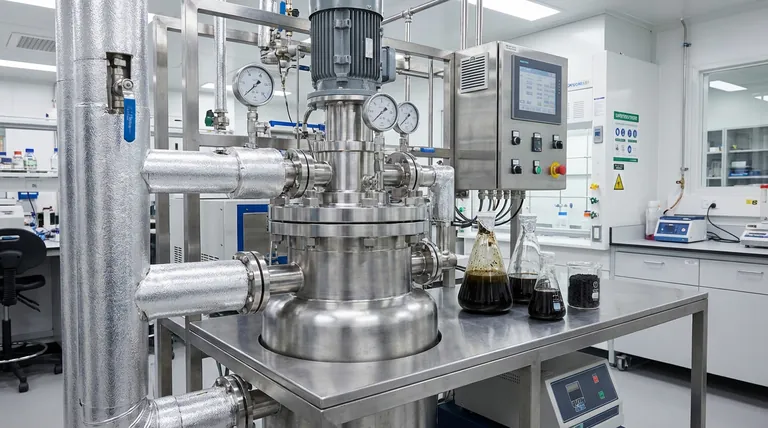
The high-pressure reactor serves as the fundamental vessel for enabling subcritical water chemistry. By creating a sealed environment, the reactor allows solvents like water to generate autogenous pressure during heating, which accelerates the conversion of biomass into carbon hydrogel skeletons at relatively low temperatures.
The reactor is indispensable because it maintains water in a liquid state well above its boiling point, facilitating the intense hydrolysis and structural rearrangement necessary to form the porous, stable skeletons required for phase change materials.
Creating the Critical Environment
The Power of Autogenous Pressure
The primary function of the reactor is to harness autogenous pressure. As the solvent (typically water) is heated within the sealed vessel, it generates its own pressure, which drastically alters the reaction dynamics compared to open-air heating.
Achieving the Subcritical State
By maintaining high pressure, the reactor keeps water in a subcritical liquid state even at temperatures exceeding 200°C (e.g., 230–240°C). In this state, water exhibits enhanced capabilities for dissolution and hydrolysis, acting as a powerful catalyst for breaking down biomass.
Transforming Biomass into Skeletons
Accelerating Carbonization
The high-pressure environment significantly accelerates the carbonization process of biomass precursors. This allows for the efficient transformation of raw materials, such as watermelon peel or wood powder, into useful carbon structures without requiring the extreme temperatures of traditional pyrolysis.
Driving Chemical Restructuring
Within the reactor, the biomass undergoes a complex series of intense physical and chemical changes. These include decomposition, hydrolysis, dehydration, and decarboxylation, which strip away oxygen and hydrogen to leave a carbon-rich structure.
Defining Morphology and Functionality
The specific conditions maintained by the reactor directly dictate the physical properties of the resulting material. This process converts the biomass into carbon hydrogel skeletons with specific morphologies, a primary pore structure, and abundant surface functional groups, all of which are critical for holding phase change materials.
Understanding the Trade-offs
Batch Processing Limitations
Because the reactor relies on a sealed, pressurized environment to generate autogenous pressure, it operates primarily as a batch process. This can limit throughput compared to continuous flow systems used in other industrial applications.
Safety and Complexity
Operating a vessel under high pressure and temperature requires strict safety protocols and robust materials, such as stainless steel. This adds a layer of operational complexity and equipment cost that is not present in ambient-pressure synthesis methods.
Making the Right Choice for Your Goal
When designing a synthesis protocol for phase change material skeletons, consider your specific structural requirements:
- If your primary focus is Morphology Control: The high-pressure reactor is essential for producing specific 3D hydrogel structures and preserving the "skeleton" integrity of the precursor.
- If your primary focus is Surface Chemistry: This equipment allows for the retention of abundant surface functional groups, which can improve the compatibility between the skeleton and the phase change material.
The high-pressure reactor is not merely a container; it is the active instrument that forces water to act as a solvent, catalyst, and reactant simultaneously to engineer the perfect carbon backbone.
Summary Table:
| Feature | Role in Hydrothermal Carbonization |
|---|---|
| Pressure Mechanism | Generates autogenous pressure to keep water liquid above 100°C |
| Reaction Medium | Subcritical water acts as a solvent, catalyst, and reactant |
| Chemical Changes | Drives hydrolysis, dehydration, and decarboxylation |
| Material Output | Produces porous carbon hydrogel skeletons with rich surface groups |
| Temp Range | Typically 180°C - 240°C for efficient biomass conversion |
Elevate Your Material Synthesis with KINTEK
High-precision research demands equipment that can withstand the rigors of subcritical chemistry. KINTEK provides state-of-the-art High-Pressure Reactors, Vacuum systems, and customizable lab furnaces designed to give you absolute control over your hydrothermal carbonization process.
Backed by expert R&D and world-class manufacturing, our systems ensure the safety, durability, and morphology control required to create the next generation of Phase Change Materials. Whether you need a standard Muffle furnace or a bespoke high-pressure vessel, we tailor our solutions to your unique laboratory needs.
Ready to engineer perfect carbon backbones? Contact KINTEK today to discuss your custom equipment requirements!
References
- Yuan Jia, Yushi Liu. Recent advances in energy storage and applications of form‐stable phase change materials with recyclable skeleton. DOI: 10.1002/cnl2.117
This article is also based on technical information from Kintek Furnace Knowledge Base .
Related Products
- High Pressure Laboratory Vacuum Tube Furnace
- 9MPa Air Pressure Vacuum Heat Treat and Sintering Furnace
- Custom Made Versatile CVD Tube Furnace Chemical Vapor Deposition CVD Equipment Machine
- MPCVD Machine System Reactor Bell-jar Resonator for Lab and Diamond Growth
- Vacuum Hot Press Furnace Machine Heated Vacuum Press
People Also Ask
- What are the different types of tube furnaces available? Find the Perfect Fit for Your Lab's Needs
- What are the main advantages of vacuum tube furnaces in the market? Achieve Purity and Precision in Material Processing
- What is the role of a vacuum tube furnace during the final thermal treatment stage of Fe3O4@CSAC catalysts?
- What parameters must be controlled when calcining freeze-dried oxide precursors in a laboratory tube furnace? A Guide
- Why is a laboratory tube furnace necessary for BiVO4/RGO synthesis? Achieve Precise Nano-Structure Control



















