
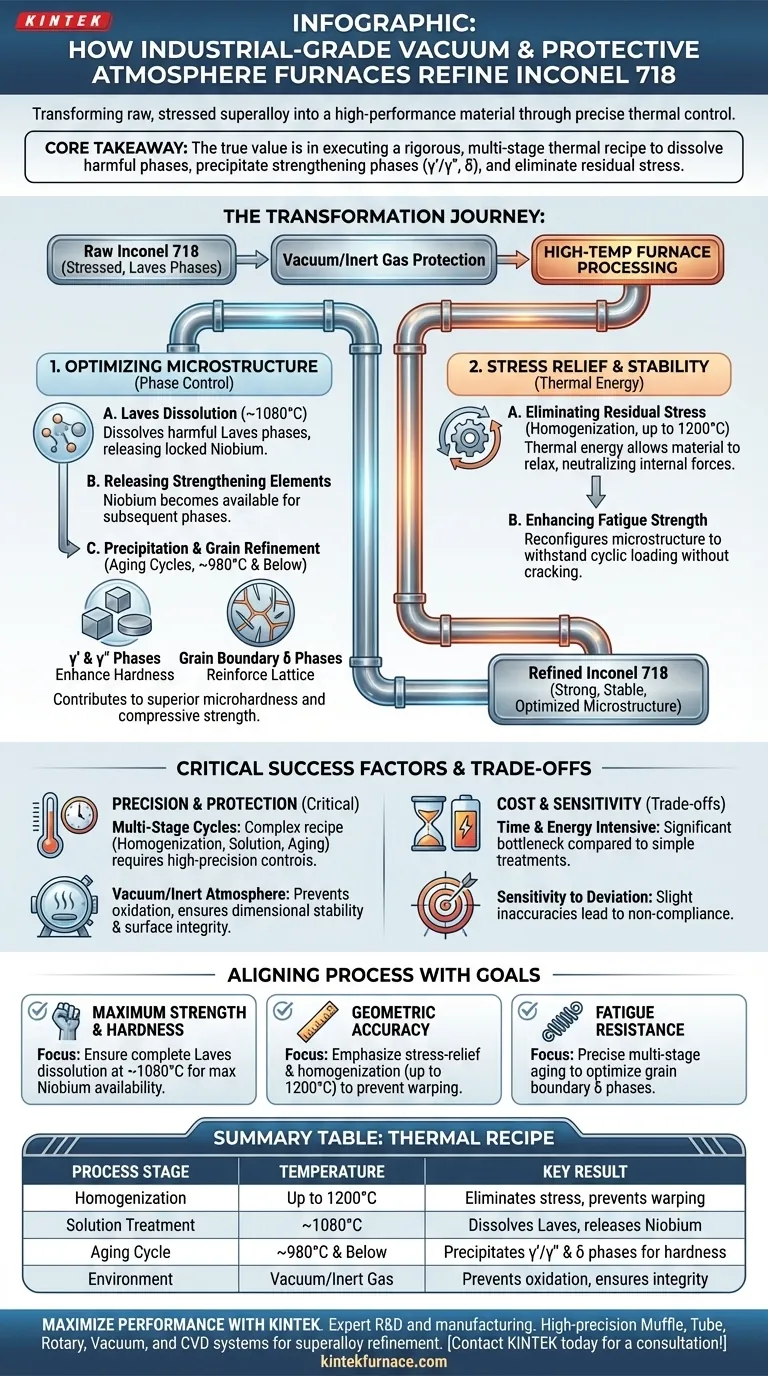
Industrial-grade vacuum and protective atmosphere furnaces are critical for transforming Inconel 718 from a raw, stressed state into a high-performance superalloy. By maintaining precise thermal windows and controlled environments, these furnaces dissolve harmful Laves phases, induce the precipitation of strengthening phases, and eliminate residual stresses accumulated during fabrication.
Core Takeaway The true value of these furnaces lies in their ability to execute a rigorous, multi-stage thermal recipe. They facilitate the dissolution of segregation-prone elements and drive the precipitation of $\gamma'/\gamma''$ and $\delta$ phases, which are fundamental to achieving Inconel 718’s required microhardness, compressive strength, and dimensional stability.
Optimizing Microstructure Through Phase Control
Dissolving Harmful Byproducts
During the initial fabrication or printing of Inconel 718, harmful Laves phases often form within the material.
These phases sequester valuable alloying elements and weaken the structure. Industrial furnaces utilize precise solution treatments, such as holding the material at approximately 1080 °C, to effectively dissolve these Laves phases back into the matrix.
Releasing Strengthening Elements
Once the Laves phases are dissolved, the niobium locked within them is released.
This niobium is the key ingredient required for the subsequent precipitation of strengthening phases. Without this controlled dissolution, the material cannot reach its potential hardness.
Inducing Grain Refinement
The controlled cooling and aging cycles promote the formation of $\gamma'$ (gamma prime) and $\gamma''$ (gamma double prime) phases.
Simultaneously, the process precipitates grain boundary $\delta$ (delta) phases. Together, these phases reinforce the lattice structure, significantly enhancing microhardness and compressive strength.
Stress Relief and Material Stability
Eliminating Residual Stress
Fabrication processes, particularly 3D printing, introduce significant residual stress into Inconel components.
High-temperature furnaces address this through homogenization cycles, sometimes reaching up to 1200°C. This thermal energy allows the material to relax, effectively neutralizing internal forces that could cause warping or failure.
Enhancing Fatigue Strength
By reconfiguring the microstructure and removing stress, the furnace treatment directly improves fatigue strength.
This ensures that components can withstand cyclic loading over time without developing cracks, a critical requirement for aerospace and industrial applications.
The Necessity of Precision Control
Managing Multi-Stage Cycles
Inconel 718 requires a complex thermal recipe, including homogenization, solution treatment (e.g., 980°C), and multi-stage aging.
Industrial furnaces provide the high-precision heating and cooling controls necessary to transition between these stages without overshooting target temperatures.
Protecting the Surface
The use of a vacuum or protective atmosphere is not merely a feature; it is a requirement.
These environments prevent oxidation and surface contamination at high temperatures, ensuring the dimensional stability and surface integrity of the final part remain uncompromised.
Understanding the Trade-offs
The Cost of Precision
Achieving this level of microstructural refinement is time-intensive and energy-demanding.
The multi-stage process—homogenization, solution treating, and aging—can take significant time to complete, representing a major bottleneck in production throughput compared to simpler heat treatments.
Sensitivity to Deviation
Inconel 718 is unforgiving of thermal inaccuracy.
Even slight deviations from the specific temperature windows (e.g., missing the 1080°C target for Laves dissolution) can result in incomplete phase transformation or excessive grain growth, rendering the part non-compliant.
Making the Right Choice for Your Goal
To maximize the utility of your heat treatment process, align your furnace parameters with your specific engineering requirements:
- If your primary focus is maximum strength and hardness: Prioritize cycles that ensure complete dissolution of Laves phases at 1080°C to maximize Niobium availability for $\gamma'/\gamma''$ precipitation.
- If your primary focus is geometric accuracy: Emphasize the stress-relief and homogenization stages (up to 1200°C) to eliminate residual stresses that cause warping.
- If your primary focus is fatigue resistance: Ensure your recipe includes a precise multi-stage aging process to optimize the grain boundary $\delta$ phases.
The furnace is not just a heater; it is the precision tool that dictates the final mechanical identity of your Inconel 718 components.
Summary Table:
| Process Stage | Temperature Range | Key Result for Inconel 718 |
|---|---|---|
| Homogenization | Up to 1200°C | Eliminates residual stress and prevents warping |
| Solution Treatment | ~1080°C | Dissolves Laves phases and releases Niobium |
| Aging Cycle | ~980°C & Below | Precipitates γ'/γ'' and δ phases for hardness |
| Environment | Vacuum/Inert Gas | Prevents oxidation and ensures surface integrity |
Maximize the Performance of Your Inconel 718 Components
Don't let thermal inaccuracy compromise your material's integrity. Backed by expert R&D and manufacturing, KINTEK offers high-precision Muffle, Tube, Rotary, Vacuum, and CVD systems designed to handle the rigorous multi-stage cycles required for superalloy refinement. Whether you need to dissolve Laves phases or ensure absolute dimensional stability, our customizable high-temp furnaces provide the atmosphere control and temperature uniformity your lab demands.
Ready to optimize your heat treatment process? Contact KINTEK today for a consultation!
Visual Guide
References
- Sebastian Marian Zaharia, Mihai Alin Pop. Mechanical Properties and Microstructure of Inconel 718 Lattice Structures Produced by Selective Laser Melting Process. DOI: 10.3390/ma17030622
This article is also based on technical information from Kintek Furnace Knowledge Base .
Related Products
- Vacuum Heat Treat Furnace with Ceramic Fiber Liner
- 2200 ℃ Graphite Vacuum Heat Treat Furnace
- Molybdenum Vacuum Heat Treat Furnace
- 2200 ℃ Tungsten Vacuum Heat Treat and Sintering Furnace
- Vacuum Heat Treat Sintering Furnace with Pressure for Vacuum Sintering
People Also Ask
- How does vacuum heat treating affect the grain structure of metal alloys? Achieve Precise Microstructure Control
- What are the benefits of using vacuum heat treating furnaces for metal alloys? Achieve Superior Metal Properties and Performance
- What is one of the most important uses of vacuum heat treating furnaces in aerospace? Achieve Superior Strength in Aircraft Alloys
- How does a vacuum heat treat furnace work? Achieve Pristine, High-Performance Results
- What is the difference between heat treat and vacuum heat treat? Achieve Superior Metal Properties with Pristine Finishes



















