
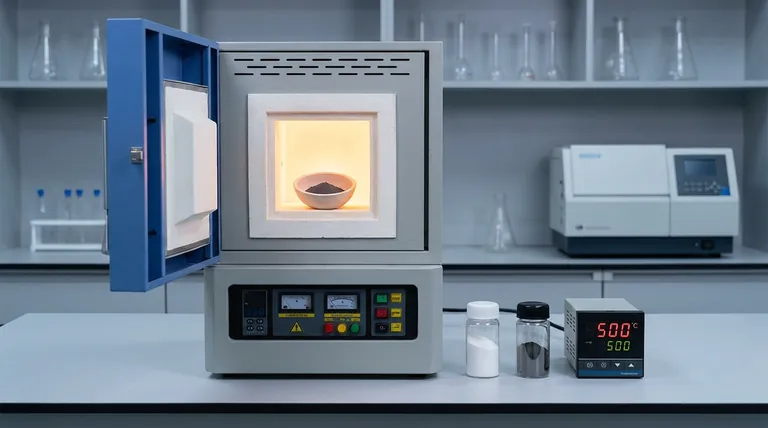
Achieving optimal catalytic performance requires a high-precision muffle furnace to maintain a rigorous 500 °C environment with a specific heating rate, such as 5 °C/min. This precision drives the uniform decomposition of precursor materials and the oxidation necessary to create active sites. Without this exact thermal control, the interaction between the palladium (Pd) and the alumina (Al2O3) support is compromised, leading to inferior catalytic activity.
The Core Insight Thermal precision is the variable that determines catalyst longevity and efficiency. A high-precision furnace does not just heat the material; it orchestrates a controlled chemical evolution, converting precursors into highly dispersed palladium oxide species while anchoring them firmly to the alumina support to prevent future degradation.
The Role of Controlled Thermal Dynamics
Regulating the Heating Rate
The primary function of the high-precision furnace is not merely reaching 500 °C, but controlling how that temperature is reached.
A precise ramp rate (e.g., 5 °C/min) is essential. This controlled rise allows for the orderly decomposition of precursors, such as nitrates or other ligands, without inducing thermal shock. Rapid or uneven heating can lead to structural collapse or the trapping of volatile impurities within the catalyst pores.
Ensuring Uniform Decomposition
The calcination phase is a chemical reaction step, not just a drying step.
The furnace facilitates the oxidation of the precursors impregnated on the support. A stable thermal environment ensures that these precursors are fully converted into their oxide forms (such as Palladium Oxide). Complete decomposition is required to expose the active metal sites that will later facilitate chemical reactions.
Optimizing Metal-Support Interactions
Creating Stable Active Centers
The 500 °C treatment is the critical moment where the "personality" of the catalyst is defined.
The heat treatment promotes a strong interaction between the active metal (Pd) and the support (Al2O3). This interaction is what creates the "preliminary formation of stable catalytic active centers." If this interaction is weak, the active metal may not function efficiently during actual operation.
Preventing Abnormal Grain Growth
Precision prevents the "sintering" or clumping of metal particles.
If the temperature fluctuates (overshooting 500 °C), metal grains can grow abnormally large. Large grains have less surface area relative to their volume, significantly reducing catalytic activity. A precise furnace maintains a stable temperature field, keeping the palladium highly dispersed on the alumina surface.
Understanding the Trade-offs
The Risk of Thermal Fluctuations
Standard furnaces often suffer from temperature hysteresis (lag), where the actual temperature oscillates around the setpoint.
In catalyst preparation, a spike of even 20-30 degrees can trigger irreversible phase changes or sintering. Conversely, dips in temperature may result in incomplete activation, leaving inactive precursor residue on the support. High-precision equipment minimizes this variance to ensure reproducibility.
Balancing Time and Temperature
While high temperature is necessary for activation, prolonged exposure can be detrimental.
There is a delicate balance between allowing enough time for the solid-phase reactions to occur and exposing the material to heat for so long that the surface area degrades. The precision of the furnace allows for exact "holding times," ensuring the reaction proceeds to completion without crossing the threshold into structural degradation.
Making the Right Choice for Your Goal
To maximize the efficacy of your Pd/Al2O3 catalyst preparation, consider your primary objective:
- If your primary focus is Durability: Ensure your furnace creates a strong metal-support interaction to prevent leaching or deactivation over time.
- If your primary focus is High Activity: Prioritize a furnace with strict ramp-rate control to maximize dispersion and prevent the formation of large, inactive metal grains.
Precision in the calcination stage is the difference between a catalyst that degrades in hours and one that performs reliably for years.
Summary Table:
| Key Requirement | Role in Catalyst Preparation | Impact on Performance |
|---|---|---|
| Precise Heating Rate | Orderly precursor decomposition (e.g., 5 °C/min) | Prevents thermal shock & pore blockage |
| Temperature Stability | Uniform oxidation into active PdO species | Ensures complete activation of metal sites |
| Low Hysteresis | Prevention of temperature overshooting | Avoids grain sintering and loss of surface area |
| Uniform Heat Field | Strong Metal-Support Interaction (SMSI) | Enhances catalyst longevity and stability |
Elevate Your Catalyst Performance with KINTEK
Don't let thermal fluctuations compromise your research. KINTEK provides industry-leading high-precision Muffle, Tube, and Vacuum furnaces designed to meet the rigorous demands of catalyst calcination. Backed by expert R&D and specialized manufacturing, our systems ensure precise ramp-rate control and uniform thermal environments tailored for your unique Pd/Al2O3 preparation needs.
Ready to achieve superior dispersion and active site stability?
Contact our technical team today to discuss your customizable solution.
References
- Lutf Ullah, Weizhen Li. Hydrogen Co-Combustion of Aromatic Volatile Organic Compounds over Pd/Al2O3 Catalyst. DOI: 10.3390/catal14090563
This article is also based on technical information from Kintek Furnace Knowledge Base .
Related Products
- 1700℃ High Temperature Muffle Oven Furnace for Laboratory
- High Temperature Muffle Oven Furnace for Laboratory Debinding and Pre Sintering
- 1800℃ High Temperature Muffle Oven Furnace for Laboratory
- Laboratory Muffle Oven Furnace with Bottom Lifting
- 1400℃ Muffle Oven Furnace for Laboratory
People Also Ask
- What is the primary function of a high-temperature laboratory muffle furnace in chemical synthesis? Achieve Precision.
- How does a high-temperature laboratory muffle furnace affect material properties? Transform Anodic Oxide Films Fast
- What role does a muffle furnace play in BCZY712 electrolyte powder production? Achieve Perfect Phase Purity
- What is the role of a high-temperature muffle furnace in guava leaf carbonization? Master Precise Pyrolysis Control
- How does the two-stage sintering process contribute to the synthesis of MeCuFeO3 perovskite? Optimize crystal purity.



















