
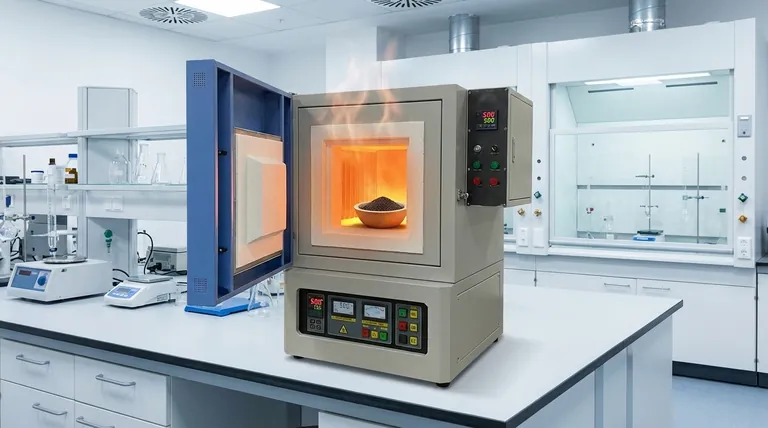
The high-temperature muffle furnace acts as the definitive stabilization tool during the synthesis of cobalt tetroxide (Co3O4) nanotubes. By subjecting the material to a static air environment at 500 °C, this equipment drives the conversion of initially formed oxides into a thermodynamically stable spinel structure. This process is essential for eliminating internal structural stress and refining crystallinity to ensure the material's physical integrity.
Core Takeaway: The muffle furnace is not used to create the nanotube shape, but to "lock it in." It provides a static, high-heat environment that relieves internal stress and finalizes the crystal phase, creating a robust foundation capable of surviving harsh subsequent treatments like acid etching.
The Mechanics of Structural Stabilization
Achieving Thermodynamic Stability
The primary function of the muffle furnace in this context is to provide a consistent thermal field at 500 °C. At this specific temperature, the precursor oxides undergo a phase transformation, converting into the thermodynamically stable spinel structure of Co3O4.
Optimizing Crystallinity
Beyond simple phase conversion, the residence time in the furnace adjusts the material's crystallinity. The heat treatment promotes ordered atomic rearrangement, ensuring the crystal lattice is well-defined and free of the defects often found in raw precipitates.
Preparing for Chemical Processing
Elimination of Structural Stress
The formation of nanotubes often introduces significant internal stress within the material's walls. The muffle furnace acts as a relaxation chamber, using thermal energy to eliminate structural stress without altering the macroscopic shape of the tube.
Establishing Chemical Resilience
This stress relief is not merely cosmetic; it is a functional requirement for the next stage of manufacturing. By solidifying the physical foundation of the nanotubes, the furnace ensures the material is robust enough to withstand subsequent acid etching processes, which would likely destroy a less stable, high-stress structure.
Understanding the Trade-offs
Static vs. Dynamic Environments
It is critical to distinguish the muffle furnace from the rotary furnace often used in earlier stages. A rotary furnace uses dynamic tumbling to facilitate the Kirkendall effect, which creates the hollow nanotube structure.
The Limitation of Static Treatment
The muffle furnace provides a static air environment, meaning the powder does not move. While this is perfect for stabilizing an existing shape and removing stress, it cannot induce the uniform gas-solid contact required to form the hollow structure initially. Using a muffle furnace too early in the synthesis could result in solid rods rather than hollow tubes; using it correctly at the end ensures those tubes do not collapse.
Making the Right Choice for Your Goal
To optimize your Co3O4 nanotube synthesis, apply the muffle furnace at the correct stage based on your immediate processing needs:
- If your primary focus is stabilizing the hollow architecture: Ensure you have completed the dynamic rotary calcination first, then use the muffle furnace to "set" the structure.
- If your primary focus is survivability during acid etching: Prioritize the 500 °C static hold to maximize stress relief and crystallinity, ensuring the walls are chemically resistant.
The muffle furnace transforms fragile, intermediate oxides into durable, engineering-grade cobalt tetroxide nanotubes.
Summary Table:
| Aspect | Details/Benefit |
|---|---|
| Primary Purpose | Thermal stabilization of Co3O4 nanotubes |
| Operating Temperature | 500 °C (Consistent thermal field) |
| Environment | Static air (No powder movement) |
| Key Outcome 1 | Achieves thermodynamically stable spinel structure of Co3O4 |
| Key Outcome 2 | Optimizes crystallinity, reduces defects, ensures well-defined lattice |
| Key Outcome 3 | Eliminates internal structural stress from nanotube formation |
| Key Outcome 4 | Establishes chemical resilience for subsequent harsh processing (e.g., acid etching) |
| Distinction (vs. Rotary) | Stabilizes existing shapes; does NOT form hollow structures (Kirkendall effect) |
Ready to achieve superior material stabilization and robust nanotube synthesis for your advanced research? KINTEK specializes in providing high-performance laboratory and industrial furnaces. Backed by expert R&D and manufacturing, we offer a comprehensive range of Muffle, Tube, Rotary, Vacuum, CVD systems, and other lab high-temp furnaces, all meticulously customizable for your unique needs. Ensure your materials withstand the toughest conditions by partnering with KINTEK. Contact us today to discuss your project!
References
- Amaya Gil-Barbarin, Beatriz de Rivas. Promotion of Cobalt Oxide Catalysts by Acid-Etching and Ruthenium Incorporation for Chlorinated VOC Oxidation. DOI: 10.1021/acs.iecr.3c04045
This article is also based on technical information from Kintek Furnace Knowledge Base .
Related Products
- 1700℃ High Temperature Muffle Oven Furnace for Laboratory
- 1800℃ High Temperature Muffle Oven Furnace for Laboratory
- 1200℃ Muffle Oven Furnace for Laboratory
- 1400℃ Muffle Oven Furnace for Laboratory
- Laboratory Muffle Oven Furnace with Bottom Lifting
People Also Ask
- What is the primary function of a high-temperature laboratory muffle furnace in chemical synthesis? Achieve Precision.
- How does a high-temperature laboratory muffle furnace affect material properties? Transform Anodic Oxide Films Fast
- What role does a muffle furnace play in BCZY712 electrolyte powder production? Achieve Perfect Phase Purity
- What role does a muffle furnace play in sintering photocathodes? Enhance Electrode Conductivity & Catalytic Activity
- How does a muffle furnace impact Ni/MgAl2O4 catalysts? Optimize Stability and Catalytic Performance



















