
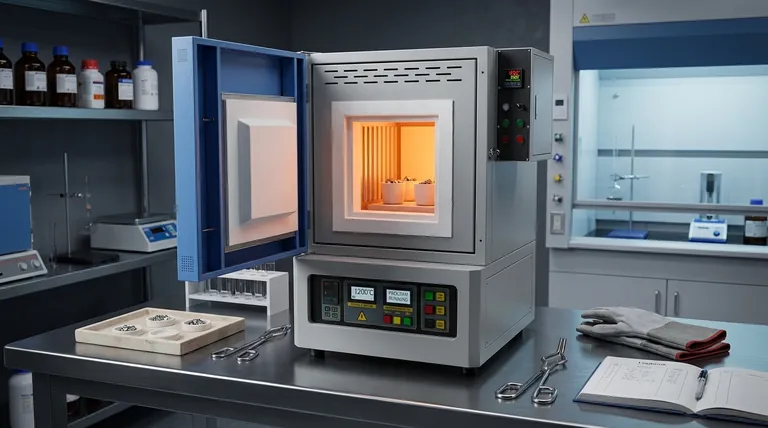
The primary role of high-precision muffle furnaces in the sintering of high-entropy alloys is to establish a strictly controlled thermal environment characterized by exceptional temperature uniformity. By maintaining a stable "constant temperature zone," these furnaces ensure that the complex mixture of elements within the alloy heats evenly, directly preventing critical structural defects such as pores, cracks, and physical deformations.
Core Takeaway In the synthesis of high-entropy alloys, thermal consistency is synonymous with structural integrity. A high-precision muffle furnace acts as a stabilizer, preventing the internal stresses and phase inconsistencies that ruin mechanical properties, ultimately ensuring the material achieves its designed microstructural stability.
The Criticality of Thermal Precision
Preventing Structural Defects
High-entropy alloys consist of multiple principal elements, making them sensitive to thermal gradients. If one area of the material heats faster than another, it leads to differential expansion.
High-precision muffle furnaces eliminate these gradients. By maintaining a constant temperature zone, they prevent the formation of macroscopic defects like warping or cracking during the sintering process.
Ensuring Mechanical Homogeneity
The mechanical properties of an alloy—such as strength and ductility—must be consistent throughout the material.
If the temperature fluctuates within the furnace chamber, the sintering density will vary across the part. Precision furnaces guarantee that the entire volume of the material experiences the exact same thermal history, resulting in uniform mechanical performance.
Controlling Microstructure and Phase Evolution
Regulating Phase Transformations
Sintering is not merely about bonding powder; it involves complex phase changes. For alloys like CuCrFeMnNi, specific temperature fields are required to induce controlled phase decomposition.
A precise furnace environment allows you to regulate these internal transformations. This control enables the induction of specific phenomena, such as annealing softening, which improves the material's processability.
Promoting Atomic Ordering
Beyond basic sintering, these furnaces are used to fine-tune the crystal structure.
For example, in Ni-Mn-Sn-In alloys, heat treatment at specific intervals (e.g., 873 K to 1073 K) promotes atomic ordering. This precision allows engineers to dictate the martensitic transformation temperature and magnetic properties of the final product.
Beyond Sintering: Stress Relief and Annealing
Eliminating Internal Stresses
The sintering process often introduces significant internal residual stresses. If left unchecked, these stresses can lead to premature failure of the component.
High-precision muffle furnaces are frequently utilized for long-duration annealing. This "soaking" period allows the material to relax, effectively eliminating internal stresses introduced during earlier processing stages.
Adjusting Hardness
Post-sintering heat treatments allow for the adjustment of hardness. By controlling the cooling rate and holding temperature, you can tailor the alloy's hardness to meet specific application requirements, balancing strength with machinability.
Understanding the Trade-offs
Densification Limitations
While high-precision muffle furnaces excel at thermal uniformity, they rely solely on heat to bond particles.
They lack the mechanical pressure mechanisms found in vacuum hot press sintering furnaces. For refractory alloys requiring high density (like RuTi), a standard muffle furnace may struggle to overcome surface tension, potentially requiring a pressure-assisted alternative to achieve full densification.
Atmosphere Sensitivity
Standard muffle furnaces must be equipped with atmosphere control capabilities when working with reactive alloys.
Without a controlled inert atmosphere (such as Argon or Nitrogen), high-entropy alloys containing oxidation-prone elements (like Aluminum or Titanium) will degrade. You must ensure the specific furnace unit supports the atmosphere requirements of your specific alloy mix.
Making the Right Choice for Your Goal
- If your primary focus is microstructural uniformity: Rely on a high-precision muffle furnace to maintain the strict constant temperature zone required to prevent phase segregation.
- If your primary focus is maximum density: Consider vacuum hot press equipment, as the muffle furnace alone may not provide the driving force needed to remove all porosity in refractory materials.
- If your primary focus is stress relief: Use the muffle furnace for post-sintering annealing to eliminate internal tension and stabilize the crystal structure.
Precision in heating is not just a feature; it is the fundamental control variable that determines whether a high-entropy alloy succeeds or fails.
Summary Table:
| Feature | Role in HEA Sintering | Benefit |
|---|---|---|
| Thermal Uniformity | Eliminates temperature gradients | Prevents warping, cracking, and pores |
| Phase Regulation | Precise temperature field control | Induces specific phase decomposition and ordering |
| Stress Relief | Long-duration soaking/annealing | Eliminates internal residual stresses |
| Mechanical Homogeneity | Uniform sintering density | Ensures consistent strength and ductility |
Elevate Your Material Research with KINTEK
Precise thermal control is the difference between a breakthrough and a failure in high-entropy alloy synthesis. KINTEK provides high-performance lab solutions backed by expert R&D and manufacturing. Our extensive range of Muffle, Tube, Rotary, Vacuum, and CVD systems are fully customizable to meet the rigorous demands of HEA sintering and microstructural tuning.
Ready to achieve superior structural integrity? Contact us today to discuss your unique needs and find the perfect high-temperature furnace for your laboratory.
Visual Guide

References
- Yuchen Wang, Haisheng Fang. Research and optimization of temperature uniformity of high-precision muffle furnace. DOI: 10.1088/1742-6596/3009/1/012076
This article is also based on technical information from Kintek Furnace Knowledge Base .
Related Products
- 1700℃ High Temperature Muffle Oven Furnace for Laboratory
- 1800℃ High Temperature Muffle Oven Furnace for Laboratory
- 1400℃ Muffle Oven Furnace for Laboratory
- High Temperature Muffle Oven Furnace for Laboratory Debinding and Pre Sintering
- 1200℃ Muffle Oven Furnace for Laboratory
People Also Ask
- What is the primary function of a high-temperature laboratory muffle furnace in chemical synthesis? Achieve Precision.
- How does a high-temperature laboratory muffle furnace affect material properties? Transform Anodic Oxide Films Fast
- What role does a muffle furnace play in BCZY712 electrolyte powder production? Achieve Perfect Phase Purity
- How does a muffle furnace impact Ni/MgAl2O4 catalysts? Optimize Stability and Catalytic Performance
- What is the role of a high-temperature muffle furnace in guava leaf carbonization? Master Precise Pyrolysis Control



















