
Achieving a uniform Ni-Ti-Hf-La alloy requires multiple melting cycles—typically four or more—to counteract the significant physical differences between the constituent elements. Single-pass melting is insufficient because variations in specific gravity and melting points cause the elements to separate rather than blend, leading to an unstable material.
Core Insight: The necessity for repetition stems from the physics of the melt itself. By subjecting the alloy to at least four cycles, the process utilizes arc forces to induce fluid flow, forcing disparate elements to mix until the internal microstructure achieves total homogenization and is free of composition segregation.
The Physical Barriers to Mixing
Creating a cohesive alloy from Nickel (Ni), Titanium (Ti), Hafnium (Hf), and Lanthanum (La) is not as simple as melting them in a pot. You are fighting against the fundamental physical properties of the materials.
Overcoming Specific Gravity Differences
The elements in this alloy possess vastly different densities, also known as specific gravity. Without intervention, heavier elements tend to sink while lighter elements float.
Multiple melting cycles are required to physically agitate the mixture long enough to prevent this stratification.
Managing Melting Point Disparities
These elements do not turn to liquid at the same temperature. Some will melt quickly, while others remain solid for longer periods during the initial heating.
Repeated cycles ensure that even the elements with the highest melting points are fully integrated into the liquid matrix, rather than remaining as undissolved inclusions.
The Role of Arc Forces
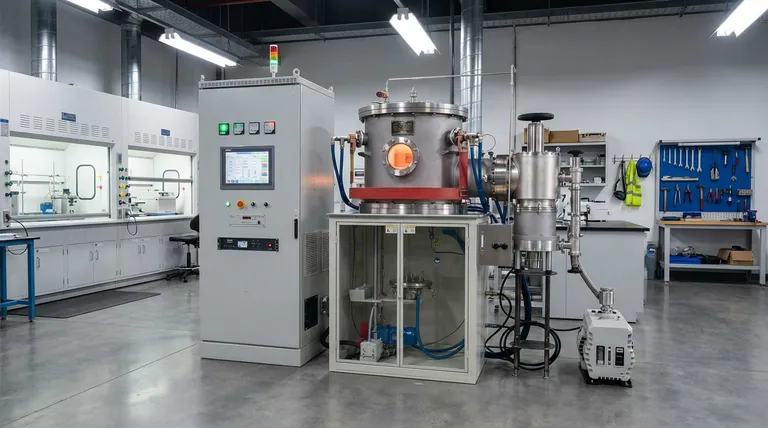
The solution to these physical barriers lies in the application of Vacuum Arc Melting (or similar arc processes). This technique does more than just apply heat; it applies physical force to the molten pool.
Inducing Fluid Flow
The process utilizes arc forces to generate vigorous fluid flow within the melt. This acts as a stirring mechanism, churning the molten metal.
By repeating this process multiple times, you maximize the exposure of the material to these mixing forces.
Achieving Microstructural Homogenization
The ultimate goal of this fluid flow is homogenization. You are aiming for a state where the chemical composition is consistent throughout the entire ingot.
This eliminates composition segregation, a defect where pockets of pure elements or uneven concentrations exist, which would compromise the alloy's performance.
Understanding the Trade-offs
While multiple melting cycles are essential for quality, it is important to understand the risks associated with the process parameters.
The Risk of Under-Processing
The most common pitfall is attempting to reduce the number of cycles below the recommended threshold (typically four).
Doing so almost invariably leads to composition segregation, resulting in an alloy with inconsistent mechanical properties and internal weaknesses.
Balancing Energy and Purity
Each re-melting cycle requires significant energy and time. However, this investment is non-negotiable for Ni-Ti-Hf-La alloys due to the complexity of the ingredients.
Shortcuts here do not save money; they result in wasted material that fails to meet microstructural standards.
Ensuring Alloy Integrity
To ensure the production of a high-performance Ni-Ti-Hf-La alloy, you must prioritize process rigor over speed.
- If your primary focus is Process Design: Mandate a minimum of four melting cycles to guarantee the arc forces have sufficient opportunity to overcome specific gravity differences.
- If your primary focus is Quality Assurance: Inspect the final microstructure specifically for composition segregation, as this is the primary indicator that the melting cycles were insufficient.
True reliability in complex alloys is engineered through the disciplined repetition of the melting process.
Summary Table:
| Factor | Influence on Alloy Quality | Role of Repeated Melting |
|---|---|---|
| Specific Gravity | Causes stratification (heavier elements sink) | Continuous agitation prevents element layering |
| Melting Points | Leads to undissolved inclusions/solid pockets | Ensures high-melting-point elements fully integrate |
| Arc Forces | Drives vigorous fluid flow and stirring | Maximizes mixing duration for total consistency |
| Composition | Risk of composition segregation | Guarantees microstructural homogenization |
Elevate Your Material Integrity with KINTEK
Precision in Ni-Ti-Hf-La alloy production demands rigorous control and specialized equipment. Backed by expert R&D and world-class manufacturing, KINTEK provides high-performance Vacuum Arc Melting systems, Muffle, Tube, and Custom Lab Furnaces designed to achieve total homogenization in complex materials. Whether you are battling composition segregation or optimizing your fluid flow parameters, our customizable systems are engineered to meet your unique research and production needs.
Ready to achieve superior alloy consistency? Contact our technical experts today to find the perfect high-temperature solution for your laboratory.
References
- Microstructure, Phase Transformation, and Mechanical Properties of Ni-Ti-Hf-La Alloys. DOI: 10.3390/alloys4030014
This article is also based on technical information from Kintek Furnace Knowledge Base .
Related Products
- Controlled Inert Nitrogen Hydrogen Atmosphere Furnace
- Vacuum Induction Melting Furnace
- 1700℃ Controlled Inert Nitrogen Atmosphere Furnace
- 1200℃ Controlled Inert Nitrogen Atmosphere Furnace
- 1400℃ High Temperature Laboratory Tube Furnace with Alumina Tube
People Also Ask
- What are the characteristics and uses of hydrogen atmosphere in furnaces? Achieve Superior Surface Purity and Bonding
- What are the characteristics and uses of hydrogen atmospheres in furnaces? Unlock Clean Metal Processing
- Mechanism of Fe81Ga19 Secondary Recrystallization? High-Precision Furnace Control for Goss Grain Growth
- How does a controlled atmosphere furnace contribute to energy efficiency? Lower Costs with Advanced Thermal Management
- Why is controlled atmosphere capability important in an atmosphere furnace? Unlock Precise Material Processing



















