High-purity quartz reaction tubes are the critical standard for Chemical Vapor Deposition (CVD) because they provide a contamination-free environment capable of withstanding extreme thermal stress. Specifically, they endure temperatures exceeding 800°C without releasing impurities that would poison the Nickel-Cobalt (Ni-Co) catalyst, ensuring the structural integrity of the doped carbon nanotubes.
Core Takeaway: Successful Ni-Co doped carbon nanotube synthesis relies on isolating the catalytic reaction from environmental contamination. High-purity quartz provides the necessary combination of thermal shock resistance and chemical inertness to maintain a stable, pristine reaction zone during high-temperature cycling.
Thermal Dynamics and Stability
The synthesis of carbon nanotubes is a high-energy process. The reaction vessel must do more than simply hold the materials; it must remain physically stable under intense heat.
Withstanding Extreme Temperatures
The CVD process for Ni-Co doped nanotubes requires temperatures that frequently exceed 800°C. High-purity quartz maintains its structural integrity at these levels, whereas standard glass would melt and many metals would degrade or react.
Resisting Thermal Shock
The reaction process involves significant temperature fluctuations, specifically during the rapid heating and cooling phases. High-purity quartz possesses exceptional thermal shock stability. This property prevents the tube from cracking or shattering when the equipment transitions between room temperature and the high reaction temperatures required for growth.
Chemical Purity and Catalyst Protection
The primary challenge in doping carbon nanotubes is maintaining the specific chemical composition of the catalyst. The reaction tube must be an invisible participant in the chemical process.
Preventing Impurity Leaching
At high temperatures, inferior materials can off-gas or leach trace elements into the reaction chamber. High-purity quartz is chemically inert, preventing the release of impurities that could interfere with the Ni-Co catalytic process. This isolation is vital because even microscopic contaminants can alter the doping mechanism or halt nanotube growth entirely.
Maintaining a Stable Atmosphere
The quartz acts as a barrier, ensuring that the internal atmosphere remains strictly controlled. By effectively sealing the reaction zone, the tube allows the Ni-Co doped nanotubes to grow in a stable environment, free from cross-contamination by the containment vessel itself.
Operational Advantages
Beyond the chemical and thermal necessities, the physical properties of quartz offer specific operational benefits for CVD processes.
Optical Transparency for Monitoring
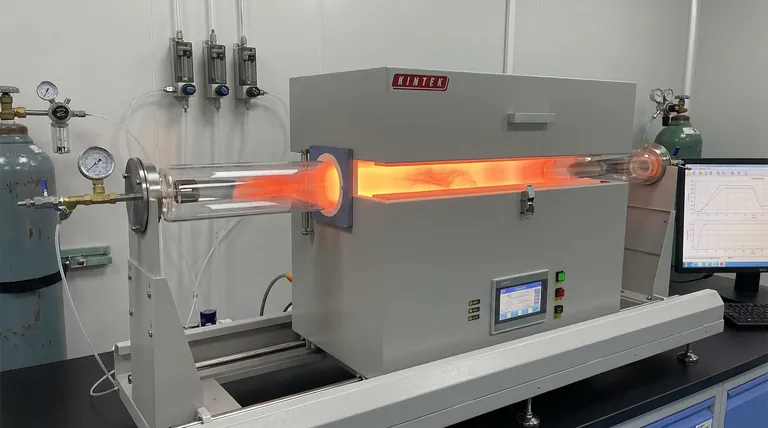
Unlike ceramic or metal reactors, high-purity quartz is transparent. This allows researchers to perform real-time observation of the wire-feeding process and the reaction progress. Being able to visually monitor the growth ensures that process anomalies can be detected and addressed immediately.
Chemical Inertness to Process Gases
CVD often utilizes reactive gases such as acetylene or argon. Quartz demonstrates excellent inertness to these specific process gases, ensuring that the tube does not become a reactant that consumes the supply gas or alters the stoichiometry of the mixture.
Understanding the Trade-offs
While high-purity quartz is the superior choice for this application, it is not without limitations. Understanding these constraints is essential for long-term equipment maintenance.
Mechanical Fragility
Despite its thermal robustness, quartz remains a glass material and is mechanically brittle. It requires careful handling during loading and cleaning to avoid micro-fractures, which can propagate into catastrophic failure under vacuum or pressure.
Sensitivity to Surface Contamination
The "high purity" aspect is a double-edged sword; the tube effectively has no buffer against external contaminants. Touching the tube with bare hands or exposing it to certain salts can create "hot spots" or devitrification points (crystallization) upon heating, which eventually compromises the tube's thermal resistance.
Making the Right Choice for Your Goal
When designing or operating a CVD system for carbon nanotube synthesis, the quality of your reaction vessel dictates the quality of your yield.
- If your primary focus is Catalyst Activity: Prioritize quartz with certified high purity to prevent trace elements from poisoning the Ni-Co reaction.
- If your primary focus is Process Longevity: Implement strict handling protocols to protect the quartz from mechanical shock and surface oils, extending the tube's operational life.
Ultimately, the use of high-purity quartz is not a luxury but a technical necessity to ensure that the rigorous thermal and chemical demands of Ni-Co doping are met with absolute precision.
Summary Table:
| Property | Benefit in Ni-Co CVD Reactions | Why It Matters |
|---|---|---|
| Thermal Stability | Withstands >800°C & Thermal Shock | Prevents tube failure during rapid heating/cooling. |
| Chemical Inertness | No Impurity Leaching | Protects Ni-Co catalysts from poisoning and contamination. |
| Optical Clarity | Transparent Material | Enables real-time visual monitoring of nanotube growth. |
| Gas Resistance | Inert to Process Gases | Maintains stoichiometry of reactive gases like acetylene. |
Elevate Your Nanomaterial Synthesis with KINTEK
Precision in Ni-Co doped carbon nanotube growth starts with the right environment. Backed by expert R&D and world-class manufacturing, KINTEK provides premium Muffle, Tube, Rotary, Vacuum, and CVD systems designed for the most demanding lab applications.
Our high-purity quartz solutions and customizable high-temperature furnaces ensure your catalysts remain pristine and your results reproducible. Whether you need standard dimensions or a bespoke system tailored to your unique research goals, KINTEK is your partner in thermal processing excellence.
Ready to optimize your CVD process? Contact us today to discuss your custom furnace needs!
References
- A. Shameem, P. Sivaprakash. A High-Performance Supercapacitor Based on Hierarchical Template-Free Ni/SnO2 Nanostructures via Hydrothermal Method. DOI: 10.3390/ma17081894
This article is also based on technical information from Kintek Furnace Knowledge Base .
Related Products
- High Pressure Laboratory Vacuum Tube Furnace
- Custom Made Versatile CVD Tube Furnace Chemical Vapor Deposition CVD Equipment Machine
- Slide PECVD Tube Furnace with Liquid Gasifier PECVD Machine
- Vertical Laboratory Quartz Tube Furnace Tubular Furnace
- Inclined Rotary Plasma Enhanced Chemical Deposition PECVD Tube Furnace Machine
People Also Ask
- What role does a high vacuum tube furnace play in Co-Al sintering? Master High-Purity Porous Material Synthesis
- What are the different types of tube furnaces available? Find the Perfect Fit for Your Lab's Needs
- What is the role of a vacuum tube furnace during the final thermal treatment stage of Fe3O4@CSAC catalysts?
- What are the main advantages of vacuum tube furnaces in the market? Achieve Purity and Precision in Material Processing
- What parameters must be controlled when calcining freeze-dried oxide precursors in a laboratory tube furnace? A Guide