
In any high-temperature laboratory setting, following correct operating procedures for a tube furnace is not merely a formality. It is the fundamental practice that separates a successful, repeatable experiment from a failed one, and a safe lab environment from a hazardous one. The core reasons are twofold: ensuring the physical safety of operators and equipment, and guaranteeing the scientific accuracy and integrity of your results.
Viewing furnace procedures as a simple checklist misses the point. The 'why' behind each step is about actively managing immense thermal energy to prevent catastrophic failures and to control the precise conditions that make your experimental data valid and trustworthy.
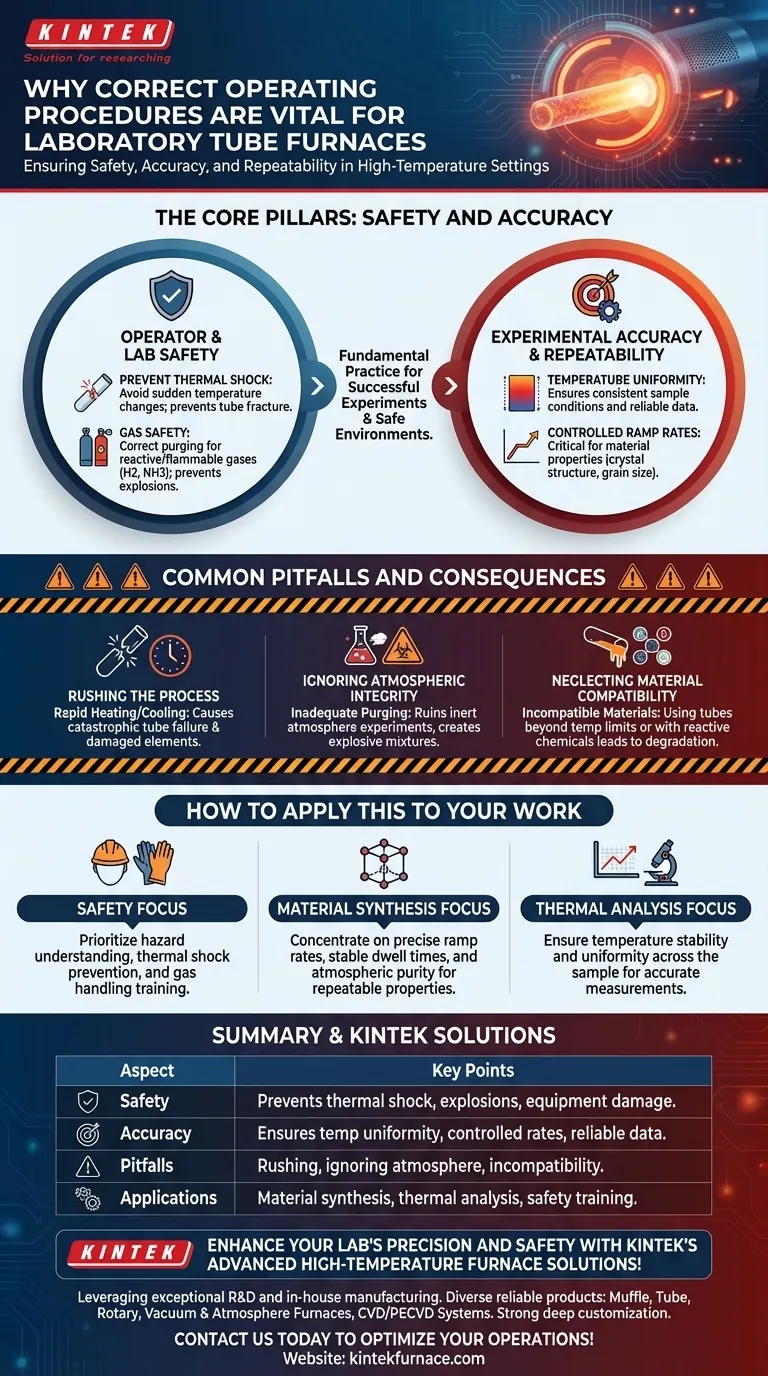
The Core Pillars: Safety and Accuracy
Every procedure for a tube furnace is built upon two essential outcomes. Understanding these outcomes is the first step to operating the equipment with true competence.
Ensuring Operator and Lab Safety
The most immediate priority is mitigating the inherent risks of high-temperature work. A tube furnace concentrates a significant amount of energy into a small space.
Procedures are designed to control this energy, preventing thermal shock—a primary cause of cracked or shattered furnace tubes. A sudden temperature change can cause the tube material (often quartz or alumina) to expand or contract unevenly, leading to catastrophic failure.
Furthermore, many experiments use controlled atmospheres with potentially flammable or reactive gases, such as hydrogen or ammonia. Correct purging and leak-checking procedures are critical to prevent fires, explosions, or the creation of toxic byproducts.
Guaranteeing Experimental Accuracy and Repeatability
The second pillar is the quality of your data. The goal of a furnace is to create a highly specific and stable thermal environment.
Procedural discipline ensures temperature uniformity and stability. Without it, different parts of your sample may experience different temperatures, leading to inconsistent material properties or skewed analytical results.
Proper operation also governs the heating and cooling rates (ramp rates). In materials science, these rates are not just about getting to a target temperature; they are a critical process variable that can define a material's final crystal structure, grain size, and physical properties.
Common Pitfalls and Their Consequences
Deviating from established procedures often stems from a desire for speed or a misunderstanding of the underlying principles. These deviations introduce significant risk.
The Pitfall of Rushing the Process
Rapidly heating or cooling a furnace tube is the most common mistake. This is akin to pouring boiling water into a cold glass—the resulting stress from rapid, uneven expansion or contraction can easily fracture the tube.
A fractured tube during operation can ruin a sample, damage expensive heating elements, and create a significant safety hazard, especially if reactive gases are in use.
Ignoring Atmospheric Integrity
Failing to properly purge the tube or check for leaks can have subtle or dramatic consequences. A small oxygen leak, for example, can completely ruin an experiment that requires an inert atmosphere by causing unintended oxidation of the sample.
In a more dangerous scenario, failing to purge air before introducing a flammable gas like hydrogen can create an explosive mixture inside the hot zone.
Neglecting Material Compatibility
Not all furnace tubes are created equal. Using a quartz tube above its recommended temperature limit (~1100-1200°C) will cause it to soften and fail.
Likewise, certain chemicals can react with and degrade the tube material at high temperatures. Following procedures includes verifying that your sample, atmosphere, and tube material are compatible under the planned experimental conditions.
How to Apply This to Your Work
Use this understanding to inform how you approach your experiments. Your primary goal should dictate which procedural aspects receive the most focus.
- If your primary focus is safety and training: Emphasize understanding hazards like thermal shock, proper gas handling, and the use of personal protective equipment before anything else.
- If your primary focus is material synthesis: Concentrate on achieving precise ramp rates, stable dwell times, and absolute atmospheric purity to ensure repeatable material properties.
- If your primary focus is thermal analysis: Prioritize temperature stability and uniformity across the sample to ensure your measurements are accurate and free from thermal artifacts.
Mastering these procedures transforms the tube furnace from a simple heat source into a precise and powerful scientific instrument.
Summary Table:
| Aspect | Key Points |
|---|---|
| Safety | Prevents thermal shock, gas explosions, and equipment damage |
| Accuracy | Ensures temperature uniformity, controlled ramp rates, and reliable data |
| Common Pitfalls | Rushing processes, ignoring atmosphere, material incompatibility |
| Applications | Material synthesis, thermal analysis, safety training |
Enhance your lab's precision and safety with KINTEK's advanced high-temperature furnace solutions! Leveraging exceptional R&D and in-house manufacturing, we provide diverse laboratories with reliable products like Muffle, Tube, Rotary Furnaces, Vacuum & Atmosphere Furnaces, and CVD/PECVD Systems. Our strong deep customization capability ensures we meet your unique experimental needs. Contact us today to discuss how our solutions can optimize your tube furnace operations and deliver superior results!
Visual Guide
Related Products
- 1400℃ High Temperature Laboratory Tube Furnace with Alumina Tube
- Laboratory Quartz Tube Furnace RTP Heating Tubular Furnace
- Laboratory Vacuum Tilt Rotary Tube Furnace Rotating Tube Furnace
- 1700℃ High Temperature Laboratory Tube Furnace with Alumina Tube
- Vertical Laboratory Quartz Tube Furnace Tubular Furnace
People Also Ask
- How are high-temperature laboratory tube furnaces applied in long-term vacuum homogenization heat treatments for intermetallic samples?
- How do high-temperature laboratory tube furnaces ensure environmental stability? Precision Thermal Reduction Tips
- How are high-temperature tube furnaces applied in testing ceramic-supported alloy membranes? Insights
- What is the mechanism of a high-temperature furnace in Bi-2223 sintering? Achieve Precision Phase Transformation
- What is the function of a furnace in CuAlMn alloy treatment? Achieve Perfect Microstructural Homogenization



















