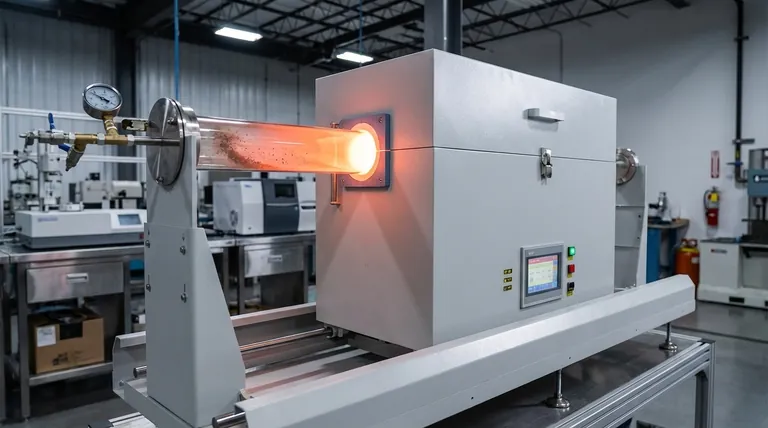
Microwave heating equipment distinctively outperforms traditional electric furnaces in iron-containing dust reduction by utilizing direct electromagnetic coupling. Unlike traditional methods that rely on radiant heat transfer from the surface inward, microwaves generate heat directly within materials like Fe3O4, resulting in uniform volumetric heating and significantly higher iron recovery efficiency.
By leveraging electromagnetic fields to create a "lens effect," microwave heating induces reduction reactions earlier and fosters the growth of larger metallic particles. This fundamental shift in heat transfer mechanics leads to superior separation and recovery rates compared to conventional radiant heating.
Distinct Heating Mechanisms
Volumetric vs. Radiant Heating
Traditional electric heating furnaces rely on radiant heating, where thermal energy is applied to the surface of the material and slowly conducts to the center. This often leads to uneven temperature gradients.
In contrast, microwave equipment utilizes direct coupling between the electromagnetic field and the material. This achieves uniform volumetric heating, meaning the material generates heat internally throughout its entire volume simultaneously.
The Role of Fe3O4
The efficiency of this process relies heavily on specific materials within the dust, such as Fe3O4. These materials couple effectively with microwave energy, acting as the primary drivers for the internal generation of heat.
Reaction Dynamics and Iron Migration
Accelerating Reduction Onset
One of the critical advantages of microwave heating is the timing of chemical reactions. The direct energy transfer allows the equipment to induce reduction reactions at an earlier stage in the process compared to traditional methods.
The "Lens Effect"
Microwave heating creates a phenomenon known as the "lens effect." This unique thermal environment promotes the directional migration of metallic iron, guiding the movement of iron atoms more precisely than radiant heat can.
Output Quality and Recovery
Enhanced Particle Growth
The "lens effect" and uniform heating conditions facilitate the formation of larger metallic particles within the residue. Larger particles are crucial because they are significantly easier to separate from waste material than fine dust.
Superior Iron Recovery
Because of the directional migration and the formation of larger particles, the overall iron recovery efficiency is significantly improved. The process ensures that more usable metal is retrieved from the dust, reducing waste and increasing yield.
Understanding the Operational Requirements
Material Specificity
It is important to note that the success of this method depends on the presence of materials capable of electromagnetic coupling, such as Fe3O4.
While traditional furnaces heat any mass indiscriminately, microwave efficiency is tied to how well the specific material composition interacts with the electromagnetic field.
Making the Right Choice for Your Goal
To determine if microwave heating is the superior choice for your specific reduction process, consider your primary operational objectives:
- If your primary focus is maximizing yield: The microwave method is superior as it promotes the formation of larger metallic particles, leading to higher recovery efficiency.
- If your primary focus is process speed: Microwave heating is advantageous because it induces reduction reactions at an earlier stage through direct volumetric heating.
Microwave heating offers a targeted, high-efficiency solution that fundamentally changes how iron is recovered from dust.
Summary Table:
| Feature | Traditional Electric Furnaces | Microwave Heating Equipment |
|---|---|---|
| Heating Mechanism | Surface-to-core radiant heating | Direct volumetric electromagnetic coupling |
| Temperature Gradient | Often uneven/gradual | Uniform internal heat generation |
| Reaction Timing | Standard onset | Earlier induction of reduction reactions |
| Particle Formation | Smaller metallic particles | Larger metallic particles due to 'Lens Effect' |
| Iron Recovery | Standard efficiency | Significantly higher recovery & separation |
Maximize Your Iron Recovery with KINTEK Innovation
Don't settle for inefficient thermal processes. KINTEK’s microwave heating solutions leverage advanced electromagnetic coupling to transform your iron dust reduction, delivering faster reactions and higher yields.
Backed by expert R&D and world-class manufacturing, KINTEK offers a comprehensive range of Muffle, Tube, Rotary, Vacuum, and CVD systems, all fully customizable to meet your specific laboratory or industrial high-temperature requirements.
Ready to upgrade your thermal processing? Contact our experts today to discover how our customizable furnaces can optimize your material recovery and lab efficiency.
Visual Guide

References
- Menglan Zeng, Fawei Lin. Application of Waste Tire Carbon for Iron-Containing Dust Reduction in Industrial Processes. DOI: 10.3390/app15126504
This article is also based on technical information from Kintek Furnace Knowledge Base .
Related Products
- Multi Heating Zones CVD Tube Furnace Machine for Chemical Vapor Deposition Equipment
- Electric Rotary Kiln Continuous Working Small Rotary Furnace Kiln for Pyrolysis Plant Heating
- 1200℃ Muffle Oven Furnace for Laboratory
- Vacuum Heat Treat Furnace with Ceramic Fiber Liner
- Split Multi Heating Zone Rotary Tube Furnace Rotating Tube Furnace
People Also Ask
- What is the function of a multi-zone tube furnace in CVD synthesis? Master 2D In2Se3 Nanosheet Precision
- Why are multi zone tube furnaces particularly useful for nanomaterial research? Unlock Precise Thermal Control for Advanced Synthesis
- What temperature-related capabilities make multi zone tube furnaces valuable for research? Unlock Precision Thermal Control
- What role do multi zone tube furnaces play in new energy research? Unlock Precise Thermal Control for Innovation
- What environmental protection applications utilize multi zone tube furnaces? Unlock Precision in Waste Treatment and Green Tech