
The primary technical problems addressed are the instability and internal tension inherent in quenched steel. By utilizing a tempering furnace or constant temperature drying oven—typically set to 170°C—manufacturers resolve the critical issues of residual internal stress and microstructural instability. This process transforms the steel from a brittle state into a durable component capable of withstanding high-load environments.
The quenching process hardens steel but leaves it dangerously stressed and brittle. The core value of using a constant temperature furnace is to facilitate a controlled microstructural change—from quenched martensite to tempered martensite—ensuring the bearing retains high hardness while gaining the necessary toughness and dimensional stability.
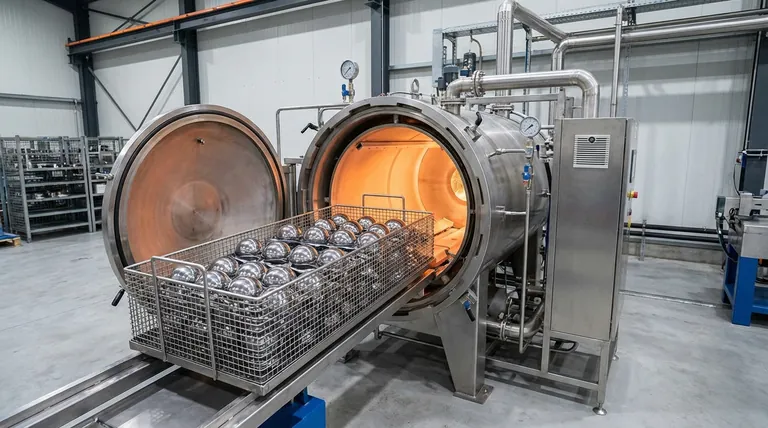
The Mechanics of Stress Relief and Stability
Eliminating Residual Internal Stresses
Rapid cooling (quenching) locks atoms in place, creating significant internal tension. If left untreated, these residual stresses can cause the steel to crack or shatter under load.
A constant temperature environment allows the atomic lattice to relax. This eliminates the internal forces fighting against the material's integrity without sacrificing the steel's strength.
Ensuring Dimensional Stability
Untempered steel is microstructurally unstable and prone to changing shape over time. This is catastrophic for precision bearings.
The tempering furnace provides a long-duration environment that stabilizes the material's volume. This ensures the bearing maintains its precise dimensions throughout its operational lifespan, preventing seizing or loose fits.
Microstructural Transformation
From Quenched to Tempered Martensite
The defining technical achievement of this process is the phase transformation of the steel. The furnace converts quenched martensite, which is hard but brittle, into tempered martensite.
This specific microstructure is the industry standard for high-carbon chromium bearing steel. It offers the optimal balance of mechanical properties required for rolling contact.
Precipitation of Fine Carbides
During the 170°C heat treatment, the furnace facilitates the precipitation of extremely fine carbides from the martensite structure.
These carbides are critical for reinforcing the steel matrix. They allow the material to maintain high hardness levels while simultaneously improving its ability to resist fracture.
Performance Outcomes
Enhancing Toughness
Hardness without toughness results in brittle failure. The tempering process imparts toughness, allowing the bearing to absorb shock and impact without cracking.
Improving Fatigue Resistance
Bearings are subjected to millions of cyclic loads. The stabilized microstructure created in the furnace significantly improves fatigue resistance, preventing surface spalling and extending the useful life of the component.
Understanding the Trade-offs
Hardness vs. Stability
There is an inherent trade-off between peak hardness and stability. While quenching achieves maximum hardness, it is unusable due to brittleness.
Tempering slightly reduces this peak hardness to achieve stability. The constant temperature of 170°C is a calculated compromise: it is high enough to relieve stress and stabilize the structure, but low enough to maintain the high hardness required for wear resistance.
The Cost of Inconsistency
Using a standard oven without precise constant temperature control risks inconsistent results.
Fluctuations below 170°C may leave residual stresses intact, leading to early failure. Fluctuations above this temperature can over-soften the steel, drastically reducing its wear life.
Making the Right Choice for Your Goal
To maximize the performance of high-carbon chromium bearing steel, apply the following principles:
- If your primary focus is Dimensional Precision: Ensure the furnace maintains a strict constant temperature for a sufficient duration to complete the transformation to tempered martensite.
- If your primary focus is Wear Resistance: Verify that the temperature does not exceed the 170°C threshold to preserve the fine carbide structure and high hardness.
Reliability in bearing steel is not achieved during hardening, but during the precise, controlled stress relief of the tempering process.
Summary Table:
| Technical Issue | Resolution through Tempering | Impact on Performance |
|---|---|---|
| Residual Stress | Relaxes atomic lattice & eliminates internal tension | Prevents cracking and shattering under load |
| Microstructural Instability | Converts quenched martensite to tempered martensite | Ensures long-term dimensional precision |
| Extreme Brittleness | Facilitates fine carbide precipitation | Enhances toughness and shock resistance |
| Low Fatigue Life | Creates a stabilized matrix structure | Improves fatigue resistance and extends component life |
Precision Heat Treatment for Superior Bearing Performance
Don't let residual stress compromise your material integrity. KINTEK provides industry-leading thermal solutions designed to deliver the precise constant temperature control required for high-carbon chromium bearing steel transformation.
Backed by expert R&D and manufacturing, KINTEK offers Muffle, Tube, Rotary, Vacuum, and CVD systems, along with other specialized lab high-temp furnaces. All our systems are fully customizable to meet your unique metallurgical needs, ensuring optimal hardness and dimensional stability for your components.
Ready to enhance your lab's precision? Contact KINTEK today for a custom solution!
References
- Wenwen Xu, Chaobin Lai. Effect of Rare Earth Y on Microstructure and Mechanical Properties of High-Carbon Chromium Bearing Steel. DOI: 10.3390/met14040372
This article is also based on technical information from Kintek Furnace Knowledge Base .
Related Products
- 2200 ℃ Tungsten Vacuum Heat Treat and Sintering Furnace
- Laboratory Muffle Oven Furnace with Bottom Lifting
- 1200℃ Muffle Oven Furnace for Laboratory
- 2200 ℃ Graphite Vacuum Heat Treat Furnace
- High Temperature Muffle Oven Furnace for Laboratory Debinding and Pre Sintering
People Also Ask
- How does a tungsten-heated vacuum sintering furnace prepare (TbxY1-x)2O3 ceramics? Achieve 99%+ Density & Purity
- What wear-resistance enhancements are achieved by powder coating? The Role of Vacuum Sintering Furnaces
- How do compaction pressure and vacuum sintering optimize porous ceramics? Maximize Density & Toughness
- What role does a high-temperature vacuum sintering furnace play in the densification of WC-10(Ni, Ni/Co) alloys?
- What core role does a high-temperature vacuum sintering furnace play in Sm:YAG ceramics? Mastering Optical Clarity



















