
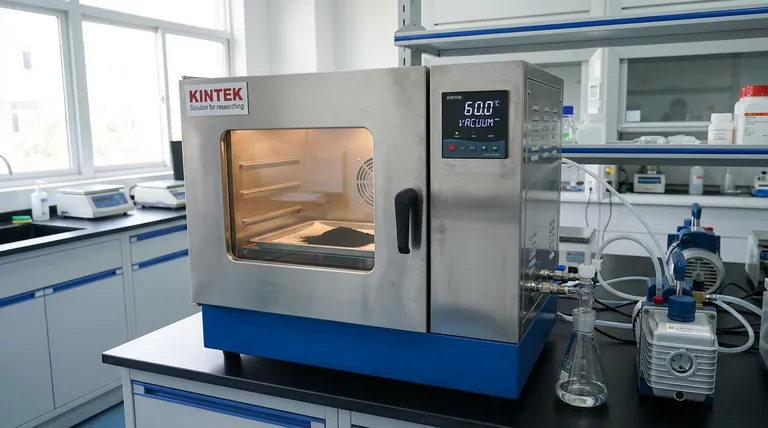
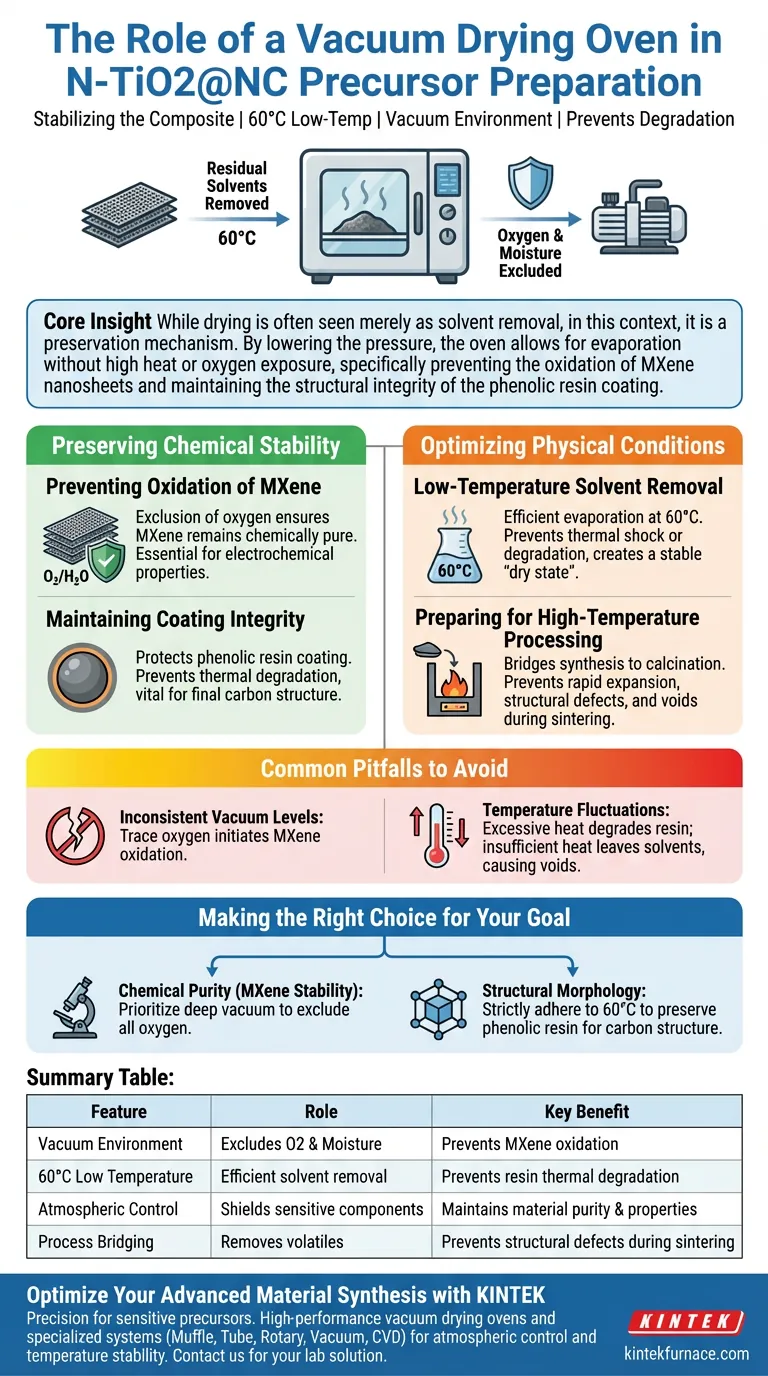
The role of a vacuum drying oven in the final stage of N-TiO2@NC precursor preparation is to stabilize the composite material. It functions by removing residual solvents at a controlled, low temperature of 60°C. Critically, it operates under a vacuum to exclude oxygen and moisture, which shields the sensitive chemical components from degradation before the next processing phase.
Core Insight While drying is often seen merely as solvent removal, in this context, it is a preservation mechanism. By lowering the pressure, the oven allows for evaporation without high heat or oxygen exposure, specifically preventing the oxidation of MXene nanosheets and maintaining the structural integrity of the phenolic resin coating.
Preserving Chemical Stability
Preventing Oxidation of MXene
The most critical function of the vacuum environment is the exclusion of oxygen. MXene nanosheets are highly susceptible to oxidation when exposed to air, especially during heating.
By processing the precursor in a vacuum, the oven ensures that the MXene component remains chemically pure. This preservation is essential for maintaining the material's intended electrochemical properties.
Maintaining Coating Integrity
The process protects the phenolic resin coating applied to the composite. High temperatures or oxidative environments could degrade this organic layer.
Maintaining the structural integrity of this coating is vital. It serves as the carbon source and structural framework during the subsequent high-temperature thermal processing steps.
Optimizing Physical Conditions
Low-Temperature Solvent Removal
The vacuum lowers the boiling point of solvents, allowing them to evaporate efficiently at just 60°C.
This low-temperature operation prevents thermal shock or degradation that might occur at higher drying temperatures. It ensures the material creates a stable "dry state" without altering its chemical composition.
Preparing for High-Temperature Processing
This drying stage is the bridge between synthesis and calcination. It ensures the precursor is free of volatile solvents that could cause rapid expansion or structural defects during sintering.
By delivering a dry, non-oxidized precursor, the vacuum oven sets the stage for uniform carbonization in the final thermal treatment.
Common Pitfalls to Avoid
Inconsistent Vacuum Levels
If the vacuum seal is compromised or the pressure is not sufficiently low, trace amounts of oxygen can enter the chamber. Even minor oxygen exposure at 60°C can initiate the oxidation of the MXene nanosheets, compromising the final performance of the N-TiO2@NC material.
Temperature Fluctuations
While 60°C is the target, significant deviations can be detrimental. Excessive heat may prematurely cure or degrade the phenolic resin, while insufficient heat may leave residual solvents trapped within the composite, leading to voids or cracks during the final high-temperature firing.
Making the Right Choice for Your Goal
To ensure the highest quality N-TiO2@NC precursors, prioritize the control of atmospheric conditions over speed.
- If your primary focus is Chemical Purity (MXene Stability): Ensure your vacuum system is capable of maintaining a deep vacuum to strictly exclude all oxygen and moisture during the cycle.
- If your primary focus is Structural Morphology: Strictly adhere to the 60°C limit to preserve the phenolic resin coating, as this defines the final carbon structure.
Success in this stage is defined not just by drying the material, but by freezing its chemical state to ensure uniformity in the final product.
Summary Table:
| Feature | Role in N-TiO2@NC Preparation | Key Benefit |
|---|---|---|
| Vacuum Environment | Excludes oxygen and moisture | Prevents oxidation of sensitive MXene nanosheets |
| 60°C Low Temperature | Efficient solvent removal at low boiling points | Prevents thermal degradation of phenolic resin |
| Atmospheric Control | Shields sensitive chemical components | Maintains material purity and electrochemical properties |
| Process Bridging | Removes volatile solvents before calcination | Prevents structural defects and voids during sintering |
Optimize Your Advanced Material Synthesis with KINTEK
Precision is non-negotiable when handling sensitive precursors like MXene and phenolic resins. KINTEK provides high-performance vacuum drying ovens and specialized high-temperature systems designed to deliver the rigorous atmospheric control and temperature stability your research demands.
Backed by expert R&D and manufacturing, KINTEK offers Muffle, Tube, Rotary, Vacuum, and CVD systems, all customizable to protect your chemical integrity and ensure structural morphology.
Ready to elevate your material quality? Contact us today to find the perfect solution for your lab.
Visual Guide
References
- Hui Zhang, ZhengMing Sun. Phase Engineering of <scp>MXene</scp> Derivatives Via Molecular Design for High‐Rate Sodium‐Ion Batteries. DOI: 10.1002/eem2.12692
This article is also based on technical information from Kintek Furnace Knowledge Base .
Related Products
- Vacuum Heat Treat Sintering and Brazing Furnace
- Vacuum Heat Treat Sintering Furnace Molybdenum Wire Vacuum Sintering Furnace
- Dental Porcelain Zirconia Sintering Ceramic Vacuum Press Furnace
- Molybdenum Vacuum Heat Treat Furnace
- Vacuum Hot Press Furnace Machine Heated Vacuum Press
People Also Ask
- How does vacuum heat treating affect the grain structure of metal alloys? Achieve Precise Microstructure Control
- What are the benefits of using vacuum heat treating furnaces for metal alloys? Achieve Superior Metal Properties and Performance
- What is one of the most important uses of vacuum heat treating furnaces in aerospace? Achieve Superior Strength in Aircraft Alloys
- What is the temperature of a vacuum furnace brazing? Optimize Your Joint Strength and Cleanliness
- What are the steps involved in a typical vacuum brazing treatment? Master the Process for Strong, Clean Joints












