
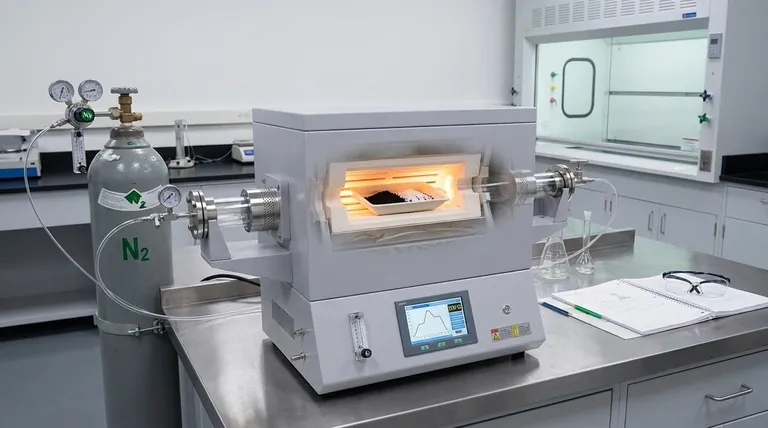
A high-temperature tube furnace establishes a strictly controlled thermal and atmospheric environment essential for chemically modifying recovered carbon black. Specifically, it maintains a stable temperature around 500 °C while utilizing a continuous flow of inert gas, such as nitrogen, to prevent material oxidation.
This apparatus allows for the precise regulation of heating duration and ramp rates. These controls are critical for enabling activating agents, particularly zinc chloride, to effectively penetrate and open the pore structure of the carbon black, thereby maximizing its specific surface area.
The tube furnace functions not merely as a heater, but as a precision reactor. It balances thermal energy with atmospheric isolation to allow chemical agents to re-engineer the carbon microstructure without burning away the base material.
Critical Process Parameters
Thermal Stability and Target Temperature
The primary function of the furnace is to reach and hold a specific activation temperature, typically 500 °C for zinc chloride activation. At this thermal plateau, the energy is sufficient to drive the chemical interaction between the activating agent and the carbon framework. This process transforms the dense, recovered material into a porous, high-surface-area structure.
Inert Atmosphere Protection
Chemical activation cannot occur in the presence of oxygen, which would simply burn the carbon into ash. The tube furnace employs a sealed system with a constant flow of inert gas (Nitrogen). This creates an oxygen-free zone that preserves the carbon yield while allowing the chemical activation reactions to proceed.
Role of the Activating Agent
The process relies on the presence of chemical agents, such as zinc chloride (ZnCl2). Under the furnace's controlled heat, these agents act as a template or corrosive force. They chemically "eat" into the carbon structure to create new micropores and mesopores, significantly increasing the material's adsorption capabilities.
Controlled Heating Kinetics
Success depends on more than just the final temperature; the heating rate and duration are equally vital. The furnace allows you to program exactly how fast the temperature rises and how long it stays there. This temporal precision ensures the activation reaction is uniform throughout the sample batch, preventing under-activation or structural collapse.
Understanding the Trade-offs
While the tube furnace provides the ideal environment for this process, there are inherent constraints you must navigate to ensure success.
Temperature Specificity vs. Agent Selection
The 500 °C standard is specific to zinc chloride activation. If you switch to different activating agents (such as KOH or KCl), the required temperature regime may shift drastically, potentially rising to 750 °C or even 1000 °C. Using the wrong temperature for your specific agent will result in either negligible activation or excessive material loss.
Atmosphere Purity vs. Cost
The integrity of the inert atmosphere is absolute; even minor leaks or impure nitrogen can lead to surface oxidation. High-purity gas and rigorous sealing protocols increase operational costs but are non-negotiable for high-performance carbon black.
Optimizing Your Activation Strategy
To achieve the best results with recovered carbon black, tailor your furnace settings to your specific end-goal.
- If your primary focus is maximizing Surface Area: Prioritize the precise control of the 500 °C soak time to ensure the zinc chloride has fully reacted with the carbon matrix to open the maximum number of pores.
- If your primary focus is Yield Retention: Strictly monitor the nitrogen flow rate and furnace seals to ensure zero oxygen ingress, which is the primary cause of material loss during heat treatment.
By mastering the balance between thermal input and atmospheric protection, you turn a waste recovery process into a precision engineering operation.
Summary Table:
| Process Parameter | Requirement for ZnCl2 Activation | Function / Benefit |
|---|---|---|
| Target Temperature | ~500 °C | Drives chemical reaction between agent and carbon |
| Atmosphere Type | Inert (Nitrogen Flow) | Prevents oxidation and material loss (ash) |
| Activating Agent | Zinc Chloride (ZnCl2) | Creates micropores to increase surface area |
| Heating Kinetics | Controlled Ramp & Soak | Ensures uniform activation and pore structural integrity |
| System Seal | High-Purity Sealing | Maintains oxygen-free zone for high-performance yields |
Elevate Your Material Activation with KINTEK Precision
Transform recovered carbon black into high-value porous materials with KINTEK’s advanced thermal solutions. Backed by expert R&D and world-class manufacturing, we provide high-performance Tube, Muffle, Rotary, Vacuum, and CVD systems tailored for the rigorous demands of chemical activation and material engineering.
Why choose KINTEK for your lab?
- Precise Atmosphere Control: Ensure zero oxygen ingress for maximum yield retention.
- Uniform Heating: Programmable ramp rates and soak times for consistent pore development.
- Customizable Designs: Scalable solutions designed to meet your specific temperature and chemical agent requirements.
Ready to optimize your activation strategy? Contact our technical experts today to find your perfect furnace solution.
Visual Guide

References
- M. M. El-Maadawy, Ahmed Taha. Conversion of carbon black recovered from waste tires into activated carbon <i>via</i> chemical/microwave methods for efficient removal of heavy metal ions from wastewater. DOI: 10.1039/d4ra00172a
This article is also based on technical information from Kintek Furnace Knowledge Base .
Related Products
- 1700℃ High Temperature Laboratory Tube Furnace with Alumina Tube
- 1400℃ High Temperature Laboratory Tube Furnace with Alumina Tube
- 1200℃ Split Tube Furnace Laboratory Quartz Tube Furnace with Quartz Tube
- High Temperature Muffle Oven Furnace for Laboratory Debinding and Pre Sintering
- Vertical Laboratory Quartz Tube Furnace Tubular Furnace
People Also Ask
- How does zone-melting in tube furnaces synthesize bismuth micro-wires? Master Single-Crystal Thermoelectric Growth
- How are high-temperature laboratory tube furnaces applied in long-term vacuum homogenization heat treatments for intermetallic samples?
- How are high-temp tube furnaces used to measure diffusion coefficients per Fick's law? Master Precision Annealing
- How do high-temperature laboratory tube furnaces ensure environmental stability? Precision Thermal Reduction Tips
- How are high-temperature tube furnaces applied in testing ceramic-supported alloy membranes? Insights



















