
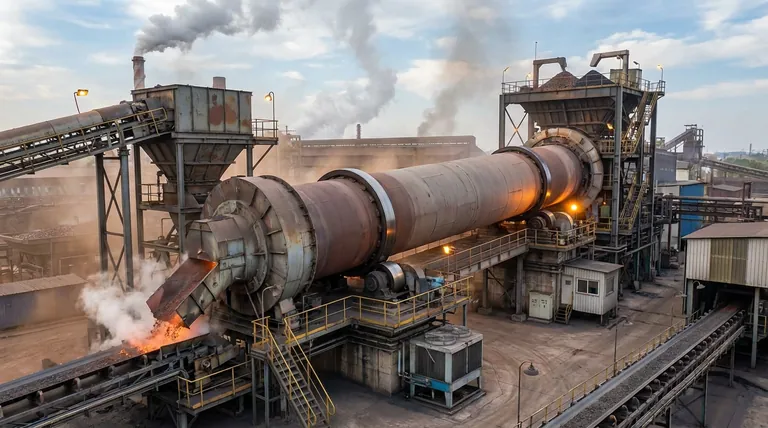
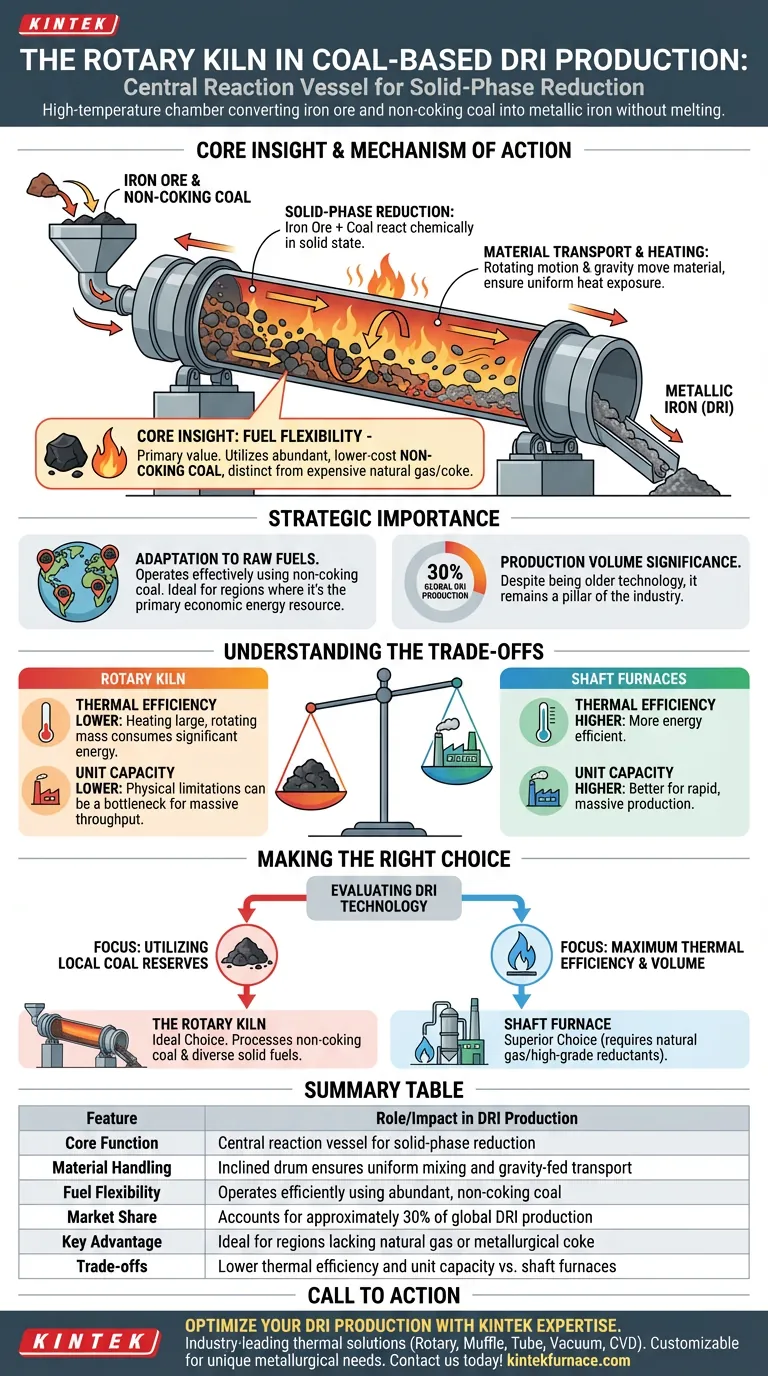
The rotary kiln serves as the central reaction vessel in coal-based Direct Reduced Iron (DRI) production. It functions as a high-temperature chamber where iron ore and non-coking coal are mixed to undergo solid-phase reduction, chemically converting the ore into metallic iron without melting it.
Core Insight: The rotary kiln's primary value lies in its fuel flexibility. While it generally has lower thermal efficiency and capacity compared to shaft furnaces, it remains essential for approximately 30% of the market because it allows producers to utilize abundant, lower-cost non-coking coal rather than expensive natural gas or metallurgical coke.
The Mechanism of Action
Solid-Phase Reduction
The primary biological or chemical function of the kiln is to facilitate solid-phase reduction. Inside the vessel, iron ore and coal react chemically while remaining in a solid state.
The rotating motion ensures that the coal (reductant) and iron ore are thoroughly mixed. This constant tumbling exposure allows carbon from the coal to strip oxygen from the iron ore, producing metallic iron.
Material Transport and Heating
Physically, the kiln is a large, cylindrical drum that is slightly inclined. As the drum rotates, gravity and friction work together to gradually move the material from the input end to the discharge end.
This design eliminates the need for internal conveyors. It ensures the raw materials are exposed to uniform heat throughout the journey, which is critical for maintaining a consistent chemical reaction.
Strategic Importance in Coal-Based DRI
Adaptation to Raw Fuels
The most significant advantage of the rotary kiln in this context is its adaptability to diverse raw fuels.
Unlike blast furnaces or gas-based shaft furnaces that often require high-grade coke or natural gas, the rotary kiln operates effectively using non-coking coal. This makes it the technology of choice in regions where non-coking coal is the primary or most economic energy resource.
Production Volume Significance
Despite being an older technology compared to some modern gas-based methods, the rotary kiln remains a pillar of the industry. It accounts for roughly 30% of global DRI production, underscoring its relevance in specific geographic and economic contexts.
Understanding the Trade-offs
Thermal Efficiency
While versatile, the rotary kiln operates with lower thermal efficiency than shaft furnaces. The nature of heating a large, rotating mass of solids consumes significant energy relative to the output produced.
Unit Capacity Limitations
The scale of production is also a constraint. Rotary kilns generally offer lower unit capacity compared to shaft furnaces. For operations requiring massive, rapid throughput, the physical limitations of the rotating drum can become a bottleneck.
Making the Right Choice for Your Goal
If you are evaluating DRI production technologies, the decision largely depends on your available energy resources and production scale.
- If your primary focus is utilizing local coal reserves: The rotary kiln is the ideal choice due to its ability to process non-coking coal and diverse solid fuels effectively.
- If your primary focus is maximum thermal efficiency and volume: A shaft furnace is likely superior, provided you have access to the necessary natural gas or high-grade reductants.
The rotary kiln remains a vital tool for converting low-cost solid fuels into valuable iron units where other methods are economically unfeasible.
Summary Table:
| Feature | Role/Impact in DRI Production |
|---|---|
| Core Function | Central reaction vessel for solid-phase reduction |
| Material Handling | Inclined drum ensures uniform mixing and gravity-fed transport |
| Fuel Flexibility | Operates efficiently using abundant, non-coking coal |
| Market Share | Accounts for approximately 30% of global DRI production |
| Key Advantage | Ideal for regions lacking natural gas or metallurgical coke |
| Trade-offs | Lower thermal efficiency and unit capacity vs. shaft furnaces |
Optimize Your DRI Production with KINTEK Expertise
Are you looking to maximize your ironmaking efficiency using non-coking coal or other solid fuels? KINTEK provides industry-leading thermal solutions backed by expert R&D and precision manufacturing.
Our extensive range of high-temperature equipment includes Rotary, Muffle, Tube, Vacuum, and CVD systems, all of which can be fully customized to meet your unique metallurgical and laboratory requirements. Whether you are refining DRI processes or developing new materials, we deliver the durability and control you need.
Ready to enhance your production capabilities? Contact us today to discuss your custom furnace needs!
Visual Guide
References
- Tetiana Golub, Molchanov Lavr. ESTABLISHMENT OF THERMODYNAMICAL AND PHYSICO-CHEMICAL PREREQUISITES FOR DIRECT OBTAINING IRON BY THERMOLISIS OF OXIDES. DOI: 10.31319/2519-2884.47.2025.1
This article is also based on technical information from Kintek Furnace Knowledge Base .
Related Products
- Electric Rotary Kiln Small Rotary Furnace Biomass Pyrolysis Plant Rotating Furnace
- Electric Rotary Kiln Continuous Working Small Rotary Furnace Kiln for Pyrolysis Plant Heating
- Electric Rotary Kiln Pyrolysis Furnace Plant Machine Small Rotary Kiln Calciner
- Electric Rotary Kiln Small Rotary Furnace for Activated Carbon Regeneration
- Vacuum Sealed Continuous Working Rotary Tube Furnace Rotating Tube Furnace
People Also Ask
- What are the main applications of a rotary kiln electric furnace? Achieve Uniform Heat Treatment for Powders
- What are the key components of a rotary kiln electric furnace? Unlock Efficient Thermal Processing
- What is the significance of the refractory lining in a rotary kiln electric furnace? Unlock Efficiency and Longevity
- What is the benefit of adjustable speed control in rotary kilns? Optimize Efficiency and Quality
- What are the main advantages of using rotary kilns for bulk solids processing? Achieve High-Volume, Uniform Thermal Processing









