
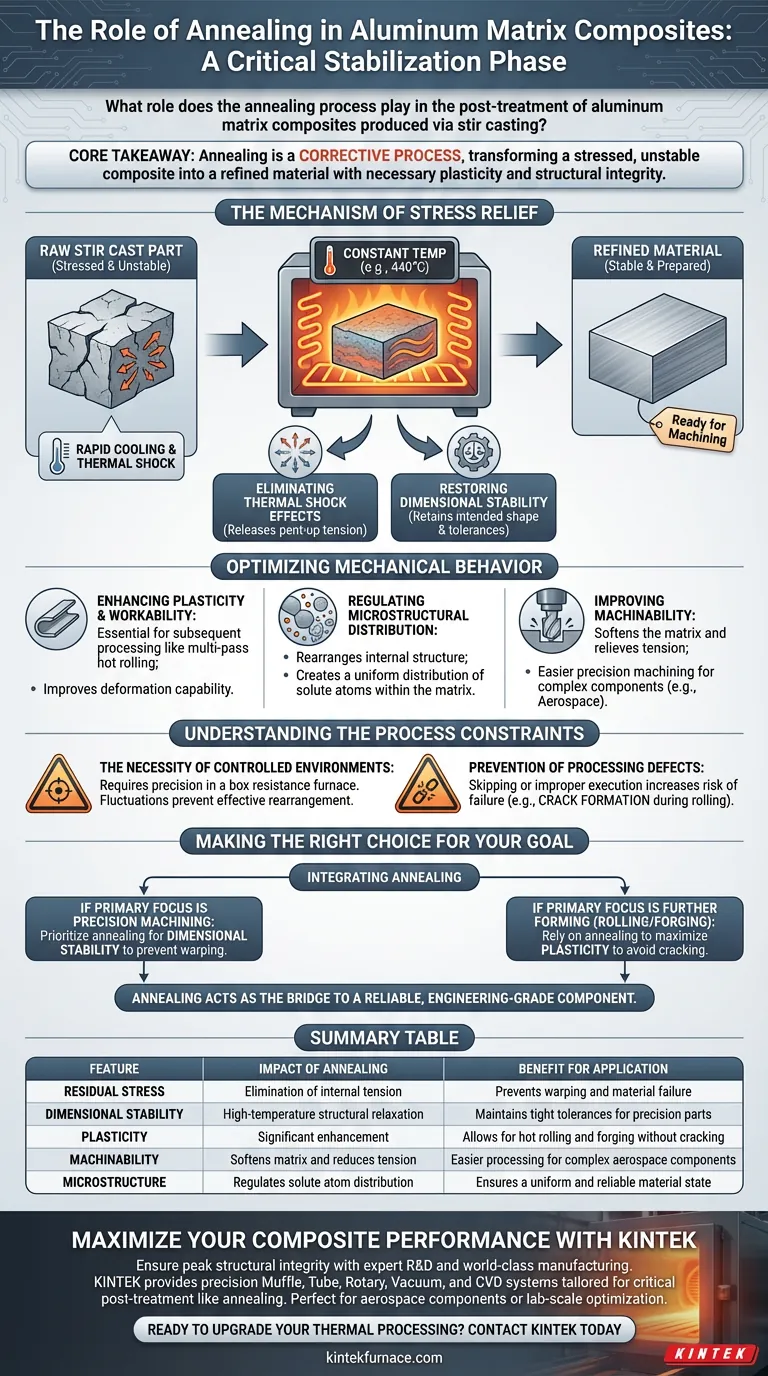
Annealing serves as a critical stabilization phase in the post-treatment of aluminum matrix composites, designed to eliminate residual stresses accumulated during the stir casting process. By subjecting the composite to a controlled, constant-temperature environment, this heat treatment relaxes the material's internal structure, ensuring it is dimensionally stable and physically prepared for machining or high-performance applications.
Core Takeaway Annealing is not merely about heating; it is a corrective process that neutralizes the thermal shock of rapid cooling. It transforms a composite from a stressed, potentially unstable state into a refined material with the necessary plasticity and structural integrity for aerospace components and complex machining.
The Mechanism of Stress Relief
Eliminating Thermal Shock Effects
During stir casting, the material undergoes intense heating followed by rapid cooling. This temperature fluctuation locks residual stresses deep within the composite's matrix. Annealing uses high-temperature furnaces to release this pent-up tension safely.
Restoring Dimensional Stability
If these residual stresses remain, the material may warp or deform unpredictably over time. The annealing process ensures dimensional stability, meaning the component retains its intended shape and tolerances even under mechanical load.
Optimizing Mechanical Behavior
Enhancing Plasticity and Workability
Beyond stress relief, annealing significantly improves the material's plasticity. This modification is essential if the composite will undergo subsequent processing, such as multi-pass hot rolling.
Regulating Microstructural Distribution
The process allows for the rearrangement of the internal microstructure. Specifically, it helps regulate the distribution of solute atoms within the aluminum matrix, creating a more uniform internal state.
Improving Machinability
By softening the matrix and relieving tension, the composite becomes easier to machine. This optimization is particularly vital for precision sectors like aerospace, where material failure during machining is unacceptable.
Understanding the Process Constraints
The Necessity of Controlled Environments
Annealing requires precision; it is typically conducted in a box resistance furnace to maintain a stable, constant temperature (e.g., 440 °C). Fluctuations in this environment can prevent the effective rearrangement of the microstructure.
Prevention of Processing Defects
Skipping or improperly executing this stage introduces a high risk of failure. Without the plasticity gained from annealing, the material is prone to crack formation during subsequent mechanical processing or rolling.
Making the Right Choice for Your Goal
When integrating annealing into your production line, consider your downstream requirements:
- If your primary focus is Precision Machining: Prioritize annealing to ensure dimensional stability, preventing warping when material is removed.
- If your primary focus is Further Forming (Rolling/Forging): Rely on annealing to maximize plasticity, ensuring the material can deform without cracking.
Annealing acts as the bridge between a raw cast part and a reliable, engineering-grade component.
Summary Table:
| Feature | Impact of Annealing | Benefit for Application |
|---|---|---|
| Residual Stress | Elimination of internal tension | Prevents warping and material failure |
| Dimensional Stability | High-temperature structural relaxation | Maintains tight tolerances for precision parts |
| Plasticity | Significant enhancement | Allows for hot rolling and forging without cracking |
| Machinability | Softens matrix and reduces tension | Easier processing for complex aerospace components |
| Microstructure | Regulates solute atom distribution | Ensures a uniform and reliable material state |
Maximize Your Composite Performance with KINTEK
Ensure your aluminum matrix composites achieve peak structural integrity and dimensional stability. Backed by expert R&D and world-class manufacturing, KINTEK provides precision Muffle, Tube, Rotary, Vacuum, and CVD systems tailored for critical post-treatment processes like annealing.
Whether you are refining aerospace components or optimizing lab-scale stir casting, our customizable high-temperature furnaces deliver the thermal precision required to eliminate stress and enhance workability.
Ready to upgrade your thermal processing? Contact KINTEK today to find the perfect solution for your unique manufacturing needs!
Visual Guide
References
- Naguib G. Yakoub. Catalysts of Strength: Unveiling the Mechanical and Tribological Mastery of Al-2024 MMC with Fly ash/TiB2/SiC Reinforcements. DOI: 10.21608/jessit.2024.283185.1010
This article is also based on technical information from Kintek Furnace Knowledge Base .
Related Products
- Controlled Inert Nitrogen Hydrogen Atmosphere Furnace
- Mesh Belt Controlled Atmosphere Furnace Inert Nitrogen Atmosphere Furnace
- 1400℃ High Temperature Laboratory Tube Furnace with Alumina Tube
- Small Vacuum Heat Treat and Tungsten Wire Sintering Furnace
- Laboratory Muffle Oven Furnace with Bottom Lifting
People Also Ask
- How does hydrogen furnace annealing assist in preparing mechanically alloyed powders for compaction?
- How does atmospheric annealing in a controlled hydrogen furnace affect the cold compaction behavior of metal powders?
- What are the characteristics and uses of hydrogen atmospheres in furnaces? Unlock Clean Metal Processing
- What are the characteristics and uses of hydrogen atmosphere in furnaces? Achieve Superior Surface Purity and Bonding
- What controlled-atmosphere furnace conditions are required for sintering powder metallurgy copper alloy compacts? Ideal Setup





