
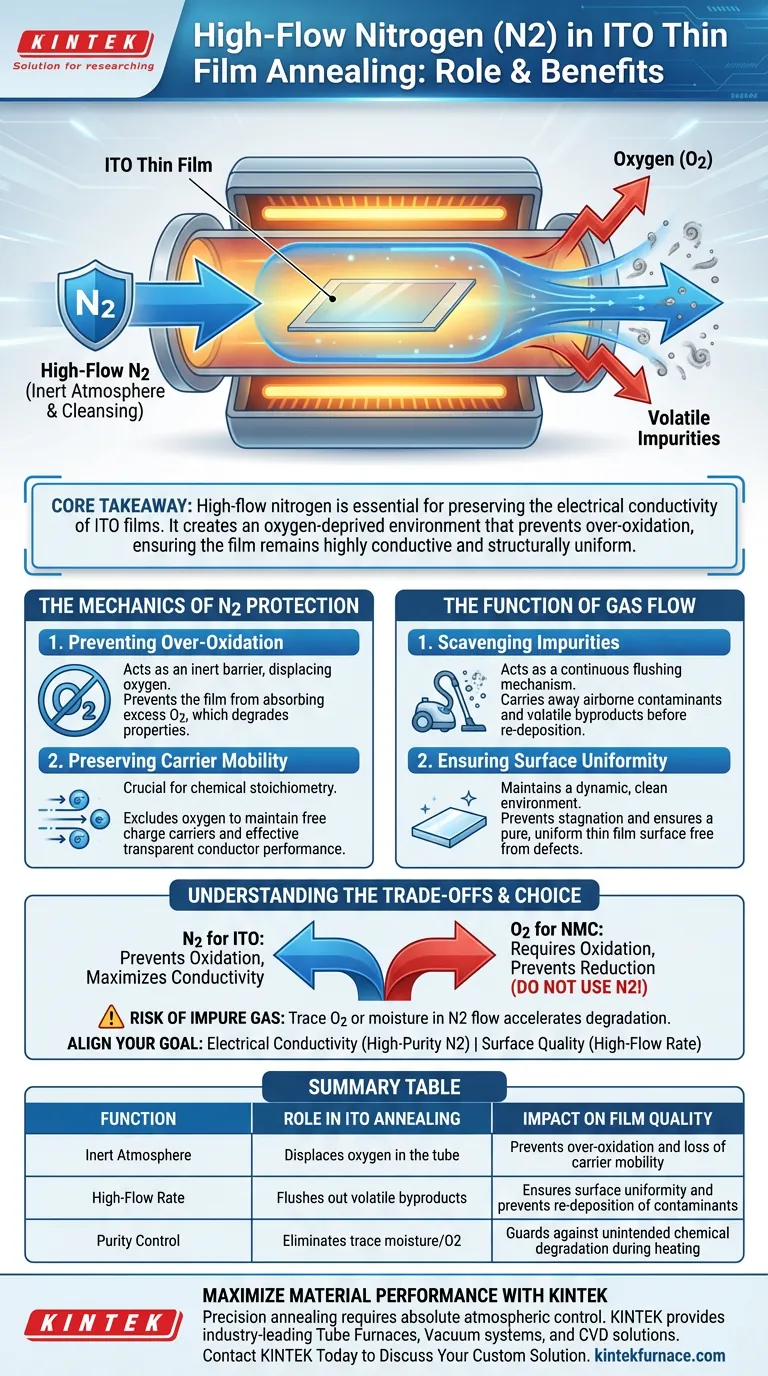
High-flow nitrogen (N2) serves as a critical protective and cleansing agent during the annealing of Indium Tin Oxide (ITO) thin films. Its primary function is to establish an inert atmosphere that prevents the film from absorbing excess oxygen, while simultaneously sweeping away volatile impurities released during the heating process.
Core Takeaway The introduction of high-flow nitrogen is essential for preserving the electrical conductivity of ITO films. It creates an oxygen-deprived environment that prevents over-oxidation—a reaction that degrades carrier mobility—ensuring the film remains highly conductive and structurally uniform.
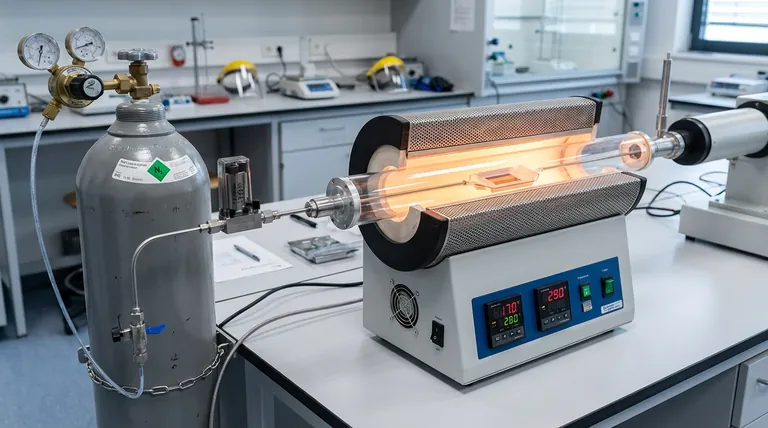
The Mechanics of Nitrogen Protection
Preventing Over-Oxidation
The central challenge in annealing ITO is managing oxygen levels. At high temperatures, materials are highly reactive and prone to absorbing oxygen from the environment.
Nitrogen acts as an inert barrier, displacing oxygen within the tube furnace. This prevents the ITO film from over-oxidizing, a chemical change that fundamentally alters the material's properties.
Preserving Carrier Mobility
The electrical performance of ITO relies heavily on its specific chemical stoichiometry.
If the film absorbs too much oxygen (over-oxidation), the number of free charge carriers decreases. By excluding oxygen, nitrogen preserves the carrier mobility required for the film to function effectively as a transparent conductor.
The Function of Gas Flow
Scavenging Impurities
The "high-flow" aspect of the process is just as critical as the gas type. As the tube furnace heats up, the substrate and film may release trace impurities or volatile byproducts.
A continuous, high-volume flow of nitrogen acts as a flushing mechanism. It actively carries these airborne contaminants out of the heating zone before they can re-deposit onto the film.
Ensuring Surface Uniformity
By maintaining a constant flow, the environment inside the tube remains dynamic and clean.
This prevents the stagnation of gases and ensures that the thin film surface remains pure and uniform, free from defects caused by settling particulate matter or chemical contaminants.
Understanding the Trade-offs
Atmosphere Specificity
It is vital to understand that nitrogen annealing is specific to materials like ITO that require protection from oxidation.
Conversely, materials like NMC (Nickel Manganese Cobalt) thin films require an oxygen-rich environment to prevent reduction and maintain their chemical structure. Using nitrogen on an oxide-dependent material would strip it of necessary oxygen, while using oxygen on ITO would destroy its conductivity.
The Risk of Impure Gas
The effectiveness of this process relies entirely on the purity of the nitrogen source.
If the nitrogen supply contains even trace amounts of oxygen or moisture, the high-flow rate will inadvertently introduce these contaminants to the hot film, accelerating the very oxidation and degradation you are trying to prevent.
Making the Right Choice for Your Goal
To maximize the quality of your ITO films, align your furnace settings with your specific performance metrics:
- If your primary focus is Electrical Conductivity: Prioritize high-purity nitrogen flow to strictly limit oxygen exposure and maximize carrier mobility.
- If your primary focus is Surface Quality: Ensure the flow rate is sufficient to rapidly evacuate any volatile impurities generated during the ramp-up phase.
By controlling the atmosphere with high-flow nitrogen, you convert the tube furnace from a simple heater into a precision tool for chemical stabilization.
Summary Table:
| Function | Role in ITO Annealing | Impact on Film Quality |
|---|---|---|
| Inert Atmosphere | Displaces oxygen in the tube | Prevents over-oxidation and loss of carrier mobility |
| High-Flow Rate | Flushes out volatile byproducts | Ensures surface uniformity and prevents re-deposition of contaminants |
| Purity Control | Eliminates trace moisture/O2 | Guards against unintended chemical degradation during heating |
Maximize Your Material Performance with KINTEK
Precision annealing requires more than just heat; it requires absolute atmospheric control. KINTEK provides industry-leading Tube Furnaces, Vacuum systems, and CVD solutions designed to maintain the high-purity environments essential for ITO and semiconductor research.
Backed by expert R&D and manufacturing, our systems are fully customizable to meet your unique gas flow and temperature requirements. Whether you are optimizing electrical conductivity or surface uniformity, our technical team is ready to help you configure the perfect setup.
Ready to elevate your thin film research?
Contact KINTEK Today to Discuss Your Custom Solution
Visual Guide
References
- Hessa I. Alabdan, Tapas K. Mallick. Monolithic Use of Inert Gas for Highly Transparent and Conductive Indium Tin Oxide Thin Films. DOI: 10.3390/nano14070565
This article is also based on technical information from Kintek Furnace Knowledge Base .
Related Products
- Controlled Inert Nitrogen Hydrogen Atmosphere Furnace
- 1200℃ Controlled Inert Nitrogen Atmosphere Furnace
- Inclined Rotary Plasma Enhanced Chemical Deposition PECVD Tube Furnace Machine
- Vertical Laboratory Quartz Tube Furnace Tubular Furnace
- Inclined Rotary Plasma Enhanced Chemical Deposition PECVD Tube Furnace Machine
People Also Ask
- How does hydrogen furnace annealing assist in preparing mechanically alloyed powders for compaction?
- How does atmospheric annealing in a controlled hydrogen furnace affect the cold compaction behavior of metal powders?
- What are the characteristics and uses of hydrogen atmosphere in furnaces? Achieve Superior Surface Purity and Bonding
- What are the characteristics and uses of hydrogen atmospheres in furnaces? Unlock Clean Metal Processing
- What controlled-atmosphere furnace conditions are required for sintering powder metallurgy copper alloy compacts? Ideal Setup



















