
The 1200 °C constant temperature environment provided by a muffle furnace is the specific thermal threshold required to synthesize single-phase monoclinic ZrO2:Ti ceramics. It provides the necessary energy to incorporate titanium ions into the zirconia lattice while actively preventing the formation of performance-degrading ZrTiO4 impurities.
Achieving a stable 1200 °C environment is not merely about heating; it is a precise thermodynamic control mechanism that enables essential grain growth and recrystallization while suppressing the formation of secondary phases that would compromise the ceramic's stability.
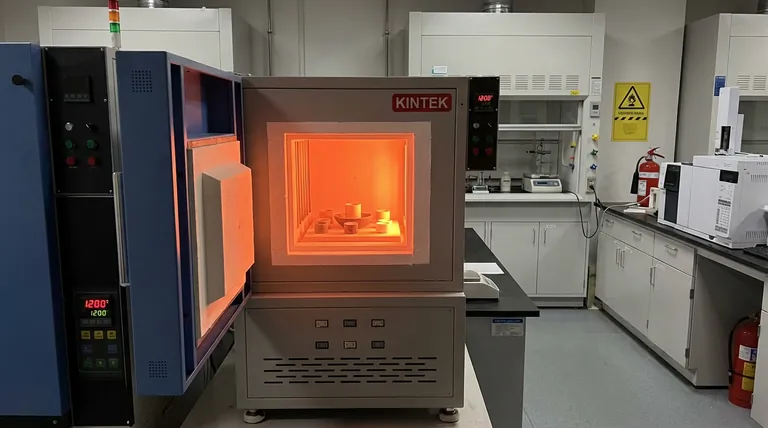
Facilitating Solid-State Reactions
To transform raw powders into a functional ceramic, you must overcome significant energy barriers. The muffle furnace provides the thermal driving force necessary for these changes on an atomic level.
Driving Phase Transitions
At 1200 °C, the ceramic green bodies (the unfired, pressed powder) gain enough energy to undergo critical phase transitions. This heat triggers the solid-state reactions required to alter the material's internal structure fundamentally.
Titanium Incorporation
The specific target of this process is the integration of dopants. The high temperature allows titanium ions to diffuse and be successfully incorporated into the zirconia lattice structure.
Recrystallization Mechanics
The constant heat environment promotes recrystallization. This process reorganizes the crystal structure, ensuring the material transitions from a loose powder aggregate to a cohesive solid.
Optimizing Microstructure and Density
Beyond chemical composition, the physical architecture of the ceramic is defined during this sintering phase.
Grain Growth and Merging
The thermal energy causes individual grains within the green body to merge and grow. This growth is driven by diffusion mechanisms that are only active at these elevated temperatures.
Eliminating Porosity
A high-quality ceramic requires high density. The 1200 °C environment drives the elimination of residual pores, resulting in a denser, stronger final product with superior structural integrity.
Managing Impurities and Trade-offs
In ceramic synthesis, higher temperatures are not always better; specificity is key. The 1200 °C setpoint is chosen to balance reaction kinetics against the risk of unwanted byproducts.
Preventing ZrTiO4 Formation
The primary risk in this synthesis is the creation of ZrTiO4 impurities. The 1200 °C environment is chemically tuned to facilitate the desired reaction while preventing the thermodynamic conditions that lead to this specific impurity.
Ensuring Single-Phase Stability
By strictly controlling the temperature to avoid impurities, the furnace ensures the production of single-phase monoclinic ZrO2:Ti ceramics. A single-phase structure is essential for achieving predictable and stable material performance.
The Risk of Thermal Fluctuation
While the primary reference highlights the specific temperature, supplementary data suggests that temperature uniformity is equally vital. Poor control can lead to uneven density or incomplete phase transformation, compromising the ceramic's quality factor.
Making the Right Choice for Your Goal
When configuring your sintering process for ZrO2:Ti ceramics, your equipment settings must align with your material quality objectives.
- If your primary focus is Phase Purity: Maintain a strict 1200 °C ceiling to specifically block the formation of ZrTiO4 impurities and ensure a monoclinic structure.
- If your primary focus is Mechanical Density: Ensure your furnace provides superior temperature field uniformity to maximize pore elimination and grain diffusion throughout the entire sample.
Success in sintering ZrO2:Ti relies on using temperature not just as heat, but as a precise filter for chemical structure.
Summary Table:
| Process Objective | Role of 1200 °C Thermal Environment |
|---|---|
| Phase Control | Facilitates single-phase monoclinic structure; prevents ZrTiO4 impurities. |
| Dopant Integration | Provides thermal driving force for titanium ion diffusion into the lattice. |
| Microstructure | Promotes grain growth and recrystallization for structural integrity. |
| Density | Eliminates residual porosity through high-temperature diffusion mechanisms. |
Elevate Your Material Research with KINTEK Precision
Achieving exact thermodynamic thresholds like 1200 °C requires more than just heat—it requires uncompromising temperature uniformity and control. Backed by expert R&D and manufacturing, KINTEK offers a comprehensive range of Muffle, Tube, Rotary, Vacuum, and CVD systems. Whether you are synthesizing ZrO2:Ti ceramics or developing next-generation materials, our lab high-temp furnaces are fully customizable to meet your unique sintering needs.
Ready to optimize your sintering process? Contact our technical experts today to find the perfect furnace solution.
References
- Alma Dauletbekova, Anatoli I. Popov. Luminescence Properties of ZrO2: Ti Ceramics Irradiated with Electrons and High-Energy Xe Ions. DOI: 10.3390/ma17061307
This article is also based on technical information from Kintek Furnace Knowledge Base .
Related Products
- 1200℃ Muffle Oven Furnace for Laboratory
- 1200℃ Controlled Inert Nitrogen Atmosphere Furnace
- 1200℃ Split Tube Furnace Laboratory Quartz Tube Furnace with Quartz Tube
- High Temperature Muffle Oven Furnace for Laboratory Debinding and Pre Sintering
- 1400℃ Muffle Oven Furnace for Laboratory
People Also Ask
- What is the primary function of a high-temperature laboratory muffle furnace in chemical synthesis? Achieve Precision.
- How does a high-temperature laboratory muffle furnace affect material properties? Transform Anodic Oxide Films Fast
- How is a laboratory muffle furnace used in 3D-printed PP-CF cross-linking? Achieve Thermal Stability at 150 °C
- How is a laboratory high-temperature muffle furnace used to evaluate porous Co-Al materials? Precision Thermal Analysis
- What is the role of a laboratory high-temperature muffle furnace in iron analysis? Key to Precise Sample Mineralization



















