
A vacuum annealing furnace acts as the essential transformation chamber for converting polymer precursors into nanocrystalline graphite (NCG). It provides a controlled, high-temperature reducing environment that drives thermal decomposition while physically protecting the material from oxidative destruction.
The furnace facilitates the carbonization of organic materials by maintaining a deep vacuum (typically 10^-6 mbar) at sustained temperatures around 600°C. This specific environment allows the precursor to evolve into a graphite structure with high-density grain boundary defects without burning away.
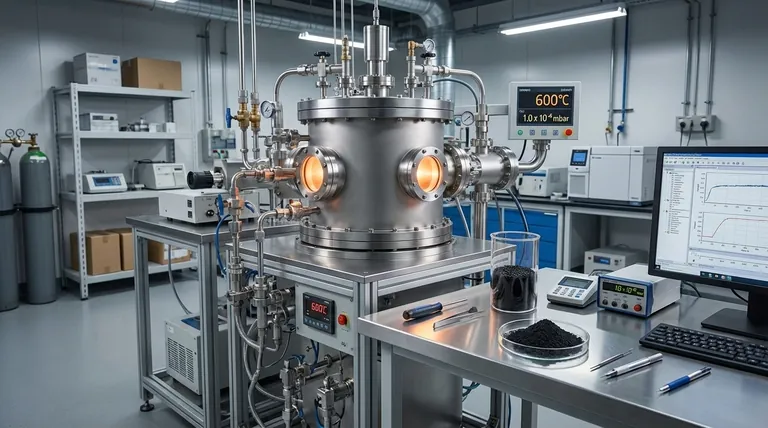
The Mechanism of NCG Conversion
Thermal Decomposition and Carbonization
The primary function of the furnace is to initiate the chemical breakdown of the polymer precursor. By applying sustained heat—specifically at approximately 600°C—the furnace forces the organic material to undergo thermal decomposition.
This process strips away non-carbon elements from the polymer chain. The remaining carbon atoms rearrange themselves, effectively transitioning the material from a raw organic state into a structured carbon framework.
The Necessity of Deep Vacuum
Creating NCG requires a pristine environment, achieved by lowering the pressure to extreme levels, such as 10^-6 mbar.
This high vacuum serves a dual purpose: it aids in the volatile removal of decomposition byproducts and creates a strictly reducing environment. Without this vacuum, high temperatures would cause the carbon to react with atmospheric oxygen, leading to the immediate oxidative loss (burning) of the material rather than conversion.
Forming the Nanocrystalline Structure
The furnace does not just produce generic carbon; it engineers a specific microstructure. The conditions controlled within the chamber promote the formation of nanocrystalline graphite.
Unlike single-crystal graphite, this resulting structure is characterized by high-density grain boundary defects. The vacuum annealing process ensures these specific structural features are developed uniformly throughout the material.
Understanding the Process Variables
Precision in Temperature Control
While the target is often 600°C, the uniformity of heating is critical. Just as vacuum annealing allows for uniform treatment in metallurgy, the conversion of NCG relies on consistent thermal energy distribution to ensure the entire polymer mass carbonizes at the same rate.
Managing Capillary Resistance
In related nanocasting applications, vacuum environments help precursors overcome capillary resistance to fill nanoscale pores. Similarly, in NCG synthesis, the vacuum environment ensures that the structural evolution is not hindered by trapped gases or surface tension issues, allowing for a dense and cohesive final structure.
Making the Right Choice for Your Goal
If your primary focus is Material Purity: Ensure your furnace can maintain a steady vacuum of 10^-6 mbar to completely prevent oxidation and material loss during the heating phase.
If your primary focus is Structural Definition: Prioritize precise thermal regulation at 600°C to ensure the proper formation of high-density grain boundary defects within the graphite lattice.
If your primary focus is Precursor Conversion: Verify that the furnace provides a sustained reducing environment to drive the complete thermal decomposition of the polymer without leaving organic residues.
The success of NCG synthesis relies less on the peak temperature alone and more on the stability of the vacuum environment that allows carbonization to occur chemically unhindered.
Summary Table:
| Process Component | Role in NCG Synthesis | Key Parameter |
|---|---|---|
| Thermal Energy | Drives decomposition of polymer precursors into carbon | ~600°C |
| Deep Vacuum | Prevents oxidative loss and removes volatile byproducts | 10^-6 mbar |
| Reducing Environment | Protects carbon structure and promotes grain boundary defects | Oxygen-free state |
| Uniform Heating | Ensures consistent carbonization and structural density | High Temperature Stability |
Elevate Your Nanomaterial Synthesis with KINTEK
Precision is the foundation of high-performance nanocrystalline graphite. At KINTEK, we understand that achieving a 10^-6 mbar vacuum and stable 600°C thermal profiles is non-negotiable for successful carbonization. Backed by expert R&D and world-class manufacturing, we offer high-performance Vacuum, Tube, and CVD systems tailored for advanced material research.
Whether you need customizable lab furnaces or high-temp industrial systems, KINTEK provides the reliability required to prevent oxidation and master structural definition. Contact us today to discuss your unique synthesis needs and discover how our specialized furnace technology can optimize your NCG conversion process.
References
- Sandeep Kumar, Ralph Krupke. On the mechanism of piezoresistance in nanocrystalline graphite. DOI: 10.3762/bjnano.15.34
This article is also based on technical information from Kintek Furnace Knowledge Base .
Related Products
- Small Vacuum Heat Treat and Tungsten Wire Sintering Furnace
- Vacuum Heat Treat Sintering and Brazing Furnace
- Vacuum Heat Treat Sintering Furnace Molybdenum Wire Vacuum Sintering Furnace
- Vacuum Heat Treat Sintering Furnace with Pressure for Vacuum Sintering
- Vacuum Sealed Continuous Working Rotary Tube Furnace Rotating Tube Furnace
People Also Ask
- How does vacuum sintering improve dimensional tolerances? Achieve Uniform Shrinkage and Precision
- What are the key components of a vacuum sintering furnace? Essential Parts for Precision Material Processing
- What is the purpose of setting a mid-temperature dwell stage? Eliminate Defects in Vacuum Sintering
- What are the main structural components of a vacuum sintering furnace? Unlock Precision in High-Temperature Processing
- What are the main types of sintering furnaces? Find the Perfect Match for Your Materials



















