
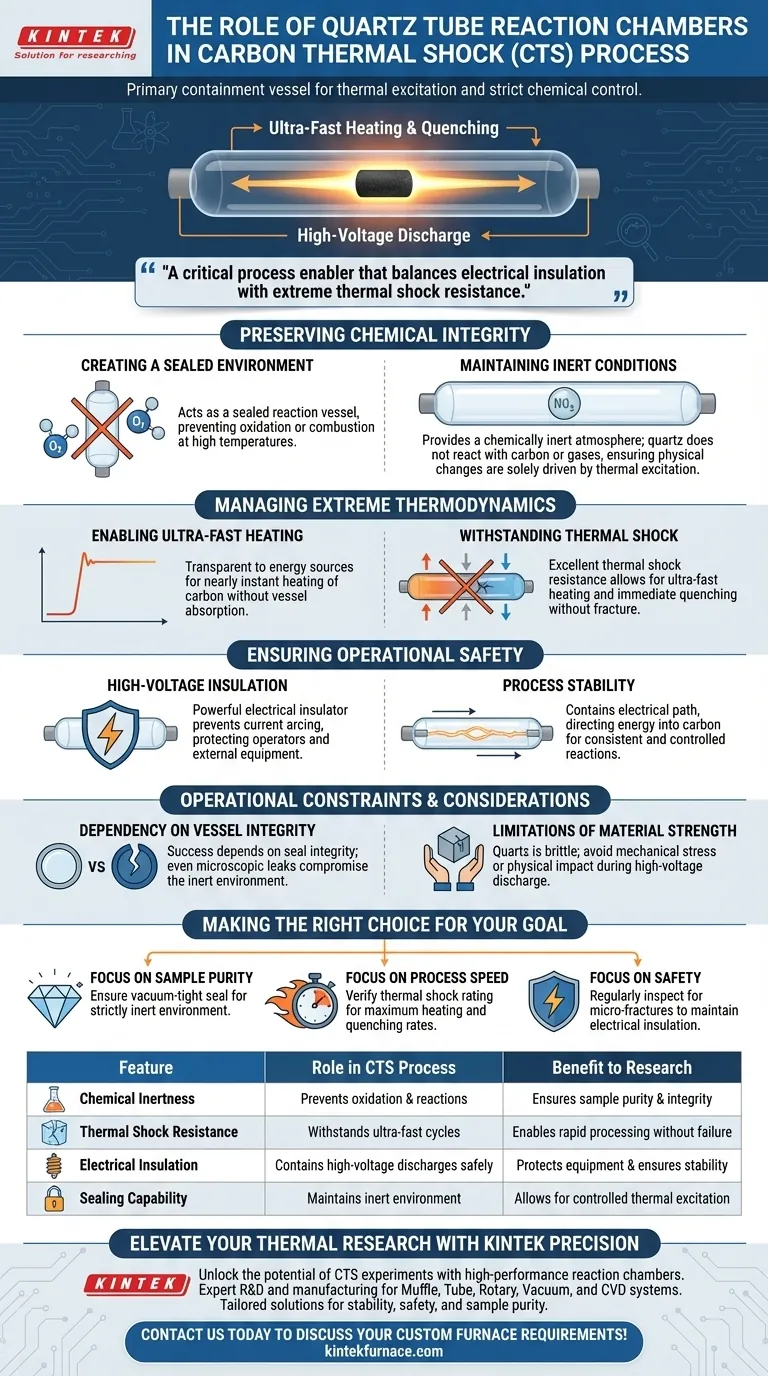
The quartz tube serves as the primary containment vessel for the Carbon Thermal Shock (CTS) process. It functions as a sealed reaction chamber that facilitates thermal excitation while strictly controlling the chemical environment. By isolating the carbon materials, the tube prevents oxidation at high temperatures and ensures the structural integrity of the process during high-voltage operations.
The quartz tube is not merely a container; it is a critical process enabler that balances electrical insulation with extreme thermal shock resistance, allowing for ultra-fast heating and quenching cycles without compromising safety or sample purity.
Preserving Chemical Integrity
Creating a Sealed Environment
The fundamental role of the quartz tube is to act as a sealed reaction vessel.
In the CTS process, carbon materials are subjected to extreme heat. Without a sealed environment, oxygen would interact with the carbon, leading to immediate oxidation or combustion.
Maintaining Inert Conditions
The tube provides a chemically inert atmosphere essential for processing carbon.
Because quartz does not react with carbon or the surrounding gases at these temperatures, it ensures that the physical changes occurring in the carbon are driven solely by thermal excitation, not unwanted chemical reactions.
Managing Extreme Thermodynamics
Enabling Ultra-Fast Heating
The CTS process relies on thermal excitation, which involves rapid temperature spikes.
The quartz tube is transparent to the energy sources used for excitation, allowing the carbon inside to heat up almost instantly without the vessel itself absorbing excessive energy or degrading.
Withstanding Thermal Shock
Standard glass or ceramics would shatter under the rapid temperature changes of CTS.
Quartz possesses excellent thermal shock resistance. This property allows the system to undergo the "shock" aspect of the process—ultra-fast heating followed by immediate quenching—without the tube fracturing due to thermal stress.
Ensuring Operational Safety
High-Voltage Insulation
The CTS process utilizes a high-voltage discharge to generate heat.
Quartz acts as a powerful electrical insulator. This prevents the electrical current from arcing outside the reaction zone, protecting the operator and external equipment from high-voltage hazards.
Process Stability
The insulating properties of the quartz tube contribute to the overall stability of the discharge process.
By containing the electrical path effectively, the tube ensures the energy is directed entirely into the carbon material, resulting in a consistent and controlled reaction.
Operational Constraints and Considerations
Dependency on Vessel Integrity
The success of the CTS process is entirely dependent on the integrity of the seal.
Any breach in the quartz tube compromises the inert environment. Even a microscopic leak can introduce oxygen, causing the carbon material to oxidize rather than undergoing the intended thermal modification.
Limitations of Material Strength
While quartz is resistant to thermal shock, it remains a brittle material.
Operators must ensure the tube is not subjected to mechanical stress or physical impact, as a fracture during the high-voltage discharge poses significant safety risks and would immediately halt the quenching process.
Making the Right Choice for Your Goal
To maximize the effectiveness of the Carbon Thermal Shock process, you must prioritize the condition and specifications of the quartz reaction chamber.
- If your primary focus is Sample Purity: Ensure the quartz tube allows for a vacuum-tight seal to maintain a strictly inert environment and prevent oxidation.
- If your primary focus is Process Speed: Verify the specific thermal shock rating of the quartz used to ensure it can withstand the maximum heating and quenching rates required by your protocol.
- If your primary focus is Safety: Inspect the tube regularly for micro-fractures that could compromise its electrical insulating properties during high-voltage discharge.
The quartz tube is the linchpin of the CTS process, bridging the gap between extreme thermal energy and precise chemical control.
Summary Table:
| Feature | Role in CTS Process | Benefit to Research |
|---|---|---|
| Chemical Inertness | Prevents carbon oxidation and unwanted reactions | Ensures sample purity and integrity |
| Thermal Shock Resistance | Withstands ultra-fast heating and quenching cycles | Enables rapid processing without vessel failure |
| Electrical Insulation | Contains high-voltage discharges safely | Protects equipment and ensures process stability |
| Sealing Capability | Maintains a vacuum-tight or inert environment | Allows for controlled thermal excitation |
Elevate Your Thermal Research with KINTEK Precision
Unlock the full potential of your Carbon Thermal Shock (CTS) experiments with high-performance reaction chambers. Backed by expert R&D and manufacturing, KINTEK offers premium Muffle, Tube, Rotary, Vacuum, and CVD systems designed to withstand the most demanding lab environments.
Whether you require specialized quartz configurations or custom high-temperature furnaces, our solutions are tailored to meet your unique research needs. Ensure process stability, safety, and sample purity with industry-leading technology.
Ready to optimize your high-temperature protocols? Contact us today to discuss your custom furnace requirements!
Visual Guide
References
- Mitesh Ganpat Mapari, Tae Young Kim. Edge‐Free Graphene‐Derived Mesoporous Carbon for High‐Voltage Supercapacitors. DOI: 10.1002/sstr.202500265
This article is also based on technical information from Kintek Furnace Knowledge Base .
Related Products
- Laboratory Quartz Tube Furnace RTP Heating Tubular Furnace
- Vertical Laboratory Quartz Tube Furnace Tubular Furnace
- Multi Zone Laboratory Quartz Tube Furnace Tubular Furnace
- High Pressure Laboratory Vacuum Tube Furnace
- 1200℃ Split Tube Furnace Laboratory Quartz Tube Furnace with Quartz Tube
People Also Ask
- What physical conditions does a laboratory Tube Furnace provide for SOEC? Precision Heat for Solid Oxide Characterization
- What are the main features and functions of a laboratory tube furnace? Unlock Precise High-Temp Control for Your Lab
- What conditions do tube furnaces provide for Au-Seeded TiO2 nanowires? Master Precision Thermal Synthesis
- What conditions does a tube furnace provide for post-ion-implantation? Achieve Precise Microstructural Repair
- What role does a laboratory tube furnace play in geological and mineralogical research? Unlock Earth's Secrets with Precision






