
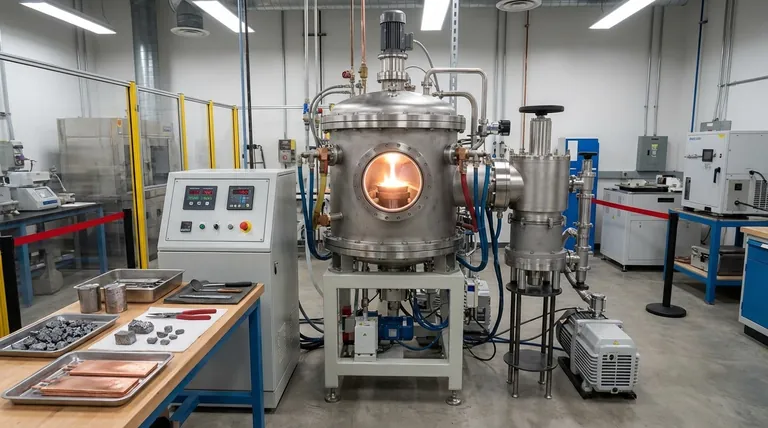
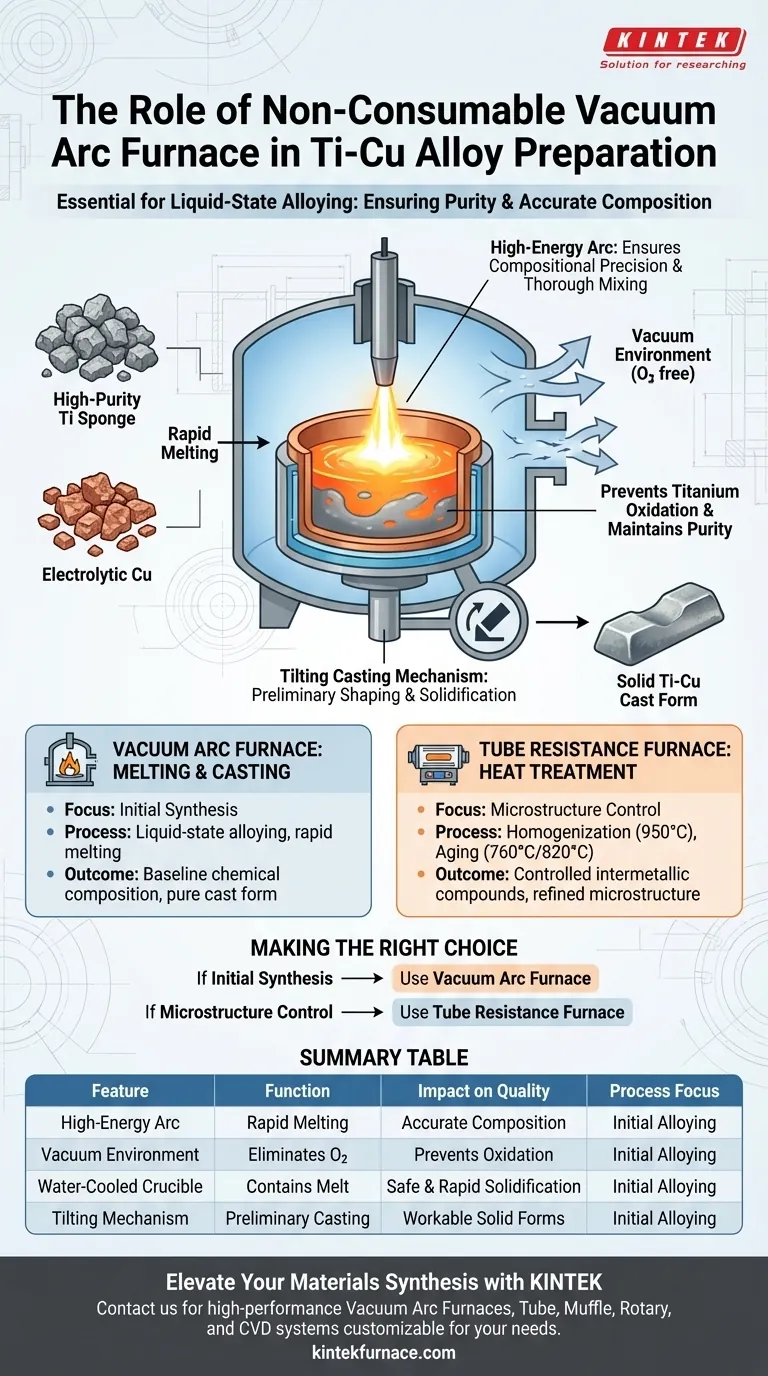
The non-consumable vacuum arc furnace serves as the foundational tool for the initial synthesis and melting of Titanium-Copper (Ti–Cu) alloys. Its primary function is to generate a high-energy arc that rapidly melts raw materials—specifically high-purity titanium sponge and electrolytic copper—while strictly controlling the chemical atmosphere.
Core Takeaway The non-consumable vacuum arc furnace is essential for the liquid-state alloying phase, utilizing a vacuum environment to prevent titanium oxidation while employing a water-cooled crucible to facilitate rapid melting and preliminary casting.
Achieving Accurate Chemical Composition
The Role of the High-Energy Arc
The furnace employs a high-energy arc as its heat source. This intense thermal input allows for the rapid melting of materials with high melting points, specifically high-purity titanium sponge and electrolytic copper.
Ensuring Compositional Precision
Because titanium is highly reactive, maintaining the exact ratio of elements is difficult in open air. The rapid melting process provided by the arc ensures the raw materials mix thoroughly before solidifying, establishing the baseline accuracy of the alloy's chemical composition.
Environmental Protection and Purity
The Necessity of Vacuum Conditions
Titanium alloys are extremely sensitive to oxygen at high temperatures. The furnace operates under a vacuum environment (often backfilled with inert gases) to shield the molten metal.
Preventing Oxidation
This protective environment is critical for preventing the oxidation of titanium. By eliminating oxygen exposure during the melt, the furnace ensures the material retains its intended purity and mechanical potential.
Hardware and Preliminary Shaping
Water-Cooled Copper Crucible
The melting process takes place within a water-cooled copper crucible. This component contains the melt and manages the extreme heat, facilitating the initial consolidation of the liquid metal.
Tilting Casting Mechanism
Beyond simple melting, this furnace is equipped for preliminary shaping. A tilting casting mechanism allows the operator to pour the molten alloy, transitioning it from a liquid mixture into a solid cast form ready for further processing.
Understanding the Process Distinctions
It is vital to distinguish the role of the vacuum arc furnace from downstream heat treatment equipment.
Melting vs. Heat Treatment
The vacuum arc furnace is strictly for melting and casting. It does not provide the precise, long-duration temperature control required for solid-state phase transformations.
Downstream Homogenization
For processes like homogenization (at 950°C) or aging (at 760°C/820°C), a tube resistance furnace is required. While the arc furnace creates the alloy, the tube furnace is responsible for controlling the precipitation of intermetallic compounds (like Ti2Cu) through precise thermal regulation.
Making the Right Choice for Your Goal
To ensure the successful preparation of Ti-Cu alloys, select the equipment that matches your processing stage:
- If your primary focus is initial synthesis: Use the non-consumable vacuum arc furnace to melt titanium sponge and copper without oxidation.
- If your primary focus is microstructure control: Move the cast alloy to a tube resistance furnace to regulate precipitate size and distribution through aging treatments.
The vacuum arc furnace is the gatekeeper of purity, ensuring the alloy is chemically correct before any microstructural tuning begins.
Summary Table:
| Feature | Function in Ti-Cu Preparation | Impact on Quality |
|---|---|---|
| High-Energy Arc | Rapid melting of Ti sponge and electrolytic Cu | Ensures accurate chemical composition |
| Vacuum Environment | Eliminates oxygen exposure during melting | Prevents titanium oxidation and maintains purity |
| Water-Cooled Crucible | Contains and cools the molten metal | Facilitates safe melting and rapid solidification |
| Tilting Mechanism | Preliminary casting and shaping | Transforms liquid alloy into workable solid cast forms |
| Process Focus | Initial liquid-state alloying | Establishes the baseline material for heat treatment |
Elevate Your Materials Synthesis with KINTEK
Precise alloy preparation begins with the right thermal technology. Backed by expert R&D and manufacturing, KINTEK offers high-performance Vacuum Arc Furnaces, Tube, Muffle, Rotary, and CVD systems, all customizable for your unique laboratory needs. Whether you are performing initial synthesis of Ti-Cu alloys or precise downstream aging treatments, our equipment ensures maximum purity and control.
Ready to optimize your lab's high-temperature processes? Contact us today to discuss your project and discover how our specialized furnace solutions can drive your research forward.
Visual Guide
References
- Daisy Rabbitt. Antimicrobial Titanium–Copper Alloys: The Role of Microstructure in Arc‐Melted Compositions. DOI: 10.1002/adem.202500347
This article is also based on technical information from Kintek Furnace Knowledge Base .
Related Products
- Molybdenum Vacuum Heat Treat Furnace
- Vacuum Sealed Continuous Working Rotary Tube Furnace Rotating Tube Furnace
- 2200 ℃ Tungsten Vacuum Heat Treat and Sintering Furnace
- Vacuum Heat Treat Sintering Furnace Molybdenum Wire Vacuum Sintering Furnace
- Small Vacuum Heat Treat and Tungsten Wire Sintering Furnace
People Also Ask
- What is the primary application of vacuum heat treating furnaces in aerospace? Enhance Component Performance with Precision
- How does vacuum heat treating work in terms of temperature and time control? Master Precise Material Transformations
- Why are vacuum heat treating furnaces essential for aerospace? Ensure Superior Material Integrity for High-Stakes Applications
- What is the process of vacuum heat treating? Achieve Superior Metallurgical Properties
- How does a vacuum heat treating furnace improve the condition of metal alloys? Achieve Superior Metal Performance

















