
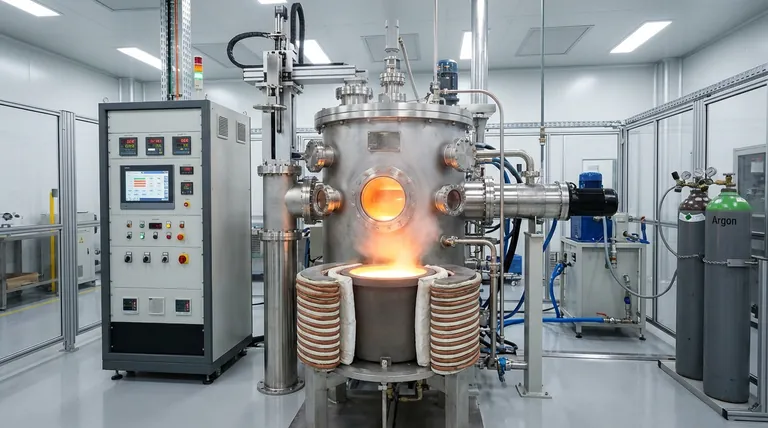
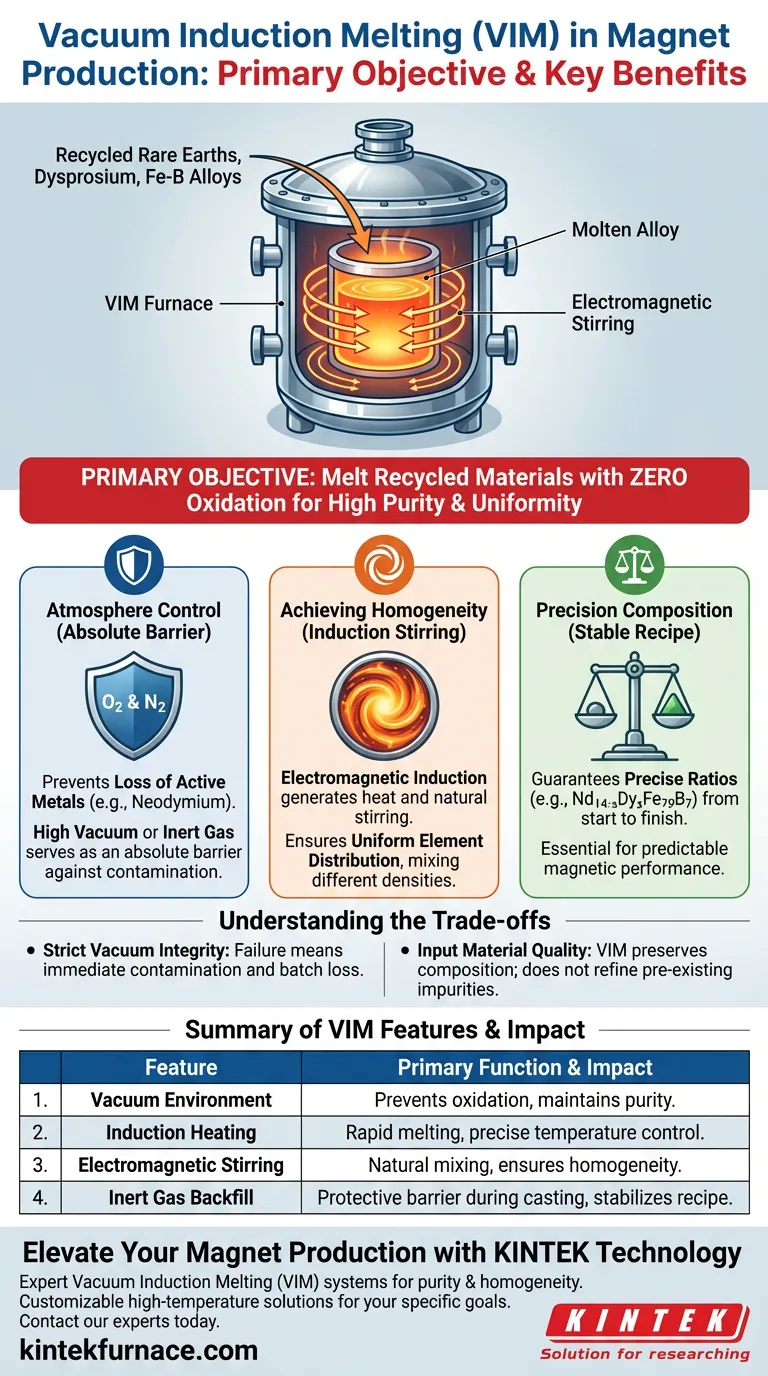
The primary objective of using a Vacuum Induction Melting (VIM) furnace in this stage is to melt recycled rare earth concentrates, supplemental dysprosium, and iron-boron alloys using electromagnetic induction within a protective vacuum environment. This process is specifically designed to prevent the oxidation of highly reactive metals like neodymium, ensuring the final alloy maintains strict chemical uniformity and high purity.
By eliminating atmospheric contact during the melting process, the VIM furnace acts as an absolute barrier against oxidation for reactive rare earth elements. This preservation of purity is the deciding factor in achieving stable magnetic performance in recycled alloys.
The Critical Role of Atmosphere Control
Preventing the Loss of Active Metals
The central challenge in magnet production is the high reactivity of rare earth elements, particularly neodymium. If exposed to oxygen during the high-temperature melting phase, these metals effectively burn off or degrade.
Ensuring an Absolute Barrier
The VIM furnace operates under a high vacuum or an inert gas atmosphere (such as argon). This environment serves as an absolute barrier, preventing oxygen and nitrogen from contaminating the melt and altering the target chemical composition.
Achieving Homogeneity Through Induction
The Mechanism of Electromagnetic Stirring
Beyond simple heating, the VIM furnace utilizes electromagnetic induction to generate heat. A key byproduct of this method is a natural stirring effect within the molten metal.
Uniform Element Distribution
This stirring action is critical for mixing materials with different densities, such as heavy dysprosium and lighter iron-boron alloys. It ensures that the elements are distributed evenly throughout the ingot, creating a consistent chemical base for the magnet.
Precision in Alloy Composition
Stabilizing the Chemical Recipe
The recast stage often involves complex formulas, such as Nd₁₄₋ₓDyₓFe₇₉B₇. The VIM process guarantees that the ratio of these elements remains precise from the start of the melt to the final casting.
Consistency for Downstream Processing
By securing the purity and uniformity of the alloy at this stage, the VIM furnace establishes a high-quality foundation. This consistency is required for predictable results in subsequent thermal processing and magnetic performance evaluations.
Understanding the Trade-offs
The Necessity of Strict Vacuum Integrity
The VIM process is unforgiving regarding equipment integrity. Because the primary goal is oxidation prevention, any failure in the vacuum seal or inert gas backfilling system can result in immediate contamination and the loss of the entire batch of expensive rare earth materials.
Dependence on Input Material Quality
While VIM is excellent at preserving the composition of the input materials, it is primarily a melting and mixing tool, not a refining tool for removing all types of pre-existing impurities. The quality of the final ingot is still heavily dependent on the purity of the recycled concentrates and raw sponges introduced into the furnace.
Making the Right Choice for Your Goal
To maximize the effectiveness of the VIM process in your production line, consider the following specific objectives:
- If your primary focus is Chemical Purity: Prioritize the vacuum level and leak rate integrity of the furnace to ensure zero oxidation of neodymium and dysprosium.
- If your primary focus is Material Homogeneity: Optimize the frequency and power of the induction field to maximize the electromagnetic stirring effect for uniform elemental distribution.
The VIM furnace ultimately transforms volatile, recycled raw ingredients into a stable, high-performance alloy ready for advanced magnet manufacturing.
Summary Table:
| Feature | Primary Function in Magnet Production | Impact on Alloy Quality |
|---|---|---|
| Vacuum Environment | Prevents oxidation of reactive rare earth elements | Maintains chemical purity and prevents material loss |
| Induction Heating | Rapid, efficient melting of recycled concentrates | Precise temperature control for complex recipes |
| Electromagnetic Stirring | Natural mixing of elements with different densities | Ensures uniform distribution (homogeneity) of Dysprosium and Iron-Boron |
| Inert Gas Backfill | Provides a protective barrier during casting | Stabilizes the chemical recipe against atmospheric contamination |
Elevate Your Magnet Production with KINTEK Technology
Precise alloy composition is the cornerstone of high-performance magnet manufacturing. KINTEK provides industry-leading Vacuum Induction Melting (VIM) systems designed to protect your volatile rare earth materials from oxidation while ensuring perfect elemental homogeneity.
Backed by expert R&D and manufacturing, we offer customizable Vacuum, CVD, and high-temperature lab furnaces tailored to your specific chemical purity and material distribution goals. Don't compromise on your alloy quality—contact our technical experts today to discover how our advanced heating solutions can optimize your production line.
Visual Guide
References
- Finks, Christopher. Technical Analysis: Magnet-to-Magnet Rare Earth Recycling Without Solvent Extraction (M2M-Δ Architecture) - Defense Supply Chain Resilience. DOI: 10.5281/zenodo.17625286
This article is also based on technical information from Kintek Furnace Knowledge Base .
Related Products
- Vacuum Induction Melting Furnace
- 600T Vacuum Induction Hot Press Vacuum Heat Treat and Sintering Furnace
- Vacuum Heat Treat Sintering Furnace with Pressure for Vacuum Sintering
- Magnesium Extraction and Purification Condensing Tube Furnace
- Vacuum Heat Treat Sintering Furnace Molybdenum Wire Vacuum Sintering Furnace
People Also Ask
- What are the core functions of the High Vacuum Induction Melting (VIM) furnace? Optimize DD5 Superalloy Purification
- What is the role of VIM and directional solidification in aero-engine blade substrates? Engineering Extreme Durability
- What are the technical advantages of using a Vacuum Induction Melting furnace in the development of advanced packaging steel?
- What role does a Vacuum Induction Melting furnace play in the production of high-aluminum nickel-based superalloys?
- Why is a Vacuum Induction Melting furnace (VIM) used for Cu-Zn-Al-Sn alloys? Achieve Precision Composition Control



















