
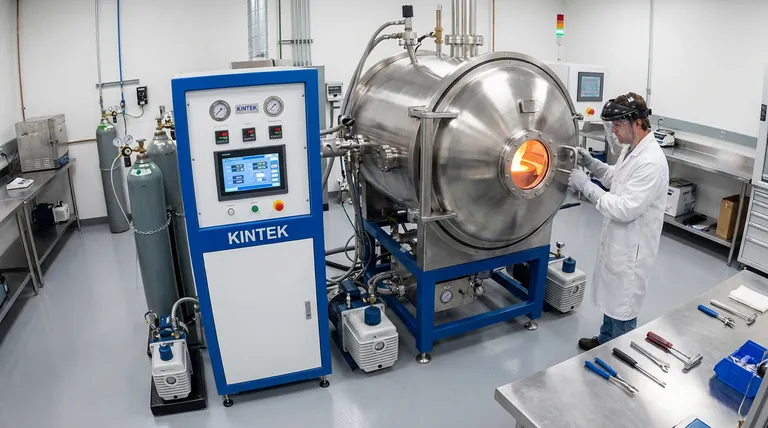
The primary function of a Vacuum Induction Melting (VIM) furnace is to create an isolated, ultra-pure environment for processing high-value metal alloys. For nickel-based heat-resistant alloys specifically, the VIM furnace is the critical first step used to melt the charge while completely shielding it from atmospheric contamination, ensuring the material meets stringent chemical and mechanical specifications.
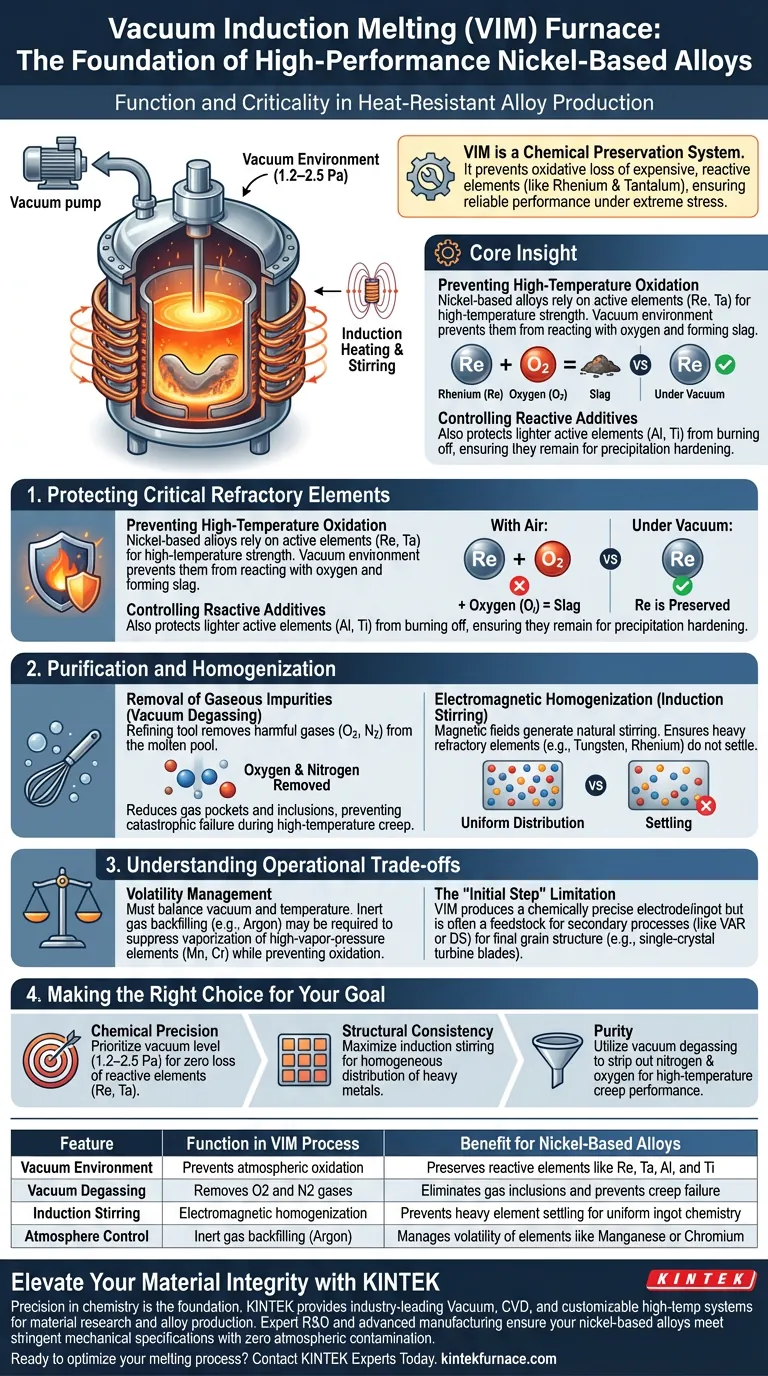
Core Insight: The VIM furnace is not merely a melting vessel; it is a chemical preservation system. Its central purpose is to prevent the oxidative loss of expensive, reactive elements (like Rhenium and Tantalum) that define the alloy's heat resistance, ensuring the final material performs reliably under extreme stress.
Protecting Critical Refractory Elements
The defining characteristic of nickel-based heat-resistant alloys is their complex chemistry, often including reactive refractory metals. The VIM furnace addresses the deep need to preserve these elements during the liquid phase.
Preventing High-Temperature Oxidation
Nickel-based alloys rely on active elements such as rhenium (Re) and tantalum (Ta) for their high-temperature strength. However, these elements are highly susceptible to oxidation.
If melted in the presence of air, these elements would react with oxygen to form slag, effectively stripping them from the alloy. By operating under vacuum pressures ranging from 1.2 to 2.5 Pa, the VIM furnace creates an environment where this oxidation cannot occur.
Controlling Reactive Additives
Beyond refractory metals, these alloys often utilize aluminum (Al) and titanium (Ti) for precipitation hardening.
Supplementary data indicates that the VIM process is equally vital for protecting these lighter active elements. The vacuum environment prevents them from burning off, ensuring they remain in the solution to perform their strengthening roles in the final product.
Purification and Homogenization
Achieving the correct chemistry is only half the battle; the alloy must also be chemically pure and structurally uniform.
Removal of Gaseous Impurities
The VIM furnace acts as a refining tool. Through a process known as vacuum degassing, the equipment removes harmful gaseous impurities—specifically oxygen and nitrogen—from the molten pool.
Reducing these gases is non-negotiable for heat-resistant alloys, as gas pockets or inclusions can lead to catastrophic failure during high-temperature creep.
Electromagnetic Homogenization
A unique advantage of the induction aspect of VIM is the natural stirring effect it creates within the melt.
Magnetic fields generate movement within the molten metal, termed induction stirring. This ensures that heavy refractory elements (like Tungsten or Rhenium) do not settle at the bottom, creating a chemically uniform ingot that serves as a consistent base for downstream processing.
Understanding the Operational Trade-offs
While VIM is essential for high-performance alloys, it requires precise management of the vacuum environment to be effective.
Volatility Management
While the vacuum removes impurities, it can also vaporize desirable elements with high vapor pressures (such as Manganese or Chromium) if not carefully controlled.
Operators must balance the vacuum level and temperature carefully. In some specific alloy cases, backfilling with an inert gas like Argon is required to suppress the evaporation of these volatile alloying elements while still preventing oxidation.
The "Initial Step" Limitation
VIM produces a chemically precise electrode or ingot, but it often does not provide the final solidification structure required for critical rotating parts.
For the highest-end applications (such as single-crystal turbine blades), the VIM ingot is usually the feedstock for a secondary process (like Vacuum Arc Remelting or Directional Solidification). VIM secures the chemistry; subsequent steps secure the grain structure.
Making the Right Choice for Your Goal
The VIM furnace is the gatekeeper of alloy quality. How you utilize it depends on which defect you are most trying to eliminate.
- If your primary focus is Chemical Precision: Prioritize the vacuum level (aiming for 1.2–2.5 Pa) to ensure virtually zero loss of reactive elements like Rhenium and Tantalum.
- If your primary focus is Structural Consistency: Maximize the induction stirring phase to guarantee the homogeneous distribution of heavy refractory metals throughout the melt.
- If your primary focus is Purity: Utilize the vacuum degassing capability to strip out nitrogen and oxygen, which is critical for maximizing high-temperature creep performance.
The VIM furnace effectively transforms a mix of raw metals into a chemically coherent, high-performance engineering material.
Summary Table:
| Feature | Function in VIM Process | Benefit for Nickel-Based Alloys |
|---|---|---|
| Vacuum Environment | Prevents atmospheric oxidation | Preserves reactive elements like Re, Ta, Al, and Ti |
| Vacuum Degassing | Removes O2 and N2 gases | Eliminates gas inclusions and prevents creep failure |
| Induction Stirring | Electromagnetic homogenization | Prevents heavy element settling for uniform ingot chemistry |
| Atmosphere Control | Inert gas backfilling (Argon) | Manages volatility of elements like Manganese or Chromium |
Elevate Your Material Integrity with KINTEK
Precision in chemistry is the foundation of high-temperature performance. KINTEK provides industry-leading thermal solutions, including Vacuum, CVD, and customizable high-temp systems, specifically engineered for the rigorous demands of material research and alloy production.
Backed by expert R&D and advanced manufacturing, our furnaces ensure your nickel-based alloys meet the most stringent mechanical specifications with zero atmospheric contamination. Whether you need standard lab equipment or a bespoke system tailored to your unique metallurgy needs, our team is ready to assist.
Ready to optimize your melting process? Contact KINTEK Experts Today
Visual Guide
References
- Yu. H. Kvasnytska, K. H. Kvasnytska. Influence of Refractory Elements on Phase–Structural Stability of Heat-Resistant Corrosion-Resistant Alloys for Gas Turbine Blades. DOI: 10.15407/mfint.45.08.0975
This article is also based on technical information from Kintek Furnace Knowledge Base .
Related Products
- Vacuum Induction Melting Furnace
- 600T Vacuum Induction Hot Press Vacuum Heat Treat and Sintering Furnace
- Small Vacuum Heat Treat and Tungsten Wire Sintering Furnace
- Vacuum Heat Treat Sintering and Brazing Furnace
- Vacuum Heat Treat Sintering Furnace Molybdenum Wire Vacuum Sintering Furnace
People Also Ask
- What are the core functions of the High Vacuum Induction Melting (VIM) furnace? Optimize DD5 Superalloy Purification
- What are the technical advantages of using a Vacuum Induction Melting furnace in the development of advanced packaging steel?
- What are the advantages of using a VIM furnace to control residual oxygen pressure? Achieve Superior Metal Uniformity
- What role does a Vacuum Induction Melting furnace play in the production of high-aluminum nickel-based superalloys?
- Why is a Vacuum Induction Melting furnace (VIM) used for Cu-Zn-Al-Sn alloys? Achieve Precision Composition Control



















