
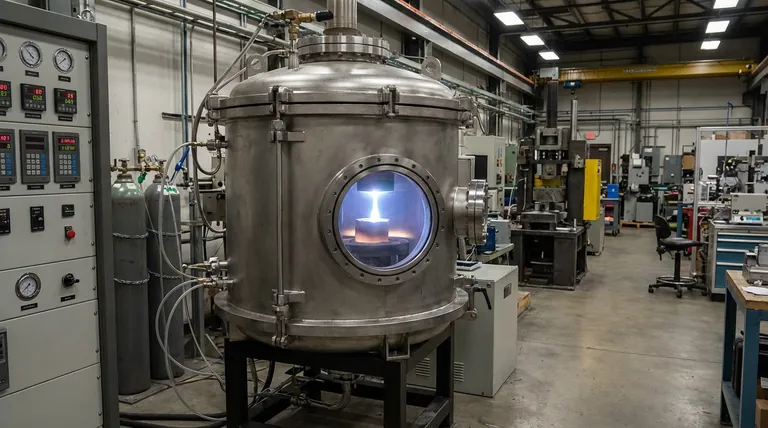
The primary role of a Vacuum Arc Furnace (VAF) is to create a controlled, high-temperature environment specifically designed to synthesize complex alloys without atmospheric contamination. It utilizes high-energy electric arcs to thoroughly melt and mix various metal components while simultaneously employing vacuum pumping or inert gas protection to preventing the oxidation of chemically active elements.
The Core Takeaway Synthesizing high-entropy alloys requires melting multiple distinct elements, often with vastly different melting points and reactivities, into a single cohesive material. The Vacuum Arc Furnace solves this by combining extreme thermal energy with a protective atmosphere, ensuring precise chemical composition and reducing impurities.
Creating the Essential Protective Environment
Preventing Element Oxidation
High-entropy alloys often contain "active" elements—such as titanium or aluminum—that react instantly with oxygen or nitrogen at high temperatures.
The VAF mitigates this by operating under a high-vacuum or argon protective atmosphere. This isolation effectively prevents these active elements from oxidizing, which is critical for maintaining the intended chemical balance of the alloy.
Ensuring Precise Composition
Because the atmosphere is tightly controlled, there is minimal loss of material due to volatilization or reaction with air.
This allows for precise control over the alloy's chemical composition, ensuring that the ratios of the various principal elements remain true to the original design.
Removal of Dissolved Gases
Beyond preventing new contamination, the vacuum environment actively improves the quality of the raw materials.
Exposure to low, near-vacuum pressure during the melting process aids in the reduction of dissolved gases within the metal. This results in a cleaner final ingot with fewer gas-induced defects.
High-Energy Melting and Mixing
Overcoming High Melting Points
High-entropy alloys frequently combine metals with high melting points (such as tungsten or tantalum) alongside metals with lower melting points.
The VAF utilizes high-temperature electric arcs to generate the intense heat necessary to completely melt these refractory components. This ensures that even the most stubborn elements are fully transitioned into the liquid phase.
Thorough Component Mixing
Achieving a homogeneous mixture is the defining challenge of high-entropy alloy preparation.
The electric arc provides the energy required to thoroughly mix the various metal components in their liquid state. This establishes the necessary conditions for the formation of complex phases, such as the dominant phases found in quasicrystal master alloys.
Understanding the Trade-offs
While the Vacuum Arc Furnace is a standard tool for initial melting, it is not without limitations compared to other processing methods.
Risk of Segregation
Unlike solid-state processing, arc melting involves solidification from a liquid, which can lead to element segregation.
References indicate that compositional non-uniformity and macroscopic casting defects can occur in arc melting. This is in contrast to methods like Vacuum Hot Pressing (VHP), which uses pressure and lower temperatures to prevent segregation.
Crucible Interactions
While VAF is cleaner than open-air melting, it typically involves a cooled hearth or crucible.
Advanced methods like Vacuum Magnetic Levitation offer a slight advantage here by suspending the metal, eliminating contact with crucible walls entirely and providing more intense electromagnetic stirring than a standard VAF.
Making the Right Choice for Your Goal
The VAF is a foundational tool, but your specific requirements dictate if it is the sole solution or part of a larger process.
- If your primary focus is Initial Synthesis: The VAF is the ideal choice for melting raw, active metal components together while protecting them from oxidation.
- If your primary focus is Homogeneity: You may need to remelt the ingot multiple times in the VAF or consider powder metallurgy techniques (like Vacuum Hot Pressing) to eliminate segregation.
- If your primary focus is Extreme Purity: Evaluate whether the standard VAF is sufficient or if a crucible-free method (like Magnetic Levitation) is required to prevent all contact contamination.
The Vacuum Arc Furnace remains the industry standard for the clean, high-energy melting required to create the foundational ingots of high-entropy alloys.
Summary Table:
| Feature | Benefit for High-Entropy Alloys |
|---|---|
| High-Vacuum/Argon Atmosphere | Prevents oxidation of active elements like Ti and Al |
| High-Energy Electric Arc | Melts refractory metals (W, Ta) with high melting points |
| Intense Liquid Mixing | Ensures thorough blending of complex multi-element phases |
| Degassing Capability | Removes dissolved gases for cleaner, defect-free ingots |
| Controlled Environment | Maintains precise chemical ratios of the principal elements |
Elevate Your Material Research with KINTEK
Precise alloy synthesis starts with superior thermal control. KINTEK provides industry-leading high-temperature laboratory solutions, including Vacuum, Muffle, Tube, Rotary, and CVD systems. Our advanced furnaces are designed to meet the rigorous demands of high-entropy alloy preparation, offering the purity and temperature stability required for groundbreaking R&D.
Backed by expert manufacturing and full customization options, we help you overcome challenges like element segregation and atmospheric contamination.
Ready to optimize your melting process?
Contact KINTEK Today for a Expert Consultation
References
- Fang Wang, Ke Liu. Predicting New Single/Multiphase-Structure High-Entropy Alloys Using a Pattern Recognition Network. DOI: 10.3390/coatings14060690
This article is also based on technical information from Kintek Furnace Knowledge Base .
Related Products
- Vacuum Hot Press Furnace Machine Heated Vacuum Press Tube Furnace
- Vacuum Sealed Continuous Working Rotary Tube Furnace Rotating Tube Furnace
- Vacuum Hot Press Furnace Machine Heated Vacuum Press
- Vacuum Heat Treat Furnace with Ceramic Fiber Liner
- Vacuum Heat Treat Sintering Furnace with Pressure for Vacuum Sintering
People Also Ask
- Why use Vacuum Hot Press (VHP) for ZnS Ceramics? Achieve Superior IR Transparency and Mechanical Strength
- What safety features are incorporated in vacuum hot press furnaces? Ensure Operator and Equipment Protection
- What are the benefits of the vacuum environment system in a vacuum hot press furnace? Unlock High-Density Sintering
- How does a vacuum hot press furnace promote densification in the manufacturing of graphite flake/copper composites? Achieve Superior Composite Materials
- What is the primary function of the vacuum environment in a vacuum hot press furnace during titanium alloy processing? Prevent Embrittlement for Superior Ductility



















