
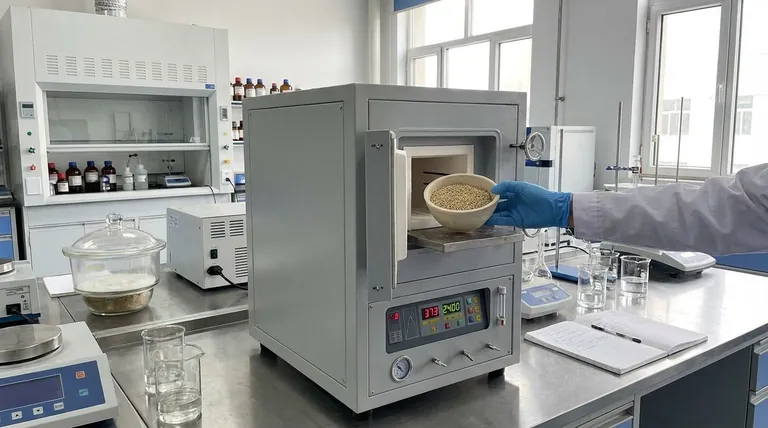
The laboratory drying oven serves as a critical structural safeguard during the post-treatment of Cu/ZIF-8 catalysts. Its primary function is to subject the washed catalyst to a controlled thermal environment at 373 K (100°C) for up to 24 hours. This specific protocol ensures the slow and complete removal of residual ethanol solvent trapped within the material's micropores.
Core Takeaway The drying process is not merely about removing moisture; it is a stabilization step that prevents the physical destruction of the catalyst. By slowly evacuating ethanol, the oven prevents "violent vaporization" during subsequent high-temperature phases, thereby preserving the catalyst's delicate microstructure from mechanical collapse.
The Mechanism of Structural Preservation
Controlled Solvent Evacuation
After synthesis and washing, Cu/ZIF-8 catalysts retain significant amounts of ethanol solvent within their microporous architecture.
The laboratory drying oven provides a steady thermal environment that drives this solvent out at a controlled rate. This "slow and thorough" removal is essential because ethanol trapped deep within the pores requires time to migrate to the surface and evaporate without disrupting the framework.
Preventing Mechanical Damage
The most critical role of this drying phase is protecting the material from mechanical damage.
If the catalyst acts as a vessel for residual solvent during subsequent high-temperature reduction or catalytic reactions, that solvent will expand rapidly. This rapid expansion causes violent vaporization, which exerts immense internal pressure on the pore walls, potentially fracturing the microstructure.
Ensuring Readiness for High-Temperature Processing
The drying step effectively bridges the gap between the wet chemical synthesis and the dry activation phases.
By removing volatile components beforehand, the oven ensures that the material is physically stable before it faces the harsh conditions of catalytic activation. This preserves the catalyst's specific surface area and pore connectivity, which are vital for its performance.
Operational Parameters
Temperature Regulation
The standard protocol for Cu/ZIF-8 involves maintaining a temperature of 373 K (100°C).
This temperature is sufficient to vaporize ethanol (boiling point ~78°C) and moisture effectively but is generally low enough to avoid thermal degradation of the ZIF-8 metal-organic framework itself.
Duration of Treatment
The process requires an extended duration, typically up to 24 hours.
This extended timeframe confirms that the drying is not just superficial. It allows for the complete desorption of solvents from the deepest parts of the porous network, ensuring no liquid pockets remain to cause structural failure later.
Understanding the Trade-offs
The Risk of Rapid Heating
It may be tempting to accelerate the process using higher temperatures to save time.
However, rapid heating can lead to thermal shock or the very violent vaporization the oven is meant to prevent. Fast evaporation can cause the pores to burst or the framework to collapse, significantly reducing the catalyst's active surface area.
Consequences of Incomplete Drying
Conversely, reducing the drying time or temperature can leave residual solvent inside the pores.
During subsequent calcination or reaction stages, this residue can react unpredictably or vaporize explosively. This not only damages the catalyst structure but can also alter the chemical environment, potentially affecting the dispersion of the active Copper (Cu) sites.
Making the Right Choice for Your Goal
When establishing your post-treatment protocol, consider the specific requirements of your final application:
- If your primary focus is Structural Integrity: Adhere strictly to the slow, 24-hour cycle at 373 K to ensure the micropores remain intact and free of mechanical fractures.
- If your primary focus is Process Efficiency: You may experiment with vacuum drying (as noted in general catalyst handling), which can lower the boiling point of solvents, potentially reducing the required time or temperature, though this must be validated against the specific stability of Cu/ZIF-8.
Ultimately, the laboratory drying oven acts as the gatekeeper of catalyst quality, ensuring that the intricate porosity engineered during synthesis is not lost to simple mechanical failure.
Summary Table:
| Parameter | Specification | Purpose |
|---|---|---|
| Temperature | 373 K (100°C) | Vaporizes ethanol/moisture without degrading framework |
| Duration | Up to 24 Hours | Ensures deep solvent removal from micropores |
| Primary Goal | Structural Safeguard | Prevents mechanical collapse from violent vaporization |
| Critical Risk | Rapid Heating | Avoids thermal shock and fractured pore walls |
Optimize Your Catalyst Research with Precision Thermal Solutions
Preserving the delicate microstructure of materials like Cu/ZIF-8 requires the steady, reliable performance of professional-grade equipment. KINTEK provides high-performance laboratory drying ovens and high-temperature furnace systems designed specifically for advanced material synthesis and post-treatment.
Why Choose KINTEK?
- Expert R&D & Manufacturing: Our systems offer the precise temperature uniformity needed to prevent thermal shock.
- Comprehensive Range: From Muffle and Tube furnaces to Vacuum and CVD systems, we cover every stage of your catalytic workflow.
- Tailored Solutions: All equipment is customizable to meet the unique requirements of your lab and specific material protocols.
Don't risk structural failure during critical drying phases. Contact KINTEK today to find the perfect thermal solution for your lab!
References
- Vijay K. Velisoju, Pedro Castaño. Copper nanoparticles encapsulated in zeolitic imidazolate framework-8 as a stable and selective CO2 hydrogenation catalyst. DOI: 10.1038/s41467-024-46388-4
This article is also based on technical information from Kintek Furnace Knowledge Base .
Related Products
- 1200℃ Muffle Oven Furnace for Laboratory
- 1800℃ High Temperature Muffle Oven Furnace for Laboratory
- High Temperature Muffle Oven Furnace for Laboratory Debinding and Pre Sintering
- 1400℃ Muffle Oven Furnace for Laboratory
- Laboratory Muffle Oven Furnace with Bottom Lifting
People Also Ask
- What is the primary function of a high-temperature laboratory muffle furnace in chemical synthesis? Achieve Precision.
- How does a high-temperature laboratory muffle furnace affect material properties? Transform Anodic Oxide Films Fast
- How is a laboratory muffle furnace used in 3D-printed PP-CF cross-linking? Achieve Thermal Stability at 150 °C
- What is the role of a laboratory high-temperature muffle furnace in iron analysis? Key to Precise Sample Mineralization
- How is a laboratory high-temperature muffle furnace used to evaluate porous Co-Al materials? Precision Thermal Analysis











