
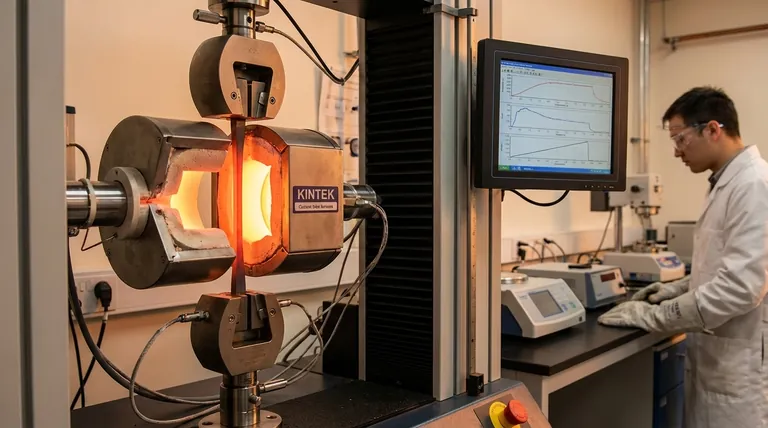
High-temperature tensile testing serves as the foundational diagnostic tool for characterizing how TC4 titanium alloy behaves under thermal stress. By simulating manufacturing conditions using an electronic universal testing machine equipped with a specific high-temperature furnace, engineers capture essential mechanical data—specifically yield strength, tensile strength, and elongation—across a spectrum of temperatures and strain rates.
This testing process transforms raw mechanical data into actionable manufacturing intelligence. It provides the physical evidence necessary to build accurate mathematical models, optimize forming temperatures like 750°C, and mitigate costly production defects such as cracking and springback.
Deriving Critical Mechanical Parameters
Measuring Strength and Ductility
The primary function of this test is to quantify how the material's strength degrades and ductility increases as heat is applied. The machine records the precise points of yield strength and tensile strength under thermal load.
Capturing Elongation Data
Beyond strength, the test measures elongation, which indicates how much the material can stretch before failure. This metric is vital for understanding the material's limits during complex shaping operations.
The Role of Strain Rates
The testing setup allows engineers to vary the speed at which the material is pulled, known as the strain rate. Capturing data at different rates helps predict how the alloy will react to faster or slower manufacturing speeds.
Optimizing Manufacturing Processes
Establishing Viscoplastic Models
The data collected provides the physical basis for creating viscoplastic constitutive models. These are complex mathematical frameworks that predict how the material flows and deforms over time under heat and stress.
Identifying the Optimal Thermal Window
Testing identifies the specific temperature ranges where the material offers the best balance of formability and strength. For TC4 titanium alloy, this data often points to 750°C as an optimal hot forming temperature.
Predicting and Preventing Defects
Mitigating Springback Risks
"Springback" occurs when a material tries to return to its original shape after forming, leading to dimensional inaccuracies. High-temperature testing data allows engineers to predict the magnitude of this effect and compensate for it in the tooling design.
Avoiding Material Failure
By understanding the elongation limits at specific temperatures, manufacturers can foresee risks of cracking. If the forming process exceeds the limits found during testing, the component will likely fail.
Understanding the Trade-offs
Simulation vs. Production Reality
While this testing provides a baseline, it is performed on standardized coupons, not complex geometries. Standardized testing cannot perfectly replicate the multi-axial stresses found in actual component manufacturing.
Equipment Sensitivity
The accuracy of the data is heavily dependent on the stability of the high-temperature furnace. Even minor fluctuations in temperature maintenance can skew the yield strength data, potentially leading to inaccurate constitutive models.
How to Apply This to Your Project
To maximize the utility of high-temperature tensile testing for TC4 titanium, align your analysis with your specific engineering objectives.
- If your primary focus is computational modeling: Prioritize data collection across a wide range of strain rates to ensure your viscoplastic constitutive models are robust and accurate.
- If your primary focus is process optimization: Concentrate on the elongation data to validate the specific hot forming temperature (e.g., 750°C) that minimizes the risk of cracking.
Accurate testing serves as the bridge between raw material potential and a flawless final component.
Summary Table:
| Parameter | Purpose in TC4 Testing | Impact on Manufacturing |
|---|---|---|
| Yield/Tensile Strength | Measures strength degradation under heat | Determines required forming force |
| Elongation | Quantifies material ductility/stretch | Predicts & prevents cracking during shaping |
| Strain Rate | Tests reaction to deformation speeds | Optimizes production cycle times |
| Viscoplastic Modeling | Creates mathematical flow frameworks | Enables accurate digital process simulation |
| Thermal Windows | Identifies optimal heat (e.g., 750°C) | Minimizes springback and dimensional errors |
Elevate Your Materials Testing with KINTEK Precision
Don't let inaccurate thermal data compromise your TC4 manufacturing. Backed by expert R&D and world-class manufacturing, KINTEK offers specialized Muffle, Tube, Rotary, Vacuum, and CVD systems, as well as customizable high-temp lab furnaces designed specifically for high-precision tensile testing.
Whether you are building complex viscoplastic models or optimizing hot forming temperatures to eliminate cracking, our equipment provides the thermal stability your research demands.
Ready to achieve flawless component forming? Contact our engineering team today to find the perfect customizable high-temperature solution for your lab's unique needs.
References
- Tao Zhang, Xiaochuan Liu. Deformation Control of TC4 Titanium Alloy in Thin-Walled Hyperbolic Structures During Hot Forming Processes. DOI: 10.3390/ma17246146
This article is also based on technical information from Kintek Furnace Knowledge Base .
Related Products
- 1400℃ High Temperature Laboratory Tube Furnace with Alumina Tube
- 1800℃ High Temperature Muffle Oven Furnace for Laboratory
- 1700℃ High Temperature Laboratory Tube Furnace with Alumina Tube
- 1700℃ High Temperature Muffle Oven Furnace for Laboratory
- 1700℃ Controlled Inert Nitrogen Atmosphere Furnace
People Also Ask
- How does zone-melting in tube furnaces synthesize bismuth micro-wires? Master Single-Crystal Thermoelectric Growth
- How are high-temp tube furnaces used to measure diffusion coefficients per Fick's law? Master Precision Annealing
- How are high-temperature laboratory tube furnaces applied in long-term vacuum homogenization heat treatments for intermetallic samples?
- How do high-temperature laboratory tube furnaces ensure environmental stability? Precision Thermal Reduction Tips
- How are high-temperature tube furnaces applied in testing ceramic-supported alloy membranes? Insights



















