
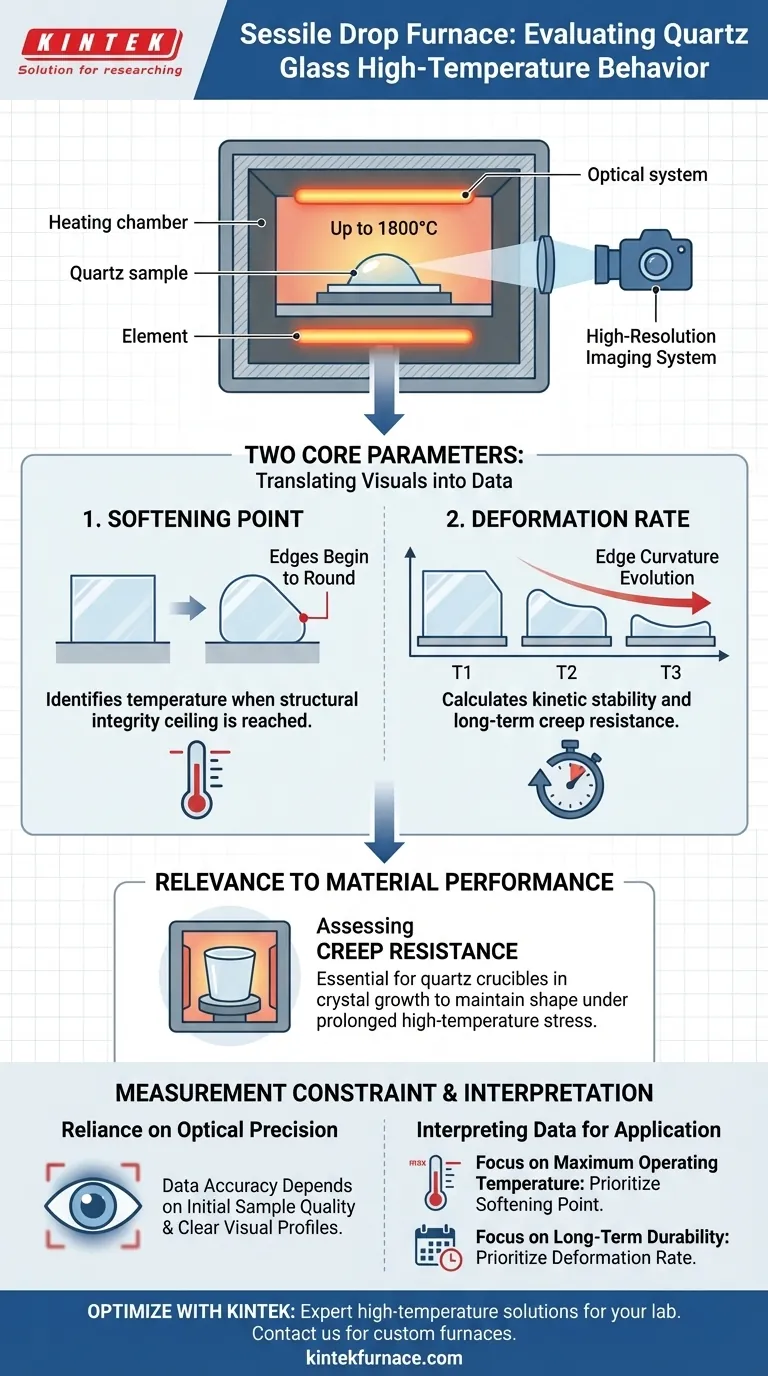
A sessile drop furnace primarily delivers critical dynamic thermomechanical data by utilizing high-resolution imaging to monitor quartz samples at temperatures up to 1800 degrees Celsius. Specifically, it provides two core parameters: the softening point, identified when sample edges begin to round, and the deformation rate, which is calculated based on the curvature of those edges.
By translating visual morphological changes into quantifiable data, the sessile drop furnace serves as the definitive tool for evaluating the high-temperature creep resistance of quartz crucibles used in crystal growth.
Analyzing Morphological Changes in Real-Time
To understand the behavior of quartz glass under extreme heat, this equipment moves beyond simple temperature readings. It focuses on physical, geometric changes captured through an optical system.
Determining the Softening Point
The softening point is a critical thermal threshold. The furnace identifies this specific temperature by detecting the exact moment the sample's edges lose their sharpness.
When the sample edges begin to round, the system records the temperature. This data point establishes the upper limit of the material's structural integrity before it transitions into a more viscous state.
Calculating the Deformation Rate
Beyond the initial softening, understanding how the material continues to move is vital. The system monitors the progression of the sample's shape over time.
This is determined specifically by analyzing edge curvature. By tracking how the curvature evolves, the system calculates a rate of deformation, providing a kinetic view of the material's stability.
The Relevance to Material Performance
The raw data provided by the furnace is not just about melting; it is about mechanical endurance under thermal stress.
Assessing Creep Resistance
The combination of the softening point and deformation rate is used to evaluate creep resistance.
Creep defines how a solid material moves slowly or deforms permanently under mechanical stresses. For quartz crucibles used in crystal growth, high creep resistance is essential to maintain shape and safety during prolonged high-temperature processes.
Understanding the Measurement Constraints
While this method provides precise morphological data, it is important to recognize the nature of the measurement.
Reliance on Optical Precision
Because the system relies on a high-resolution imaging system, the data is derived entirely from visual profiles.
This means the accuracy of the "softening point" and "deformation rate" depends heavily on the initial quality of the sample. If the sample edges are not clearly defined or if the line of sight is obstructed, the determination of edge rounding and curvature may be compromised.
Interpreting the Data for Application
When reviewing the output from a sessile drop furnace, align the parameters with your specific engineering requirements.
- If your primary focus is Maximum Operating Temperature: Prioritize the softening point to establish the absolute thermal ceiling before structural geometry is compromised.
- If your primary focus is Long-Term Durability: Prioritize the deformation rate, as this indicates how the quartz crucible will withstand prolonged stress (creep) during extended crystal growth cycles.
By isolating these two parameters, you can predict how quartz components will physically hold up in the most demanding thermal environments.
Summary Table:
| Core Parameter | Measurement Indicator | Engineering Significance |
|---|---|---|
| Softening Point | Rounding of sample edges | Defines maximum structural integrity temperature |
| Deformation Rate | Evolution of edge curvature | Indicates long-term creep resistance and durability |
| Visual Profile | High-resolution optical imaging | Translates morphology into quantifiable kinetic data |
Optimize Your Material Performance with KINTEK
Ensure the structural integrity of your quartz components under extreme conditions. Backed by expert R&D and manufacturing, KINTEK offers a comprehensive range of high-temperature solutions, including Muffle, Tube, Rotary, Vacuum, and CVD systems. Whether you need to determine precise softening points or evaluate long-term creep resistance, our equipment is fully customizable to meet your unique laboratory and industrial requirements.
Ready to elevate your thermal analysis? Contact KINTEK today to discuss your custom furnace needs with our engineering experts.
Visual Guide
References
- Bartłomiej Adam Gaweł, Marisa Di Sabatino. Influence of aluminium doping on high purity quartz glass properties. DOI: 10.1039/d4ra01716a
This article is also based on technical information from Kintek Furnace Knowledge Base .
Related Products
- Vacuum Heat Treat Sintering Furnace with Pressure for Vacuum Sintering
- Custom Made Versatile CVD Tube Furnace Chemical Vapor Deposition CVD Equipment Machine
- Controlled Inert Nitrogen Hydrogen Atmosphere Furnace
- Vacuum Dental Porcelain Sintering Furnace for Dental Laboratories
- Laboratory Muffle Oven Furnace with Bottom Lifting
People Also Ask
- What is one of the most important uses of vacuum heat treating furnaces in aerospace? Achieve Superior Strength in Aircraft Alloys
- What are the benefits of using vacuum heat treating furnaces for metal alloys? Achieve Superior Metal Properties and Performance
- How does vacuum heat treating affect the grain structure of metal alloys? Achieve Precise Microstructure Control
- What are the key components of a vacuum sintering furnace? Essential Parts for Precision Material Processing
- What is the purpose of setting a mid-temperature dwell stage? Eliminate Defects in Vacuum Sintering







