
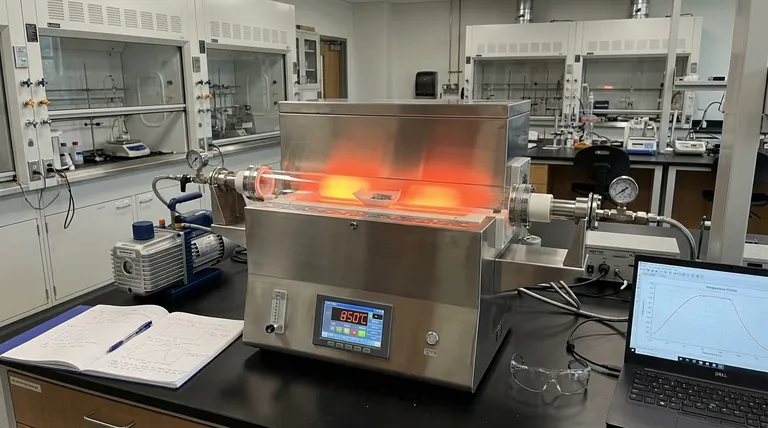
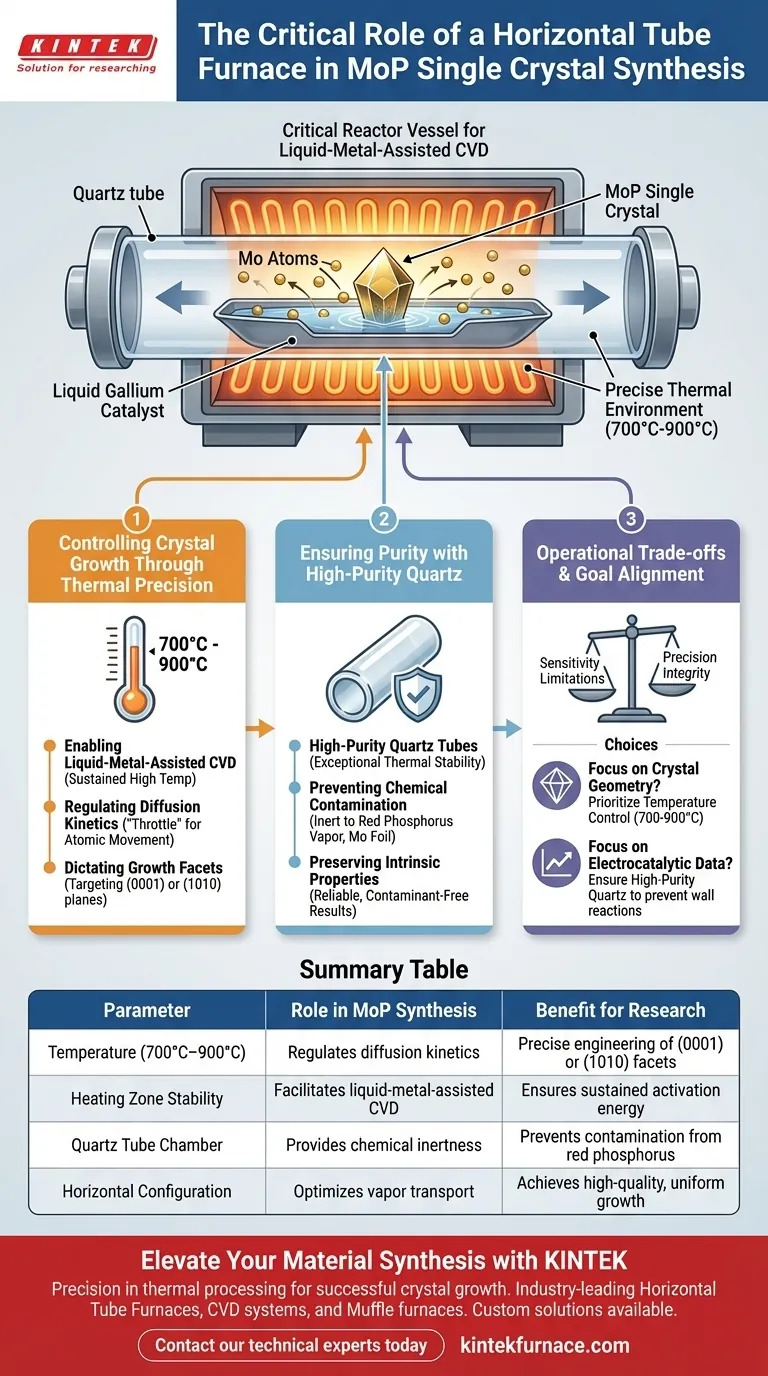
A Horizontal Tube Furnace acts as the critical reactor vessel for the synthesis of Molybdenum Phosphide (MoP) single crystals. It provides the precise thermal environment necessary to drive liquid-metal-assisted Chemical Vapor Deposition (CVD), ensuring controlled atomic diffusion and crystal formation.
The furnace is not merely a heat source; it is a tool for kinetic control. By maintaining precise temperatures between 700°C and 900°C, it regulates how molybdenum atoms diffuse across liquid gallium, allowing researchers to dictate the specific geometric growth facets of the final crystal.
Controlling Crystal Growth Through Thermal Precision
Enabling Liquid-Metal-Assisted CVD
The primary function of the furnace is to facilitate liquid-metal-assisted Chemical Vapor Deposition (CVD).
This synthesis method requires a sustained, high-temperature environment to activate the reaction. The furnace provides the stable heating zone necessary to maintain the metal catalyst in a liquid state.
Regulating Diffusion Kinetics
The furnace plays a decisive role in managing the diffusion kinetics of the reaction.
By operating within a specific window of 700°C to 900°C, the system controls the speed at which molybdenum atoms move across the liquid gallium surface. This thermal regulation is the "throttle" for atomic movement.
Dictating Growth Facets
Precise temperature control allows for the selective engineering of the crystal's physical structure.
By adjusting the heat within the specified range, researchers can preferentially grow specific crystal planes. This capability is essential for targeting the (0001) or (1010) facets in MoP crystals.
Ensuring Purity with the Right Chamber Material
The Importance of High-Purity Quartz
The horizontal configuration utilizes high-purity quartz tubes as the reaction chamber.
These tubes provide exceptional thermal stability, allowing the system to withstand the rigorous heating cycles required for synthesis without structural failure.
Preventing Chemical Contamination
The chemical inertness of the quartz tube is vital for protecting the reactants.
It prevents chemical reactions between the chamber walls and volatile components like red phosphorus vapor or the molybdenum foil itself. This isolation is critical for maintaining the integrity of the chemical precursors.
Preserving Intrinsic Properties
A contaminant-free environment ensures the reliability of the final material.
By eliminating impurities derived from the reactor walls, the resulting MoP single crystals accurately reflect their intrinsic electrocatalytic properties.
Understanding the Operational Trade-offs
Sensitivity to Temperature Fluctuations
While the furnace allows for precision, the process is highly sensitive to thermal instability.
Deviating even slightly from the 700°C to 900°C range can disrupt the diffusion kinetics. This can result in uncontrolled growth or the formation of incorrect crystal facets.
Material Limitations
The reliance on high-purity quartz imposes strict limits on the chemical environment.
While quartz is inert to phosphorus and molybdenum, it may degrade if exposed to incompatible agents or temperatures exceeding its softening point. The purity of the crystal is entirely dependent on the integrity of the tube.
Making the Right Choice for Your Goal
To maximize the quality of your Molybdenum Phosphide synthesis, you must align your furnace parameters with your specific research objectives.
- If your primary focus is Crystal Geometry: Prioritize the precision of your temperature controller to target the specific 700°C–900°C range required for (0001) or (1010) facet growth.
- If your primary focus is Electrocatalytic Data: Ensure you are using high-purity quartz tubes to prevent wall reactions and guarantee the measured properties are intrinsic to the material.
Ultimately, the Horizontal Tube Furnace converts raw thermal energy into a precise instrument for atomic engineering.
Summary Table:
| Parameter | Role in MoP Synthesis | Benefit for Research |
|---|---|---|
| Temperature (700°C–900°C) | Regulates diffusion kinetics across liquid gallium | Precise engineering of (0001) or (1010) facets |
| Heating Zone Stability | Facilitates liquid-metal-assisted CVD | Ensures sustained activation energy for reaction |
| Quartz Tube Chamber | Provides chemical inertness and thermal stability | Prevents contamination from red phosphorus vapor |
| Horizontal Configuration | Optimizes vapor transport of precursors | Achieves high-quality, uniform single crystal growth |
Elevate Your Material Synthesis with KINTEK
Precision in thermal processing is the difference between a successful crystal growth and a failed experiment. KINTEK provides industry-leading Horizontal Tube Furnaces, CVD systems, and Muffle furnaces designed to meet the rigorous demands of advanced material research.
Backed by expert R&D and manufacturing, our systems offer the thermal stability and atmospheric control necessary for targeting specific crystal facets and ensuring high-purity results. Whether you require standard lab high-temp furnaces or fully customizable solutions for unique MoP synthesis needs, KINTEK is your partner in laboratory excellence.
Ready to optimize your CVD process? Contact our technical experts today to discuss your specific requirements.
Visual Guide
References
- Seo Hyun Kim, Hyeuk Jin Han. Facet‐Controlled Growth of Molybdenum Phosphide Single Crystals for Efficient Hydrogen Peroxide Synthesis. DOI: 10.1002/adma.202500250
This article is also based on technical information from Kintek Furnace Knowledge Base .
Related Products
- Vertical Laboratory Quartz Tube Furnace Tubular Furnace
- Vacuum Sealed Continuous Working Rotary Tube Furnace Rotating Tube Furnace
- Split Multi Heating Zone Rotary Tube Furnace Rotating Tube Furnace
- High Pressure Laboratory Vacuum Tube Furnace
- Multi Zone Laboratory Quartz Tube Furnace Tubular Furnace
People Also Ask
- What are the key differences between single-zone and multi-zone vertical tube furnaces? Choose the Right Furnace for Your Lab
- What is a vertical tube furnace and how does it function? Optimize Material Processing with Precision
- How are metal support wires selected for sample suspension? Expert Guide to High-Temp Furnace Materials
- How are wafers loaded and unloaded in a vertical tube furnace? Achieve Precision and Purity in Wafer Processing
- How does a vertical single-temperature zone tube furnace facilitate the growth of high-quality PdSe2 single crystals?



















