
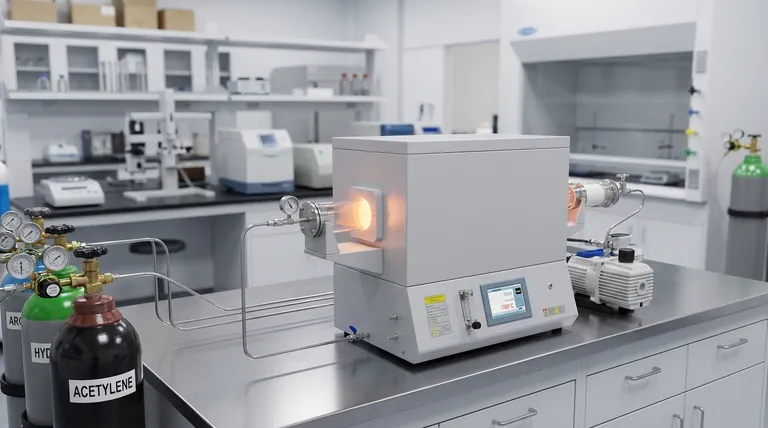
The high-vacuum or atmosphere-controlled tube furnace acts as the critical reaction chamber for synthesizing HEA@CNT nanocomposites. It establishes a precise thermal and chemical environment—typically 700 °C with a mixture of argon, hydrogen, and acetylene—that empowers High-Entropy Alloy (HEA) nanoparticles to function as catalysts. This enables the in-situ growth of Carbon Nanotubes (CNTs) directly on the alloy surface, rather than simply mixing the two materials together.
The furnace does not merely heat the materials; it orchestrates a catalytic Chemical Vapor Deposition (CVD) process. By strictly controlling the reducing atmosphere, it allows HEA particles to decompose acetylene, growing a unified 3D conductive network that significantly improves structural stability and electron transport efficiency.
The Mechanism of In-Situ Growth
Creating the Catalytic Environment
The primary function of the tube furnace in this specific application is to maintain a stable temperature of 700 °C. At this temperature, the furnace introduces a specific ratio of reducing gases, such as an Ar/H2 mixture combined with acetylene. This precise atmosphere is required to activate the chemical reaction without oxidizing the metal.
HEA Nanoparticles as Catalysts
Inside the furnace, the HEA nanoparticles play an active role rather than a passive one. Under the controlled conditions, these particles act as catalysts. They induce the decomposition of the acetylene gas, which provides the carbon source necessary for nanotube formation.
Forming a Unified 3D Network
Because the CNTs grow directly from the HEA particles (in-situ growth), the interface between the alloy and the carbon is exceptionally tight. This process results in a 3D conductive network. This structure is superior to physical mixtures because it ensures robust electron transport paths and enhanced mechanical stability for the nanocomposite.
Broader Capabilities of the Tube Furnace
Precise Atmosphere Control
Beyond HEA@CNT synthesis, the sealed nature of a tube furnace is essential for preventing contamination. As seen in similar processes like the carbonization of Co-MOF precursors or C–Ag@ZnO synthesis, the ability to maintain a protective nitrogen or argon atmosphere ensures uniform carbonization and prevents the oxidation of active metallic components.
Thermal Management and Phase Transformation
The furnace allows for programmed heating rates and dwelling times. In other material systems, such as low carbon steel or Fe2O3/N-C composites, this control facilitates atomic diffusion and phase transformation. While the specific goal for HEA@CNT is catalytic growth, the furnace’s ability to anchor active substances onto conductive frameworks is a universal benefit of this equipment.
Understanding the Trade-offs
Sensitivity to Gas Ratios
The success of the HEA@CNT synthesis relies heavily on the specific ratio of acetylene to the carrier gases. Deviations in gas flow rates can lead to excessive amorphous carbon (soot) formation or insufficient CNT growth, compromising the conductivity of the final material.
Thermal Uniformity Limitations
While tube furnaces offer excellent control, maintaining absolute thermal uniformity across a long tube can be challenging. Gradients in temperature may cause uneven CNT growth along the length of the sample boat, potentially leading to inconsistencies in the nanocomposite's performance properties.
Optimizing Synthesis for Your Goals
To achieve the best results with your HEA@CNT nanocomposites, you must tailor the furnace parameters to your specific performance targets.
- If your primary focus is Electrical Conductivity: Prioritize the precision of the acetylene and hydrogen ratio to maximize the catalytic efficiency of the HEA particles, ensuring a dense and interconnected CNT network.
- If your primary focus is Structural Stability: Focus on the dwelling time at 700 °C to ensure the complete decomposition of the carbon source and the secure anchoring of CNTs to the alloy surface.
Ultimately, the tube furnace is not just a heater, but a precision instrument that dictates the catalytic efficiency and interfacial quality of your final nanocomposite.
Summary Table:
| Feature | Function in HEA@CNT Synthesis | Critical Parameters |
|---|---|---|
| Atmosphere Control | Prevents oxidation; facilitates catalytic decomposition | Ar/H2 mixture + Acetylene (C2H2) |
| Temperature Management | Activates HEA nanoparticles as catalysts | Stable 700 °C isothermal zone |
| In-Situ Growth | Direct CNT growth on HEA for 3D conductive networks | Precise gas flow & dwelling time |
| Structural Result | Enhances electron transport and mechanical stability | High-purity interface vs. physical mixing |
Elevate Your Nanomaterial Research with KINTEK
Unlock the full potential of your HEA@CNT synthesis with high-performance CVD systems designed for precision. Backed by expert R&D and manufacturing, KINTEK offers a comprehensive range of Muffle, Tube, Rotary, Vacuum, and CVD systems, all customizable to meet your unique laboratory requirements.
Whether you need ultra-precise gas ratios for catalytic growth or superior thermal uniformity for phase transformation, our engineering team is ready to assist. Contact us today to find the perfect high-temp furnace for your lab!
Visual Guide

References
- Cheng Lu, Yue Ma. A lightweight, Li supplementary and lithiophilic interface enables anode-less lithium metal battery prototyping. DOI: 10.1039/d5eb00042d
This article is also based on technical information from Kintek Furnace Knowledge Base .
Related Products
- 1700℃ Controlled Inert Nitrogen Atmosphere Furnace
- 1700℃ High Temperature Laboratory Tube Furnace with Alumina Tube
- Multi Heating Zones CVD Tube Furnace Machine for Chemical Vapor Deposition Equipment
- Split Chamber CVD Tube Furnace with Vacuum Station CVD Machine
- Custom Made Versatile CVD Tube Furnace Chemical Vapor Deposition CVD Equipment Machine
People Also Ask
- How does oxygen partial pressure control affect ceramic sintering? Master Defect Chemistry
- How does real-time dilatometric analysis in a controlled-atmosphere furnace optimize PZT ceramic sintering?
- How do controlled-atmosphere furnaces support polymer pyrolysis? Master SiC & Si3N4 Ceramic Conversion
- Why is thorough binder burnout necessary before sintering advanced ceramics? Ensure Peak Density & Zero Defects
- Why is controlled-atmosphere heating required for functional ceramics and sensors? Master Defect Engineering



















