Knowledge What role does a high-temperature thermal simulation system play in the dissolution of precipitates in steel?
Author avatar

Tech Team · Kintek Furnace

Updated 3 hours ago

What role does a high-temperature thermal simulation system play in the dissolution of precipitates in steel?


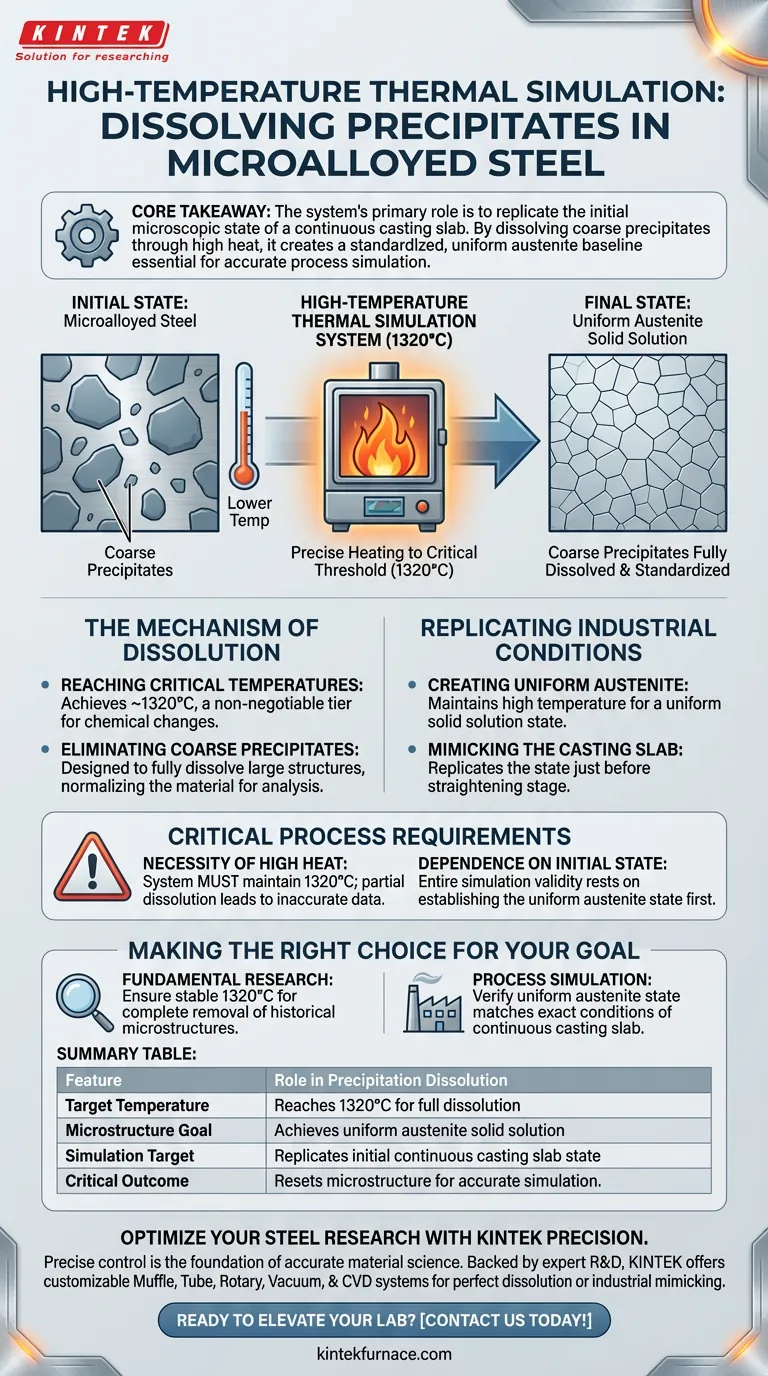
A high-temperature thermal simulation system serves as a precise microstructure reset mechanism. It utilizes efficient heating to raise microalloyed steel to approximately 1320°C, a critical threshold for fully dissolving coarse, pre-existing precipitates. By maintaining this temperature, the system forces the material into a uniform austenite solid solution state.

Core Takeaway The system's primary role is to replicate the initial microscopic state of a continuous casting slab. By dissolving coarse precipitates through high heat, it creates a standardized, uniform austenite baseline essential for accurate process simulation.
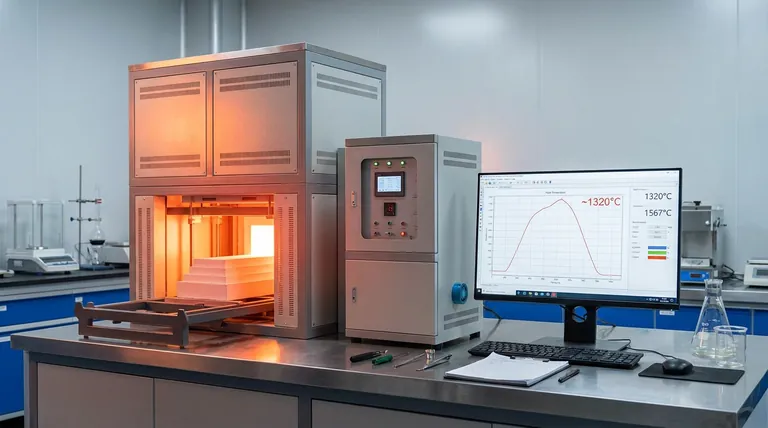
What role does a high-temperature thermal simulation system play in the dissolution of precipitates in steel?

The Mechanism of Dissolution

Reaching Critical Temperatures

To affect the microstructure of microalloyed steel, the system must achieve extreme thermal conditions.

It uses an efficient heating mechanism to reach temperatures as high as 1320°C. This specific thermal tier is non-negotiable for the intended chemical changes.

Eliminating Coarse Precipitates

At lower temperatures, steel often contains large, coarse precipitates.

The high-temperature simulation system is designed specifically to fully dissolve these existing structures. This dissolution is the first step in normalizing the material for analysis.

Replicating Industrial Conditions

Creating Uniform Austenite

Once the precipitates are dissolved, the steel enters a solid solution state.

The system maintains the high temperature to ensure this state becomes a uniform austenite solid solution. This uniformity is crucial for consistent experimental data.

Mimicking the Casting Slab

The ultimate goal of this thermal process is contextual accuracy.

It is vital for accurately replicating the initial state of a continuous casting slab. Specifically, it mimics the material's condition just before it reaches the straightening stage of production.

Critical Process Requirements

The Necessity of High Heat

The simulation is binary in its success regarding temperature.

If the system fails to reach or maintain 1320°C, the coarse precipitates will not fully dissolve. Partial dissolution leads to an inaccurate representation of the material's potential.

Dependence on Initial State

The validity of the entire simulation rests on this initial heating phase.

If the uniform austenite state is not established first, subsequent tests will not reflect the reality of the production line. The system must perfectly replicate that specific moment in the continuous casting process to be useful.

Making the Right Choice for Your Goal

When utilizing thermal simulation for microalloyed steel, understanding the intent behind the heating cycle is key to data integrity.

  • If your primary focus is Fundamental Research: Ensure your system can stably hold 1320°C to guarantee the complete removal of historical microstructures (coarse precipitates).
  • If your primary focus is Process Simulation: Verify that the "uniform austenite" state matches the exact conditions of your specific continuous casting slab prior to straightening.

Accurate simulation begins with a perfectly reset microstructure.

Summary Table:

Feature Role in Precipitation Dissolution
Target Temperature Reaches 1320°C to ensure full dissolution of coarse structures
Microstructure Goal Achieves a uniform austenite solid solution state
Simulation Target Replicates the initial state of a continuous casting slab
Critical Outcome Resets microstructure for accurate straightening stage simulation

Optimize Your Steel Research with KINTEK Precision

Precise microstructure control is the foundation of accurate material science. Backed by expert R&D and manufacturing, KINTEK offers advanced Muffle, Tube, Rotary, Vacuum, and CVD systems, along with specialized high-temperature lab furnaces—all fully customizable to meet your unique thermal simulation needs. Whether you are aiming for perfect precipitate dissolution or mimicking industrial casting slabs, our equipment provides the stability and uniformity your research demands.

Ready to elevate your lab's performance? Contact us today to discuss your custom furnace solution!

Visual Guide
What role does a high-temperature thermal simulation system play in the dissolution of precipitates in steel? Visual Guide

References

  1. Serkan Turan, Heinz Palkowski. Microscopic Investigation for Experimental Study on Transverse Cracking of Ti-Nb Containing Micro-Alloyed Steels. DOI: 10.3390/ma17040900

This article is also based on technical information from Kintek Furnace Knowledge Base .

Related Products

People Also Ask

Related Products

Laboratory Muffle Oven Furnace with Bottom Lifting

Laboratory Muffle Oven Furnace with Bottom Lifting

Boost lab efficiency with KT-BL Bottom Lifting Furnace: precise 1600℃ control, superior uniformity, and enhanced productivity for material science and R&D.

1700℃ High Temperature Muffle Oven Furnace for Laboratory

1700℃ High Temperature Muffle Oven Furnace for Laboratory

KT-17M Muffle Furnace: High-precision 1700°C lab furnace with PID control, energy efficiency, and customizable sizes for industrial & research applications.

1400℃ Muffle Oven Furnace for Laboratory

1400℃ Muffle Oven Furnace for Laboratory

KT-14M Muffle Furnace: Precision 1400°C heating with SiC elements, PID control, and energy-efficient design. Ideal for labs.

1800℃ High Temperature Muffle Oven Furnace for Laboratory

1800℃ High Temperature Muffle Oven Furnace for Laboratory

KINTEK Muffle Furnaces: Precision 1800°C heating for labs. Energy-efficient, customizable, with PID control. Ideal for sintering, annealing, and research.

1700℃ High Temperature Laboratory Tube Furnace with Quartz or Alumina Tube

1700℃ High Temperature Laboratory Tube Furnace with Quartz or Alumina Tube

KINTEK's Tube Furnace with Alumina Tube: Precision heating up to 1700°C for material synthesis, CVD, and sintering. Compact, customizable, and vacuum-ready. Explore now!

600T Vacuum Induction Hot Press Vacuum Heat Treat and Sintering Furnace

600T Vacuum Induction Hot Press Vacuum Heat Treat and Sintering Furnace

600T Vacuum Induction Hot Press Furnace for precise sintering. Advanced 600T pressure, 2200°C heating, vacuum/atmosphere control. Ideal for research & production.

1400℃ High Temperature Laboratory Tube Furnace with Quartz and Alumina Tube

1400℃ High Temperature Laboratory Tube Furnace with Quartz and Alumina Tube

KINTEK's Tube Furnace with Alumina Tube: Precision high-temperature processing up to 2000°C for labs. Ideal for material synthesis, CVD, and sintering. Customizable options available.

2200 ℃ Tungsten Vacuum Heat Treat and Sintering Furnace

2200 ℃ Tungsten Vacuum Heat Treat and Sintering Furnace

2200°C Tungsten Vacuum Furnace for high-temperature materials processing. Precise control, superior vacuum, customizable solutions. Ideal for research & industrial applications.

1200℃ Split Tube Furnace Laboratory Quartz Tube Furnace with Quartz Tube

1200℃ Split Tube Furnace Laboratory Quartz Tube Furnace with Quartz Tube

Discover KINTEK's 1200℃ Split Tube Furnace with quartz tube for precise high-temperature lab applications. Customizable, durable, and efficient. Get yours now!

1400℃ Controlled Inert Nitrogen Atmosphere Furnace

1400℃ Controlled Inert Nitrogen Atmosphere Furnace

KT-14A Controlled Atmosphere Furnace for labs & industry. 1400°C max temp, vacuum sealing, inert gas control. Customizable solutions available.

Mesh Belt Controlled Atmosphere Furnace Inert Nitrogen Atmosphere Furnace

Mesh Belt Controlled Atmosphere Furnace Inert Nitrogen Atmosphere Furnace

KINTEK Mesh Belt Furnace: High-performance controlled atmosphere furnace for sintering, hardening & heat treatment. Customizable, energy-efficient, precise temperature control. Get a quote now!

Small Vacuum Heat Treat and Tungsten Wire Sintering Furnace

Small Vacuum Heat Treat and Tungsten Wire Sintering Furnace

Compact vacuum tungsten wire sintering furnace for labs. Precise, mobile design with superior vacuum integrity. Ideal for advanced material research. Contact us!

Laboratory Quartz Tube Furnace RTP Heating Tubular Furnace

Laboratory Quartz Tube Furnace RTP Heating Tubular Furnace

KINTEK's RTP Rapid Heating Tube Furnace delivers precise temperature control, rapid heating up to 100°C/sec, and versatile atmosphere options for advanced lab applications.

1700℃ Controlled Inert Nitrogen Atmosphere Furnace

1700℃ Controlled Inert Nitrogen Atmosphere Furnace

KT-17A Controlled Atmosphere Furnace: Precise 1700°C heating with vacuum & gas control. Ideal for sintering, research & material processing. Explore now!

Vacuum Heat Treat Sintering Furnace Molybdenum Wire Vacuum Sintering Furnace

Vacuum Heat Treat Sintering Furnace Molybdenum Wire Vacuum Sintering Furnace

KINTEK's Vacuum Molybdenum Wire Sintering Furnace excels in high-temperature, high-vacuum processes for sintering, annealing, and material research. Achieve precise 1700°C heating with uniform results. Custom solutions available.

Multi Heating Zones CVD Tube Furnace Machine for Chemical Vapor Deposition Equipment

Multi Heating Zones CVD Tube Furnace Machine for Chemical Vapor Deposition Equipment

KINTEK's Multi-Zone CVD Tube Furnaces offer precision temperature control for advanced thin film deposition. Ideal for research and production, customizable for your lab needs.

Vacuum Heat Treat Sintering Furnace with Pressure for Vacuum Sintering

Vacuum Heat Treat Sintering Furnace with Pressure for Vacuum Sintering

KINTEK's Vacuum Pressure Sintering Furnace offers 2100℃ precision for ceramics, metals, and composites. Customizable, high-performance, and contamination-free. Get a quote now!

2200 ℃ Graphite Vacuum Heat Treat Furnace

2200 ℃ Graphite Vacuum Heat Treat Furnace

2200℃ Graphite Vacuum Furnace for high-temperature sintering. Precise PID control, 6*10⁻³Pa vacuum, durable graphite heating. Ideal for research & production.

Vacuum Heat Treat Furnace with Ceramic Fiber Liner

Vacuum Heat Treat Furnace with Ceramic Fiber Liner

KINTEK's Vacuum Furnace with Ceramic Fiber Lining offers precise high-temperature processing up to 1700°C, ensuring uniform heat distribution and energy efficiency. Ideal for labs and production.

Vertical Laboratory Quartz Tube Furnace Tubular Furnace

Vertical Laboratory Quartz Tube Furnace Tubular Furnace

Precision KINTEK Vertical Tube Furnace: 1800℃ heating, PID control, customizable for labs. Ideal for CVD, crystal growth & materials testing.


Leave Your Message











