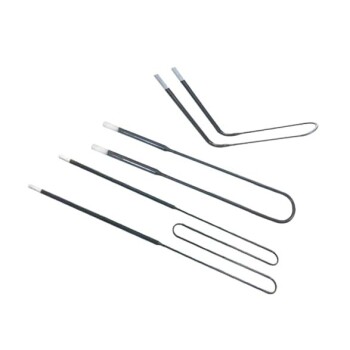
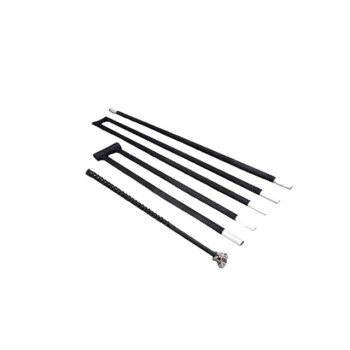
Molybdenum Disilicide (MoSi2) heating furnaces are the cornerstone of high-purity glass preparation, providing the extreme temperatures and stable oxidizing environments required for complete material synthesis. These furnaces allow glass batches to reach full melting—typically around 1400°C to 1620°C—ensuring that the resulting glass matrix achieves total chemical uniformity and remains free of internal bubbles or defects.
A high-temperature MoSi2 furnace serves as a high-precision thermal reactor that facilitates the transition of raw oxide materials into a homogeneous liquid state. By maintaining a clean, stable, and highly controlled thermal field, it ensures the purity and structural integrity of the final glass or glass-ceramic product.
Achieving Chemical Homogeneity and Purity
Complete Melting of Complex Raw Materials
MoSi2 furnaces provide the intense thermal energy required to break down oxide raw materials and facilitate a full melt. This is particularly critical for advanced systems like ZnO-MgO-Al2O3-SiO2, where high temperatures are necessary to ensure all components transition into a liquid phase.
Elimination of Gaseous Impurities
A primary role of the MoSi2 furnace is "refining," which is the process of removing gas bubbles from the molten glass. The stable heat allows bubbles to rise and escape, resulting in a homogeneous glass matrix that is essential for optical and structural applications.
Maintaining a Clean Thermal Environment
Because MoSi2 heating elements are highly resistant to oxidation, they do not contaminate the glass batch with debris or byproduct vapors. This "clean" heating is vital for producing precursor glasses used in high-performance gahnite glass-ceramics and other high-purity materials.
Technical Advantages of MoSi2 Heating Elements
Superior Oxidation Resistance
MoSi2 elements are designed to operate reliably in oxidizing atmospheres at temperatures exceeding 1773 K (1500°C). They form a protective quartz layer upon heating, which prevents further degradation and ensures long-term durability during extended firing cycles.
Precision Temperature Field Control
These furnaces create a uniform temperature field within the heating zone, which is necessary for complex phase equilibrium reactions. This precision ensures that the entire glass batch experiences the same thermal history, preventing localized crystallization or compositional shifts.
Stability During Extended Firing
In applications like slag system analysis or complex glass synthesis, furnaces must maintain a continuous heat source for 24 hours or more. MoSi2 elements provide the long-term stability required to complete these reactions without temperature fluctuations that could compromise the glass structure.
Understanding the Trade-offs
Brittleness and Handling Requirements
While MoSi2 elements offer exceptional thermal performance, they are inherently brittle, especially at room temperature. This requires careful handling during installation and maintenance to avoid mechanical failure, unlike more robust but lower-temperature metallic elements.
Atmosphere Limitations
Although they excel in oxidizing and inert environments, MoSi2 elements can be sensitive to certain reducing atmospheres or specific chemical vapors. If the glass batch releases aggressive volatiles, it may impact the longevity of the heating elements, requiring specialized furnace venting.
Comparison with Silicon Carbide (SiC)
While SiC elements offer high heating rates and are often used for melting molybdenum phosphate glass at 1200°C, MoSi2 is the preferred choice when the application requires higher peak temperatures (up to 1620°C) and superior oxidation resistance over longer durations.
How to Apply This to Your Project
Making the Right Choice for Your Goal
- If your primary focus is high-purity optical glass: Utilize a MoSi2 furnace to ensure a bubble-free, homogeneous matrix and prevent contamination from the heating source.
- If your primary focus is glass-ceramic synthesis: Leverage the high-temperature capability (1600°C+) of MoSi2 to ensure the complete melting of difficult oxide precursors like alumina and silica.
- If your primary focus is large-scale annealing or sealing: Use MoSi2 elements in the forehearths of your melting furnaces to maintain precise, uniform temperatures for reed switch sealing or ampoule production.
By selecting a MoSi2 heating furnace, you are investing in the thermal stability and precision necessary to transform raw materials into high-performance glass products.
Summary Table:
| Key Feature | Performance / Benefit | Ideal Application |
|---|---|---|
| Temperature Range | 1400°C to 1620°C | Melting complex oxide systems |
| Heating Element | MoSi2 (Molybdenum Disilicide) | Clean, oxidation-resistant environment |
| Thermal Stability | Long-term 24h+ continuous firing | Phase equilibrium & slag analysis |
| Refining Action | Effective bubble removal | Optical & high-purity glass |
| Field Control | Uniform thermal distribution | Preventing localized crystallization |
Elevate Your Glass Synthesis with KINTEK Precision
Achieving the perfect glass matrix requires uncompromising thermal control. KINTEK specializes in high-performance laboratory equipment, offering a comprehensive range of customizable high-temperature furnaces, including muffle, tube, rotary, vacuum, and CVD systems.
Whether you are refining high-purity optical glass or synthesizing advanced glass-ceramics, our MoSi2-powered solutions provide the stability and purity your research demands.
Ready to optimize your thermal process? Contact our technical experts today to find the perfect furnace tailored to your unique laboratory needs!
References
- Ruzha Harizanova, Christian Rüssel. IR-spectroscopy, thermophysical and mechanical properties of glasses in the system Na<sub>2</sub>O/BaO/TiO<sub>2</sub>/B<sub>2</sub>O<sub>3</sub>/SiO<sub>2</sub>/Al<sub>2</sub>O<sub>3</sub>. DOI: 10.59957/jctm.v58i3.74
This article is also based on technical information from Kintek Furnace Knowledge Base .
Related Products
- Molybdenum Disilicide MoSi2 Thermal Heating Elements for Electric Furnace
- Molybdenum Vacuum Heat Treat Furnace
- Vacuum Heat Treat Sintering Furnace Molybdenum Wire Vacuum Sintering Furnace
- Vacuum Heat Treat Sintering Furnace with Pressure for Vacuum Sintering
- Laboratory Quartz Tube Furnace RTP Heating Tubular Furnace
People Also Ask
- What are the typical application temperatures for molybdenum disilicide (MoSi2) heating elements? Master High-Temp Performance
- What is the primary use of molybdenum disilicide? Ideal for High-Temp Heating Elements
- What are the characteristics of molybdenum disilicide heating elements? Unlock High-Temp Performance
- What are the properties of molybdenum disilicide (MoSi2) that make it suitable for high-temperature applications? Discover Its High-Temp Resilience
- What are the applications of molybdenum disilicide heating elements? Achieve Extreme Heat Stability for Industrial Processes