
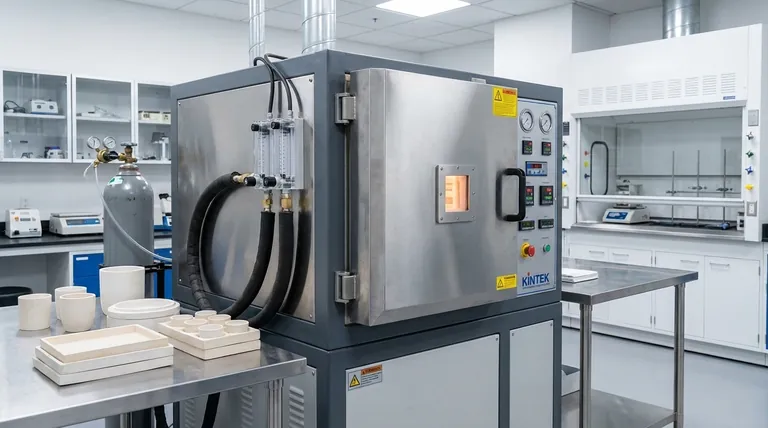
A high-temperature atmosphere sintering furnace serves as the critical environment that enables the densification of Boron Nitride-Silicon Nitride (BN-Si3N4) composites without the need for external mechanical force. By maintaining a precise thermal profile and a protective nitrogen atmosphere, the furnace allows the ceramic "green body" to solidify solely through internal physical-chemical reactions and atomic diffusion.
Core Takeaway This equipment replaces mechanical pressure with thermal precision and atmospheric control to drive the sintering process. It is the ideal solution for producing complex-shaped BN-Si3N4 components where geometric flexibility is prioritized over achieving the absolute theoretical density associated with hot-pressing methods.
The Mechanisms of Pressureless Sintering
Precise Thermal Regulation
The furnace provides the high-energy environment necessary to trigger diffusion. Because no external pressure is applied to force particles together, the process relies entirely on thermal energy to drive atomic movement.
The equipment must maintain stability at high temperatures to ensure uniform grain growth. This thermal consistency allows the material to shrink and densify naturally.
Protective Atmosphere Control
For BN-Si3N4 composites, the furnace typically utilizes a nitrogen atmosphere. This is a critical chemical requirement, not just a thermal one.
The nitrogen environment prevents the decomposition of silicon nitride and the oxidation of boron nitride at elevated temperatures. By excluding oxygen, the furnace preserves the surface activity of the particles, which is essential for successful bonding.
Reaction-Driven Densification
Inside the furnace, the densification occurs through solid-state diffusion and physical-chemical reactions.
Unlike hot-pressing, which mechanically rearranges particles, this process relies on the natural reduction of surface energy between particles. The furnace facilitates the formation of strong covalent bonds by maintaining the optimal conditions for these slow, reaction-based mechanisms to occur.
Strategic Advantages for Component Design
Capabilities for Complex Geometries
The most significant advantage of using an atmosphere sintering furnace is geometric freedom.
Because the process does not require a rigid die or uniaxial pressure, manufacturers can sinter parts with intricate shapes, internal channels, or irregular profiles. This is particularly suitable for components where near-net shaping is required to minimize post-processing.
Simplified Processing
Pressureless sintering generally allows for higher throughput compared to pressure-assisted methods.
Batch processing is easier to implement in an atmosphere furnace, as multiple parts can be sintered simultaneously without the constraints of individual pressure molds.
Understanding the Trade-offs
Density Limitations
It is important to acknowledge that pressureless sintering rarely achieves the theoretical maximum density possible with vacuum hot-pressing.
Without external mechanical force to crush agglomerates and close pores, some residual porosity typically remains. References indicate that while pressure assists in plastic flow to reach near 100% density, pressureless methods result in a slightly more porous structure.
Material Property Implications
The lower density resulting from this method may affect mechanical properties.
While the chemical composition remains sound, the presence of microscopic pores can slightly reduce the ultimate mechanical strength compared to hot-pressed counterparts. However, for many applications, the achieved density is sufficient, and the trade-off is accepted to gain geometric complexity.
Making the Right Choice for Your Goal
To determine if a high-temperature atmosphere sintering furnace is the right tool for your BN-Si3N4 application, evaluate your primary constraints.
- If your primary focus is Geometric Complexity: Choose the atmosphere sintering furnace, as it allows for the production of intricate shapes that cannot be formed in a pressure die.
- If your primary focus is Maximum Density: Consider pressure-assisted methods (like vacuum hot pressing), as pressureless sintering may not fully eliminate closed pores or achieve theoretical density.
The atmosphere sintering furnace is the enabler of design flexibility, trading a fraction of density for the ability to create complex, stress-free ceramic architectures.
Summary Table:
| Feature | Pressureless Atmosphere Sintering | Impact on BN-Si3N4 Composites |
|---|---|---|
| Driving Force | Thermal Energy & Atomic Diffusion | Enables densification without mechanical force |
| Atmosphere | Nitrogen Protective Gas | Prevents decomposition and oxidation |
| Shape Capability | Complex & Near-Net Shapes | High geometric freedom for intricate designs |
| Throughput | Batch Processing | Higher efficiency for mass production |
| Density Level | Moderate to High | Slight residual porosity compared to hot-pressing |
| Best Used For | Intricate Architectures | Components requiring geometric flexibility |
Elevate Your Ceramic Manufacturing with KINTEK
Unlock the full potential of your BN-Si3N4 composites with KINTEK’s high-performance atmosphere sintering furnaces. Backed by expert R&D and manufacturing, we provide advanced Muffle, Tube, Rotary, Vacuum, and CVD systems tailored for precision thermal processing. Whether you need to achieve complex geometries or optimize your nitrogen-protective environments, our customizable lab high-temp furnaces are designed to meet your unique materials science challenges.
Ready to optimize your sintering process? Contact KINTEK today for a custom consultation
Visual Guide

Related Products
- 1700℃ Controlled Inert Nitrogen Atmosphere Furnace
- 1400℃ Controlled Inert Nitrogen Atmosphere Furnace
- 2200 ℃ Tungsten Vacuum Heat Treat and Sintering Furnace
- High Temperature Muffle Oven Furnace for Laboratory Debinding and Pre Sintering
- Vacuum Heat Treat Sintering Furnace Molybdenum Wire Vacuum Sintering Furnace
People Also Ask
- How does real-time dilatometric analysis in a controlled-atmosphere furnace optimize PZT ceramic sintering?
- How do controlled-atmosphere furnaces support polymer pyrolysis? Master SiC & Si3N4 Ceramic Conversion
- Why is thorough binder burnout necessary before sintering advanced ceramics? Ensure Peak Density & Zero Defects
- How does oxygen partial pressure control affect ceramic sintering? Master Defect Chemistry
- Why is controlled-atmosphere heating required for functional ceramics and sensors? Master Defect Engineering



















