
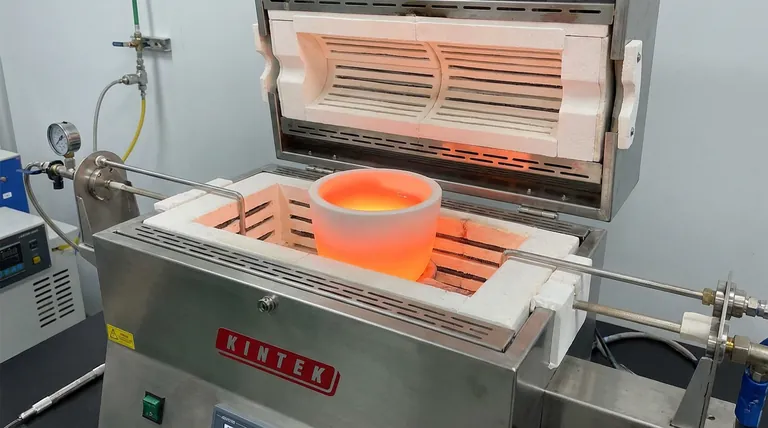
High-purity alumina and corundum crucibles serve as the essential thermal and chemical containment system for melting tellurite glass substrates. These crucibles provide a stable environment capable of withstanding temperatures exceeding 700°C while maintaining superior chemical inertness. This prevents unwanted reactions between the molten glass and the container, which is critical for preserving the final substrate's optical transparency and chemical purity.
The alumina crucible acts as a non-reactive vessel that shields tellurite glass from contamination during high-heat processing. By ensuring compositional stability, it allows the glass to maintain the high transparency required for specialized technical applications.
Thermal Resistance and Physical Support
Withstanding Extreme Processing Temperatures
Tellurite glass melting requires sustained temperatures that typically exceed 700°C. High-purity alumina is a refractory material specifically chosen for its ability to maintain structural integrity under these high-thermal loads without deforming.
Isolation from Furnace Environments
The crucible serves as a protective barrier between the glass melt and the furnace interior. This prevents the glass from coming into direct contact with heating elements or furnace linings, which could introduce impurities or cause mechanical failure during the sintering process.
Operational Durability for Extended Melting
The melting process for tellurite glass can last up to 40 minutes. Alumina crucibles are designed to survive these extended melting periods repeatedly, providing a reliable and predictable container for high-volume or precision glass production.
Chemical Stability and Substrate Purity
Preventing Chemical Leaching
Molten glass is inherently corrosive and tends to leach elements from its container. High-purity corundum's chemical inertness ensures that the crucible does not react with the tellurite melt, keeping the glass composition exactly as intended.
Preservation of Optical Transparency
For glass substrates, transparency is the primary metric of quality. By eliminating chemical reactions between the melt and the alumina, the crucible ensures that no metallic or ceramic contaminants cloud the glass or alter its refractive properties.
Maintaining Compositional Consistency
The crucible allows for precise control over the glass precursor's chemistry. This compositional stability is vital for the mass production of tellurite glass, where even minor deviations in purity can render the substrate useless for optical applications.
Understanding the Trade-offs
Time and Temperature Limitations
While alumina is highly stable, it is not infinite; its chemical resistance is optimized for specific windows, such as the 40-minute melting period mentioned for tellurite. Exceeding these time or temperature thresholds can eventually lead to minor material degradation or leaching.
Material Comparison and Performance
While alumina is excellent for tellurite glass (700°C+), it may face challenges compared to Platinum-Gold alloy crucibles used in higher-temperature silicate glass production (1500°C). Alumina is a cost-effective solution for tellurite, but it requires strict purity standards to avoid introducing its own trace elements into the melt.
Thermal Shock Sensitivity
Ceramic crucibles like corundum can be sensitive to rapid temperature changes. Users must manage heating and cooling rates carefully to prevent the crucible from cracking, which would result in the loss of the glass melt.
How to Apply This to Your Project
Depending on your specific manufacturing goals, the choice of crucible purity and processing time will dictate the quality of your tellurite substrate.
- If your primary focus is Maximum Optical Clarity: Use the highest purity corundum available (99.9%+) to ensure zero trace-element leaching during the 40-minute melt.
- If your primary focus is High-Volume Production: Ensure your furnace cycle is calibrated to stay within the 700°C–800°C range to extend the life of your alumina crucibles and maintain consistency across batches.
- If your primary focus is Material Research: Monitor the interaction between the tellurite precursor and the crucible wall to identify the exact point of chemical saturation for your specific glass formula.
Selecting the right high-purity alumina crucible is the foundational step in ensuring your tellurite glass meets the rigorous standards required for advanced optical and technical applications.
Summary Table:
| Feature | Benefit for Tellurite Glass |
|---|---|
| 99.9%+ Chemical Purity | Prevents leaching and maintains optical transparency |
| High Thermal Stability | Withstands temperatures >700°C without deformation |
| Chemical Inertness | Ensures compositional consistency of the glass melt |
| Refractory Durability | Supports extended 40-minute melting cycles safely |
Elevate Your Glass Manufacturing with KINTEK Precision
Don't let impurities compromise your optical clarity. At KINTEK, we specialize in providing high-performance laboratory solutions tailored to your technical needs. Backed by expert R&D and manufacturing, KINTEK offers a wide range of Muffle, Tube, Rotary, Vacuum, and CVD systems, along with specialized crucibles designed for high-temp processing. Whether you are producing tellurite glass or advanced ceramics, our customizable systems ensure the thermal precision and purity your project demands.
Ready to optimize your high-temperature processes? Contact our experts today to find the perfect furnace or crucible solution for your lab.
References
- Yongsheng Sun, Zhiguo Xia. Rapid synthesis of phosphor-glass composites in seconds based on particle self-stabilization. DOI: 10.1038/s41467-024-45293-0
This article is also based on technical information from Kintek Furnace Knowledge Base .
Related Products
- 1700℃ High Temperature Laboratory Tube Furnace with Alumina Tube
- 1400℃ High Temperature Laboratory Tube Furnace with Alumina Tube
- Vacuum Induction Melting Furnace
- Magnesium Extraction and Purification Condensing Tube Furnace
People Also Ask
- How does zone-melting in tube furnaces synthesize bismuth micro-wires? Master Single-Crystal Thermoelectric Growth
- How are high-temperature laboratory tube furnaces applied in long-term vacuum homogenization heat treatments for intermetallic samples?
- How do high-temperature laboratory tube furnaces ensure environmental stability? Precision Thermal Reduction Tips
- How are high-temp tube furnaces used to measure diffusion coefficients per Fick's law? Master Precision Annealing
- How are high-temperature tube furnaces applied in testing ceramic-supported alloy membranes? Insights



