
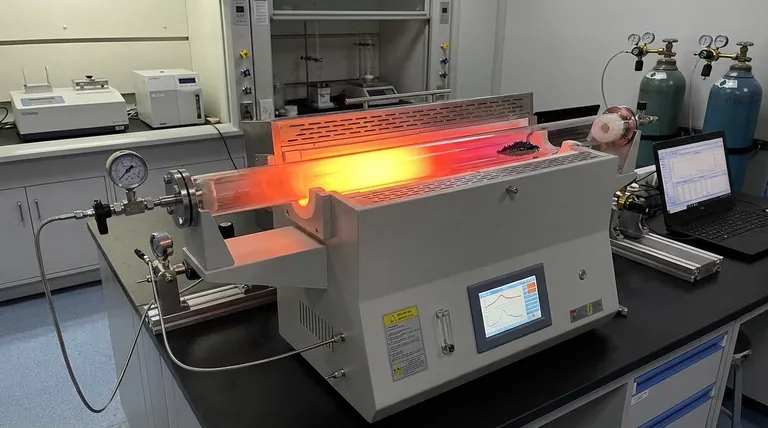
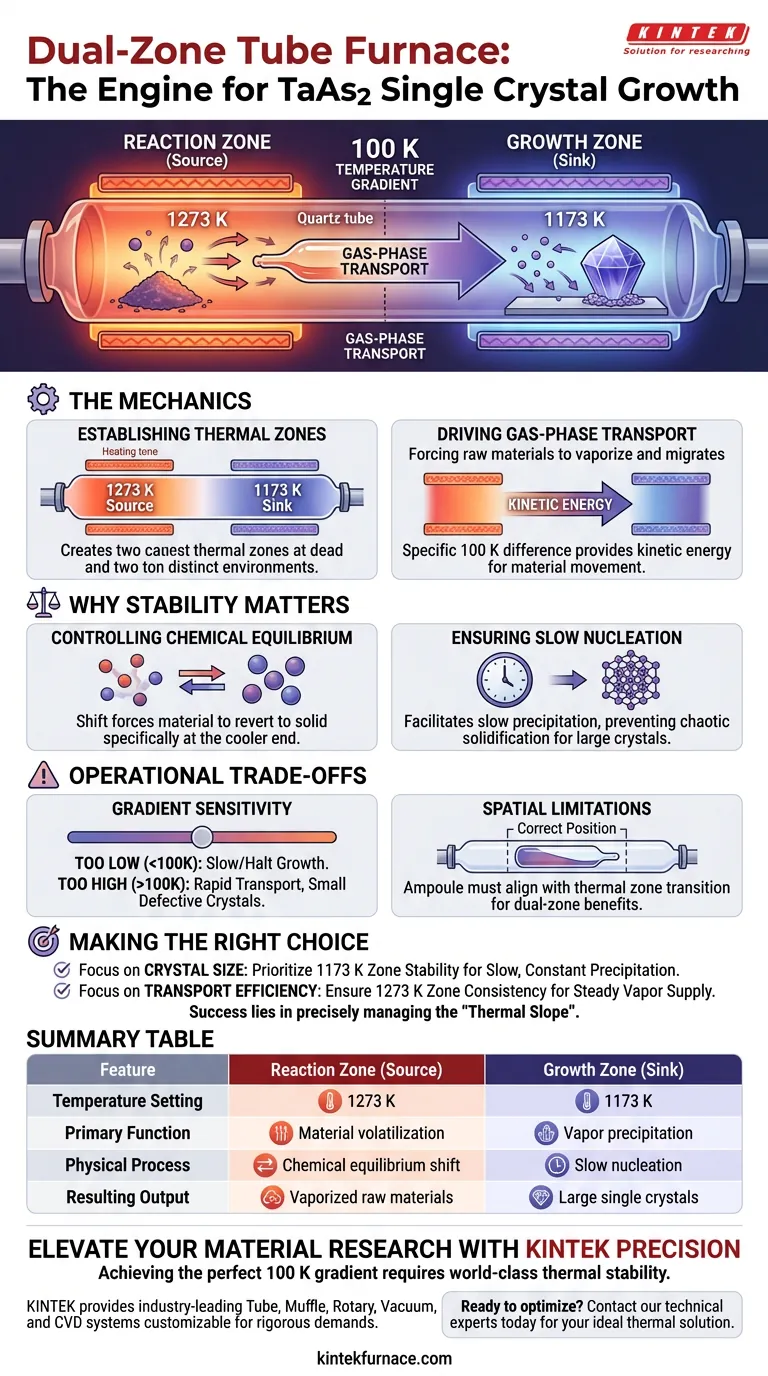
The primary role of a dual-zone tube furnace in the growth of TaAs2 single crystals is to establish and maintain a precise 100 K temperature gradient. By holding the reaction zone at 1273 K and the growth zone at 1173 K, the furnace acts as the engine for gas-phase transport, utilizing this thermal difference to drive the chemical equilibrium shifts required for crystallization.
The dual-zone furnace functions as a thermodynamic driver, creating a stable differential between a hot source and a cooler sink to force volatile components to migrate and precipitate slowly, yielding large, high-quality crystals.
The Mechanics of the Temperature Gradient
Establishing Thermal Zones
The furnace creates two distinct thermal environments within a single sealed system.
According to the specific requirements for TaAs2, the "source" or reaction zone is heated to 1273 K, while the "sink" or growth zone is maintained at 1173 K.
Driving Gas-Phase Transport
This specific 100 K temperature difference is not arbitrary; it provides the kinetic energy necessary to transport materials.
The gradient causes the raw materials to react and vaporize in the hotter zone, moving naturally toward the cooler region. Without this dual-zone control, the material would remain static, and transport would not occur.
Why Stability Matters for Crystal Quality
Controlling Chemical Equilibrium
The furnace allows for the manipulation of chemical equilibrium shifts.
As the vaporized components move from the 1273 K zone to the 1173 K zone, the change in temperature shifts the equilibrium, forcing the material to revert to a solid state. This is the fundamental mechanism that allows TaAs2 to deposit specifically at the cooler end of the tube.
Ensuring Slow Nucleation
High-quality single crystals require time to form an orderly lattice structure.
The dual-zone furnace facilitates slow precipitation, which prevents the chaotic, rapid solidification that leads to polycrystals or defects. This controlled rate of growth is directly responsible for the formation of large-sized single crystals.
Understanding the Operational Trade-offs
Gradient Sensitivity
While the dual-zone setup offers precision, it introduces sensitivity to thermal fluctuations.
If the temperature difference drops significantly below 100 K, the transport rate may slow to a halt, stopping growth entirely. Conversely, an excessive gradient could induce transport that is too rapid, resulting in smaller, defect-ridden crystals rather than large single crystals.
Spatial Limitations
The distinct zones imply a physical limit on the size of the reaction and growth areas.
The user must ensure the ampoule or tube is positioned exactly where the thermal zones transition. Misalignment of the tube within the furnace can result in the growth zone being too hot or too cold, negating the benefits of the dual-zone control.
Making the Right Choice for Your Goal
To maximize the effectiveness of a dual-zone tube furnace for TaAs2 growth, consider these focal points:
- If your primary focus is Crystal Size: Prioritize the stability of the 1173 K zone to ensure the precipitation rate remains slow and constant over the entire growth period.
- If your primary focus is Transport Efficiency: Ensure the reaction zone maintains a consistent 1273 K to fully volatilize the source material without fluctuating, which ensures a steady supply of vapor to the growth zone.
Success in growing TaAs2 lies not just in heating the material, but in precisely managing the "thermal slope" between the two zones.
Summary Table:
| Feature | Reaction Zone (Source) | Growth Zone (Sink) |
|---|---|---|
| Temperature Setting | 1273 K | 1173 K |
| Primary Function | Material volatilization | Vapor precipitation |
| Physical Process | Chemical equilibrium shift | Slow nucleation |
| Resulting Output | Vaporized raw materials | Large single crystals |
Elevate Your Material Research with KINTEK Precision
Achieving the perfect 100 K gradient for TaAs2 single crystal growth requires world-class thermal stability. KINTEK provides industry-leading Tube, Muffle, Rotary, Vacuum, and CVD systems designed to meet the rigorous demands of advanced material science.
Backed by expert R&D and precision manufacturing, our high-temperature furnaces are fully customizable to your unique research specifications, ensuring slow nucleation and defect-free crystallization every time.
Ready to optimize your crystal growth process? Contact our technical experts today to find the ideal thermal solution for your laboratory.
Visual Guide
References
- Haiyao Hu, Claudia Felser. Multipocket synergy towards high thermoelectric performance in topological semimetal TaAs2. DOI: 10.1038/s41467-024-55490-6
This article is also based on technical information from Kintek Furnace Knowledge Base .
Related Products
- Magnesium Extraction and Purification Condensing Tube Furnace
- Split Multi Heating Zone Rotary Tube Furnace Rotating Tube Furnace
- Multi Heating Zones CVD Tube Furnace Machine for Chemical Vapor Deposition Equipment
- Multi Zone Laboratory Quartz Tube Furnace Tubular Furnace
- Split Chamber CVD Tube Furnace with Vacuum Station CVD Machine
People Also Ask
- What are the advantages of using a condensing tube furnace for magnesium extraction? Achieve High Purity and Efficient Metal Recovery
- What makes tube furnaces indispensable in academic and industrial settings? Unlock Precision Heating for Advanced Materials
- What are the common applications of tube furnaces? Unlock Precision in Material Processing
- Why is a tube furnace considered essential for metal-zeolite catalysts? Unlock Porosity and Active Sites
- What is the critical role of a tube furnace in the preparation of beta-PbO powder? Optimize Lead-Acid Battery Recycling



















