
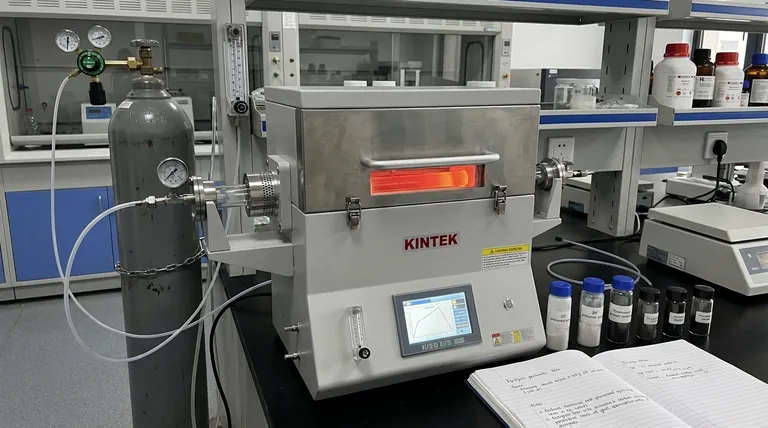
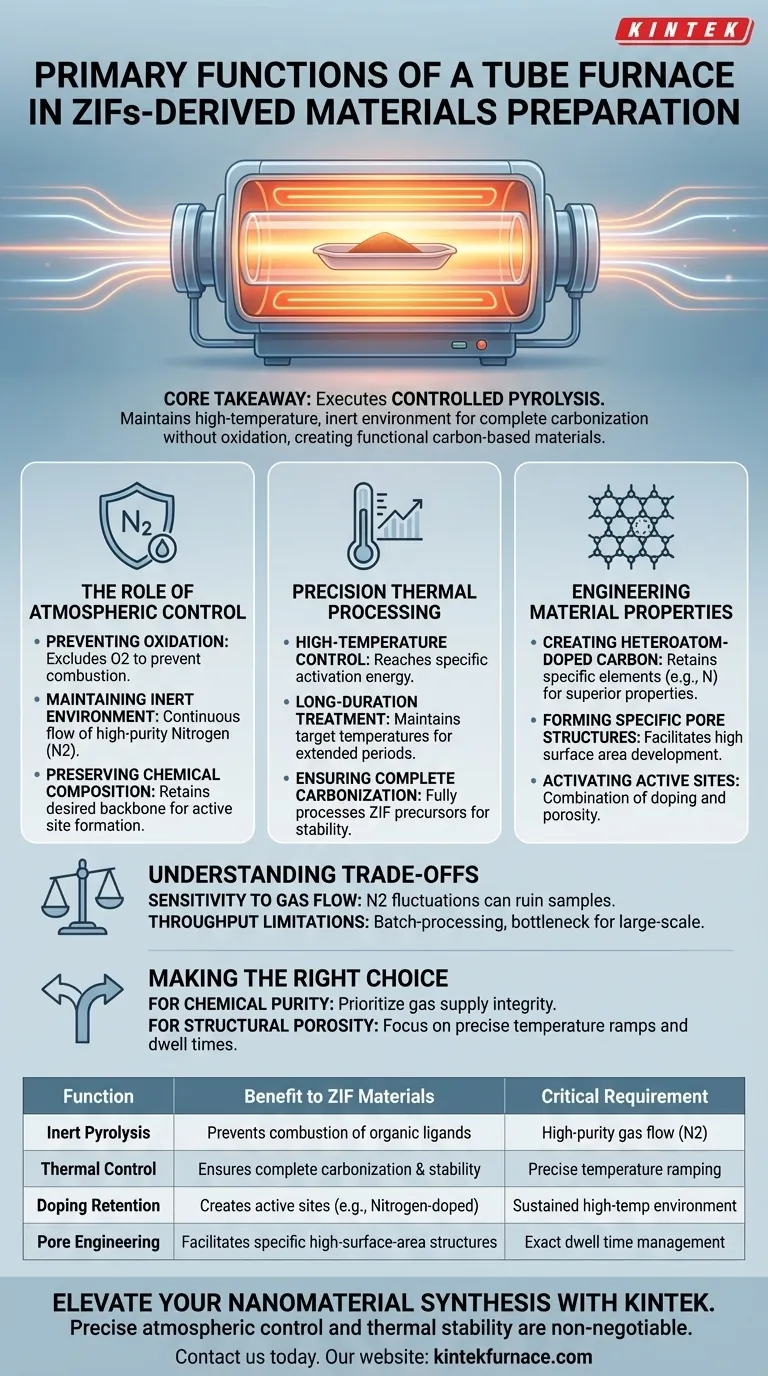
The primary function of a tube furnace in the preparation of Zeolitic Imidazolate Frameworks (ZIFs) derived materials is to execute controlled pyrolysis. By maintaining a high-temperature, inert environment, the furnace facilitates the conversion of ZIF precursors into functional carbon-based materials without burning or degrading them through oxidation.
Core Takeaway: The tube furnace serves as a precision reactor that enables the complete carbonization of ZIFs. Its ability to maintain a strict inert atmosphere for extended periods is the defining factor that allows for the creation of heteroatom-doped carbon materials with engineered pore structures.
The Role of Atmospheric Control
Preventing Material Oxidation
The most critical requirement during the heating of ZIFs is the exclusion of oxygen. If oxygen were present at high temperatures, the organic components of the ZIF would simply burn away (combust).
Maintaining an Inert Environment
The tube furnace utilizes a continuous flow of high-purity nitrogen gas. This creates a stable, inert atmosphere that protects the material.
Preserving Chemical Composition
By preventing oxidation, the furnace ensures that the resulting material retains the desired chemical backbone. This is essential for the subsequent formation of active sites within the material.
Precision Thermal Processing
High-Temperature Control
Pyrolysis requires exact thermal profiles. The tube furnace enables precise high-temperature control, ensuring the material reaches the specific activation energy required for structural transformation.
Long-Duration Treatment
Carbonization is rarely instantaneous. The equipment allows researchers to maintain target temperatures for long durations.
Ensuring Complete Carbonization
This sustained heat ensures that the ZIF precursors are fully processed. Incomplete heating would result in a hybrid material that lacks the stability and conductivity of a fully carbonized product.
Engineering Material Properties
Creating Heteroatom-Doped Carbon
The controlled environment allows for the retention of specific elements, such as nitrogen, within the carbon lattice. This results in heteroatom-doped carbon, which often exhibits superior catalytic or electronic properties.
Forming Specific Pore Structures
The heating process dictates the final morphology of the material. The tube furnace facilitates the development of specific pore structures, which are critical for applications requiring high surface area.
Activating Active Sites
The combination of doping and porosity creates active sites. These sites are the functional "engines" of the material, enabling it to perform in applications like catalysis or energy storage.
Understanding the Trade-offs
Sensitivity to Gas Flow Variations
While the tube furnace excels at atmosphere control, it is highly sensitive to the consistency of the gas flow. Fluctuations in nitrogen purity or flow rate can lead to partial oxidation, ruining the sample.
Throughput Limitations
Tube furnaces are generally batch-processing tools with limited internal volume. They are excellent for precision and research but act as a bottleneck for large-scale production compared to continuous industrial furnaces.
Making the Right Choice for Your Goal
When setting up your ZIF pyrolysis protocol, consider your primary objective:
- If your primary focus is Chemical Purity: Prioritize the integrity of your gas supply system to ensure the nitrogen atmosphere remains completely inert throughout the long-duration heat treatment.
- If your primary focus is Structural Porosity: Focus on the precision of your temperature ramp rates and dwell times, as these thermal controls dictate how the pores form during carbonization.
Ultimately, the tube furnace is the tool that bridges the gap between a raw chemical precursor and a functional, high-performance nanomaterial.
Summary Table:
| Function | Benefit to ZIF Materials | Critical Requirement |
|---|---|---|
| Inert Pyrolysis | Prevents combustion of organic ligands | High-purity gas flow (N2) |
| Thermal Control | Ensures complete carbonization & stability | Precise temperature ramping |
| Doping Retention | Creates active sites (e.g., Nitrogen-doped) | Sustained high-temp environment |
| Pore Engineering | Facilitates specific high-surface-area structures | Exact dwell time management |
Elevate Your Nanomaterial Synthesis with KINTEK
Precise atmospheric control and thermal stability are non-negotiable for high-performance ZIF-derived materials. KINTEK provides industry-leading solutions tailored for advanced research and manufacturing. Backed by expert R&D, we offer high-performance Tube, Muffle, Rotary, Vacuum, and CVD systems, all fully customizable to your specific gas flow and temperature profile requirements.
Ready to achieve superior material properties? Contact us today to discuss your unique needs with our technical specialists.
Visual Guide
References
- Yan Yang, Gai Zhang. Enhanced Electrocatalytic Activity for ORR Based on Synergistic Effect of Hierarchical Porosity and Co-Nx Sites in ZIF-Derived Heteroatom-Doped Carbon Materials. DOI: 10.3390/c11030070
This article is also based on technical information from Kintek Furnace Knowledge Base .
Related Products
- Vacuum Sealed Continuous Working Rotary Tube Furnace Rotating Tube Furnace
- 1400℃ High Temperature Laboratory Tube Furnace with Alumina Tube
- 1700℃ High Temperature Laboratory Tube Furnace with Alumina Tube
- Magnesium Extraction and Purification Condensing Tube Furnace
- High Pressure Laboratory Vacuum Tube Furnace
People Also Ask
- What is the purpose of rotary tube furnaces? Achieve Uniform Heat Treatment for Powders and Granules
- What are the key advantages of using a rotary tube furnace? Achieve Dynamic, Uniform Heating for Powders
- How does the amount of material processed vary between batch and continuous rotary tube furnaces? Scale Your Production Efficiently
- What are the advantages of rotary tube furnaces in fuel compatibility? Boost Efficiency and Cut Costs
- What is the temperature range of some rotary tube furnaces? Achieve Uniform Heating Up to 1200°C



















