
The vacuum arc furnace and titanium getter operate as a synchronized unit to overcome the dual challenges of refractory alloy synthesis: extreme melting points and high chemical reactivity.
The furnace generates the intense thermal energy required to liquefy refractory components, while the titanium getter actively purifies the internal atmosphere to prevent chemical contamination.
Core Takeaway Success in producing refractory medium-entropy alloys relies on a strict division of labor: the vacuum arc furnace provides the thermal power to melt high-temperature metals, while the titanium getter ensures chemical purity by scrubbing residual oxygen and nitrogen from the chamber.
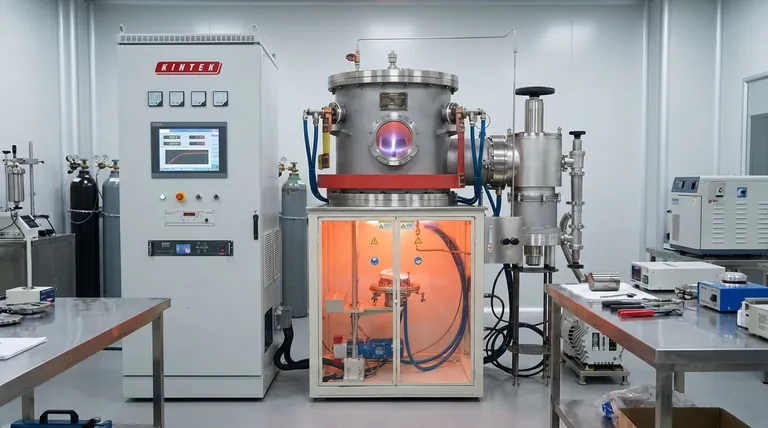
The Role of the Vacuum Arc Furnace
Generating Extreme Heat
Refractory elements are defined by their exceptionally high melting points. The primary function of the vacuum arc furnace is to provide a high-temperature environment intense enough to fully melt these robust components.
Without this specialized thermal capacity, achieving a homogeneous liquid state for alloying would be impossible.
Establishing the Base Atmosphere
Beyond heating, the furnace chamber facilitates the creation of a controlled environment. It allows for the evacuation of air and the introduction of a high-purity argon atmosphere.
This argon shielding is the first line of defense against environmental contamination, creating an inert blanket around the molten metal.
The Critical Function of the Titanium Getter
Scavenging Residual Impurities
Even within a high-purity argon atmosphere, trace amounts of oxygen and nitrogen often remain. The titanium getter acts as a chemical "sponge" to address this residual contamination.
Because titanium is highly reactive, it attracts and binds with these stray gases. By sacrificing itself to react with oxygen and nitrogen, the getter significantly reduces their levels within the furnace chamber.
Preventing Alloy Oxidation
The ultimate goal of the getter is to protect the refractory elements in the mix. Refractory metals are often highly sensitive to oxidation, which compromises their material properties.
By continuously purifying the atmosphere during the melting process, the getter ensures the chemical purity of the resulting alloy is maintained.
Understanding the Trade-offs
The Necessity of Redundancy
One might assume a vacuum and argon shield are sufficient, but relying solely on them is a common pitfall. The addition of the titanium getter acknowledges that "high purity" argon is rarely perfect.
Omitting the getter introduces a risk of interstitial contamination (oxygen or nitrogen atoms trapped in the metal lattice), which can embrittle the final alloy.
Complexity vs. Quality
Using a getter adds a step to the process and requires consumable materials (the titanium itself). However, this operational cost is a necessary trade-off to ensure the structural integrity of high-value refractory alloys.
Making the Right Choice for Your Goal
To ensure you are applying these tools effectively for your specific production needs:
- If your primary focus is Alloy Homogeneity: Prioritize the vacuum arc furnace's power settings to ensure the temperature exceeds the melting point of your most refractory element.
- If your primary focus is Mechanical Ductility: Ensure the titanium getter is fresh and properly positioned to minimize interstitial oxygen, which is a primary cause of brittleness.
By combining extreme thermal energy with active atmosphere purification, you ensure the final material is not just melted, but chemically pristine.
Summary Table:
| Component | Primary Function | Key Contribution to Alloys |
|---|---|---|
| Vacuum Arc Furnace | Generates Extreme Heat | Enables melting of refractory metals |
| Vacuum Arc Furnace | Establishes Base Vacuum | Creates inert argon atmosphere |
| Titanium Getter | Scavenges Residual Gases | Ensures chemical purity by removing O2/N2 |
| Titanium Getter | Prevents Oxidation | Preserves alloy ductility and material integrity |
Ready to perfect your refractory alloy production? KINTEK offers advanced Muffle, Tube, Rotary, Vacuum, CVD systems, and other lab high-temp furnaces, all customizable for your unique needs. Backed by expert R&D and manufacturing, we help you achieve superior thermal power and chemical purity for your high-value materials. Contact us today to discuss your specific requirements!
References
- High-Temperature Oxidation and Thermal Expansion Behavior of NbTi–X (X = 5Co, 10Cr, 10Ni, 10CoCrNi) Refractory Medium Entropy Alloys. DOI: 10.1007/s11661-025-07911-4
This article is also based on technical information from Kintek Furnace Knowledge Base .
Related Products
- Vacuum Hot Press Furnace Machine Heated Vacuum Press Tube Furnace
- Vacuum Sealed Continuous Working Rotary Tube Furnace Rotating Tube Furnace
- Vacuum Hot Press Furnace Machine Heated Vacuum Press
- Vacuum Heat Treat Furnace with Ceramic Fiber Liner
- Vacuum Heat Treat Sintering Furnace with Pressure for Vacuum Sintering
People Also Ask
- Why use Vacuum Hot Press (VHP) for ZnS Ceramics? Achieve Superior IR Transparency and Mechanical Strength
- What safety features are incorporated in vacuum hot press furnaces? Ensure Operator and Equipment Protection
- What are the benefits of the vacuum environment system in a vacuum hot press furnace? Unlock High-Density Sintering
- What is a vacuum hot press furnace? Unlock Superior Material Performance
- What is the primary function of the vacuum environment in a vacuum hot press furnace during titanium alloy processing? Prevent Embrittlement for Superior Ductility



















