
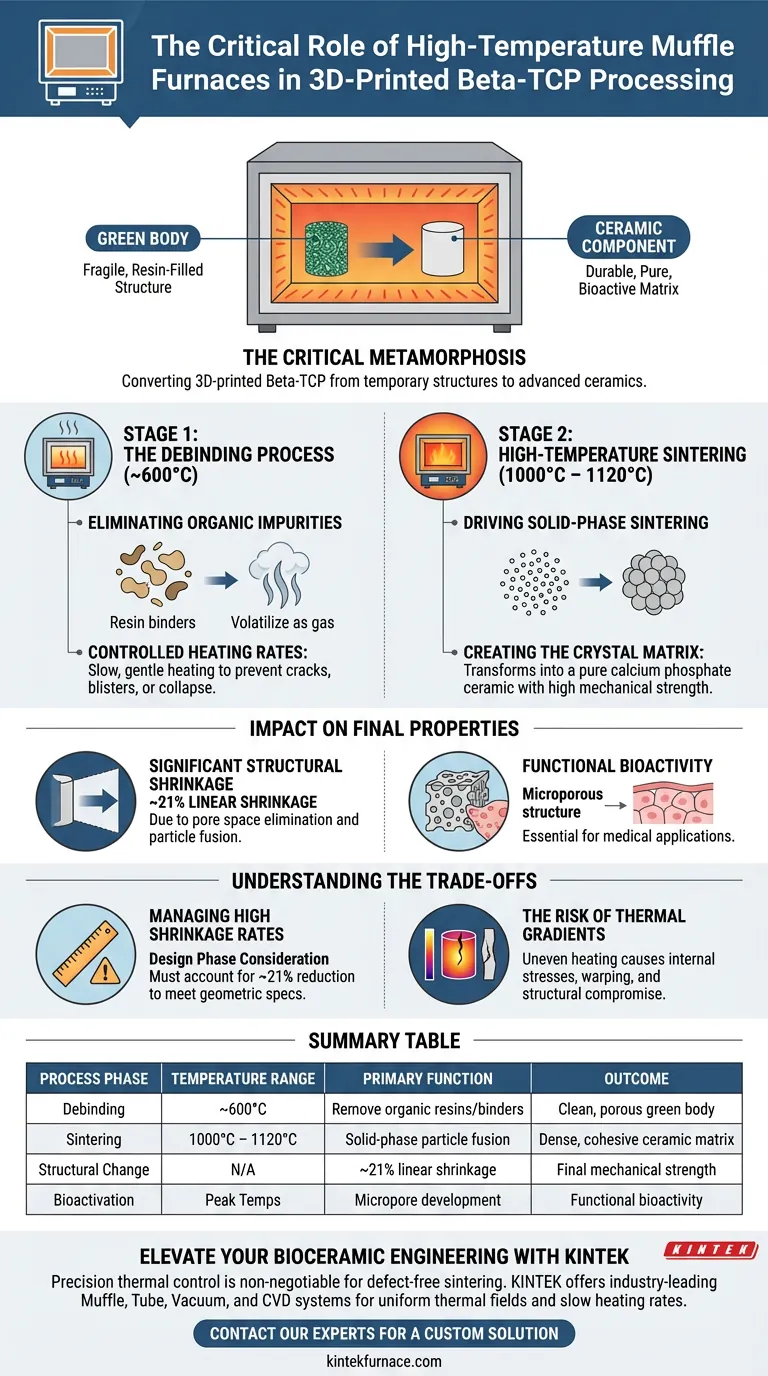
High-temperature muffle furnaces serve as the central processing unit for converting 3D-printed beta-tricalcium phosphate (beta-TCP) from fragile "green bodies" into durable ceramic components. These furnaces execute a precise, dual-stage thermal cycle that first removes organic binders and subsequently fuses the ceramic particles. Without this controlled thermal environment, the printed structures would lack the purity, strength, and biological activity required for medical applications.
The muffle furnace facilitates a critical metamorphosis: it transitions the material from a resin-filled temporary structure to a pure, solid-phase ceramic. This is achieved by sequentially eliminating impurities at 600°C and driving particle fusion at temperatures up to 1120°C, resulting in a significantly denser, biologically active matrix.
Stage 1: The Debinding Process
Eliminating Organic Impurities
The initial role of the muffle furnace is to perform debinding, typically managed at temperatures around 600°C.
During this phase, the furnace heat causes the resin binders and organic impurities used during printing to decompose and volatilize.
Controlled Heating Rates
Precision is vital during this stage; the furnace must apply slow heating rates to ensure organics are removed gently.
If the temperature rises too quickly, the rapid gas generation can cause cracks, blisters, or structural collapse within the delicate green body.
Stage 2: High-Temperature Sintering
Driving Solid-Phase Sintering
Once the binder is removed, the furnace temperature is ramped up to the 1000°C–1120°C range.
At this thermal plateau, the process shifts to solid-phase sintering, where the beta-TCP ceramic particles begin to bond and fuse at the atomic level.
Creating the Crystal Matrix
This high-heat environment transforms the loose powder structure into a cohesive pure calcium phosphate ceramic matrix.
The sustained heat ensures the final component achieves the necessary mechanical strength to function effectively as a bone substitute or scaffold.
Impact on Final Material Properties
Significant Structural Shrinkage
The densification process inside the furnace results in substantial physical changes, specifically a linear shrinkage of approximately 21%.
This reduction in volume is a direct result of the elimination of pore space as particles fuse together.
Functional Bioactivity
Beyond mere strength, the furnace treatment creates a precise microporous structure.
This structure is essential for biological activity, allowing the final ceramic component to interact successfully with biological tissues.
Understanding the Trade-offs
Managing High Shrinkage Rates
The 21% linear shrinkage driven by the muffle furnace is a significant dimensional change that must be accounted for during the initial design phase.
Failure to calculate this reduction accurately will result in final parts that do not meet geometric specifications.
The Risk of Thermal Gradients
While muffle furnaces are designed for uniformity, any inconsistency in the thermal field can be catastrophic.
Uneven heating during either debinding or sintering can lead to internal stresses, warping the component or compromising its structural integrity.
Making the Right Choice for Your Goal
To maximize the quality of your beta-TCP ceramics, you must tailor the furnace cycle to your specific objectives.
- If your primary focus is Purity and Bioactivity: Prioritize a slow, controlled ramp-up during the 600°C debinding phase to ensure absolute removal of all organic residues without damaging the pore structure.
- If your primary focus is Mechanical Strength: Ensure the furnace maintains the peak temperature (1000°C–1120°C) precisely to drive complete solid-phase sintering and optimal particle fusion.
Success lies in balancing the gentle removal of the temporary binder with the aggressive heat required to forge a permanent ceramic bond.
Summary Table:
| Process Phase | Temperature Range | Primary Function | Outcome |
|---|---|---|---|
| Debinding | ~600°C | Remove organic resins/binders | Clean, porous green body |
| Sintering | 1000°C – 1120°C | Solid-phase particle fusion | Dense, cohesive ceramic matrix |
| Structural Change | N/A | ~21% linear shrinkage | Final mechanical strength |
| Bioactivation | Peak Temps | Micropore development | Functional bioactivity |
Elevate Your Bioceramic Engineering with KINTEK
Precision thermal control is non-negotiable for the delicate metamorphosis of 3D-printed beta-TCP. KINTEK provides industry-leading high-temperature solutions—including Muffle, Tube, Vacuum, and CVD systems—engineered to deliver the uniform thermal fields and slow heating rates essential for defect-free sintering.
Backed by expert R&D and manufacturing, our systems are fully customizable to meet your unique lab requirements. Ensure the purity, strength, and bioactivity of your ceramic scaffolds today.
Contact Our Experts for a Custom Solution
Visual Guide
References
- Thomas Wojcik, Jean‐Christophe Hornez. Engineering Precise Interconnected Porosity in β-Tricalcium Phosphate (β-TCP) Matrices by Means of Top–Down Digital Light Processing. DOI: 10.3390/biomedicines12040736
This article is also based on technical information from Kintek Furnace Knowledge Base .
Related Products
- High Temperature Muffle Oven Furnace for Laboratory Debinding and Pre Sintering
- 1800℃ High Temperature Muffle Oven Furnace for Laboratory
- 1200℃ Muffle Oven Furnace for Laboratory
- 1700℃ High Temperature Muffle Oven Furnace for Laboratory
- 1400℃ Muffle Oven Furnace for Laboratory
People Also Ask
- What thermal phenomena occur during polymer binder burnout in ceramic green bodies? Lab Furnace Guide
- Why is controlled heat treatment in a muffle furnace necessary for calcined clay? Achieve Optimal Pozzolanic Activity
- What role does a high-temperature muffle furnace play in STFO synthesis? Achieve Pure Perovskite Results
- How does a high-temperature muffle furnace facilitate the formation of LaNbxAl1−xO3+δ perovskite structures? Key Roles
- What role does a high-temperature muffle furnace play in the multi-stage synthesis of Li0.5MnFe1.5O4? Key to Pure Spinel



















