
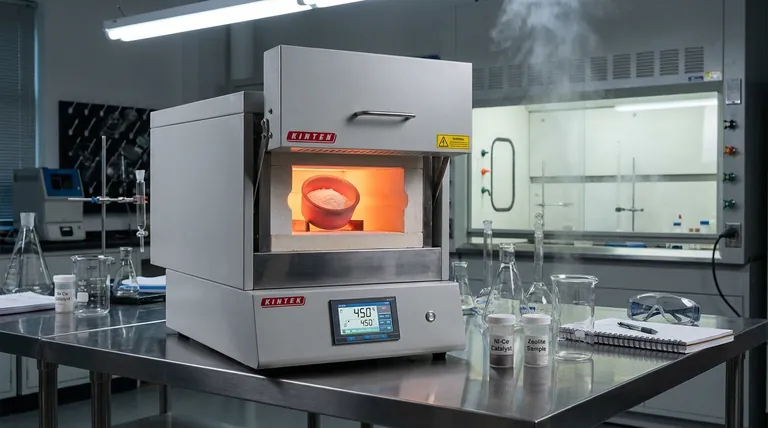
The primary function of a high-temperature box resistance furnace in this context is to perform calcination, a critical thermal treatment typically conducted at approximately 450°C. This process serves three simultaneous purposes: it purifies the material by eliminating volatile contaminants, it mechanically stabilizes the zeolite’s modified skeletal structure, and it firmly anchors active metal components to the support.
Core Takeaway The furnace acts as a thermal "locking" mechanism; it clears the pore channels of impurities (improving accessibility) while simultaneously rigidifying the fragile hierarchical framework and chemically bonding catalytic metals (like Ni-Co) to the zeolite surface.
The Purification and Activation Process
Elimination of Contaminants
The most immediate function of the furnace is the removal of unwanted byproducts from the synthesis phase.
During the calcination process, the furnace effectively burns off or evaporates organic impurities, moisture, and residual chloride ions.
Clearing the Pore Structure
By removing these substances, the furnace "activates" the zeolite.
The heat drives these blocking agents out of the internal channels, ensuring the pores are open and accessible for future chemical reactions.
Structural Stabilization and Functionalization
Stabilizing the Hierarchical Framework
Creating "hierarchical" zeolites often involves desilication (removing silicon to create larger pores).
Following this treatment, the zeolite structure can be fragile. The high-temperature environment helps to stabilize the skeletal structure, preventing the collapse of the newly formed mesopores and micropores.
Anchoring Active Components
For zeolites designed to act as catalysts, metal active components are often introduced.
The thermal energy provided by the furnace ensures that Ni-Co (Nickel-Cobalt) metal active components are securely anchored onto the zeolite support. This prevents the metals from leaching out during use and ensures consistent catalytic performance.
Understanding the Trade-offs
Temperature Sensitivity
Precise temperature control is vital. The primary reference suggests 450°C for this specific application, whereas other zeolite treatments (like ZSM-5) may require temperatures up to 550°C.
The Risk of Over-Sintering
If the temperature exceeds the material's tolerance, you risk structural collapse.
Excessive heat can cause the pores to close up or the crystalline structure to degrade, neutralizing the benefits of the hierarchical design.
The Risk of Under-Calcination
Conversely, if the temperature is too low, organic templates or chloride ions may remain trapped.
This results in blocked pores and reduced surface area, significantly hampering the material's adsorption capacity or catalytic activity.
Making the Right Choice for Your Goal
When configuring your furnace for zeolite synthesis, consider your specific end-goal:
- If your primary focus is Maximizing Pore Volume: Ensure the temperature is sufficient to fully decompose organic impurities and moisture, clearing the channels completely.
- If your primary focus is Catalytic Durability: Prioritize holding the specific temperature (e.g., 450°C) necessary to chemically bond and anchor the metal active sites (Ni-Co) to the support structure.
Success relies on balancing the heat required to clean the material against the thermal limits of the zeolite's skeletal framework.
Summary Table:
| Process Phase | Primary Function | Key Outcome |
|---|---|---|
| Purification | Removal of organic impurities, moisture, and chloride ions | Clean, open pore channels for maximum accessibility |
| Structural Stabilization | Thermal hardening of the skeletal framework | Prevention of mesopore collapse after desilication |
| Functionalization | Secure anchoring of Ni-Co metal active components | Enhanced catalytic durability and prevention of metal leaching |
| Temperature Control | Precise maintenance (e.g., 450°C to 550°C) | Balancing activation with the prevention of over-sintering |
Elevate Your Material Synthesis with KINTEK
Precise thermal control is the difference between a high-performance catalyst and a collapsed framework. Backed by expert R&D and manufacturing, KINTEK offers high-performance Muffle, Tube, Rotary, Vacuum, and CVD systems, all customizable to meet your unique lab requirements.
Whether you are synthesizing hierarchical zeolites or developing advanced catalytic supports, our high-temperature furnaces provide the uniformity and reliability you need to anchor active components and stabilize complex structures perfectly.
Ready to optimize your calcination process? Contact KINTEK today to find the ideal thermal solution for your research!
References
- Citronellal Acetylation Using Ni-Co Metal Impregnated Hierarchical Zeolite Catalysis and Its Potential as an Antibacterial, Antifungal and Antioxidants. DOI: 10.1051/e3sconf/202562202002
This article is also based on technical information from Kintek Furnace Knowledge Base .
Related Products
- 1700℃ High Temperature Laboratory Tube Furnace with Alumina Tube
- 1400℃ High Temperature Laboratory Tube Furnace with Alumina Tube
- 1700℃ Controlled Inert Nitrogen Atmosphere Furnace
- 1700℃ High Temperature Muffle Oven Furnace for Laboratory
- 1800℃ High Temperature Muffle Oven Furnace for Laboratory
People Also Ask
- How does zone-melting in tube furnaces synthesize bismuth micro-wires? Master Single-Crystal Thermoelectric Growth
- How do high-temperature laboratory tube furnaces ensure environmental stability? Precision Thermal Reduction Tips
- How are high-temp tube furnaces used to measure diffusion coefficients per Fick's law? Master Precision Annealing
- How are high-temperature laboratory tube furnaces applied in long-term vacuum homogenization heat treatments for intermetallic samples?
- How are high-temperature tube furnaces applied in testing ceramic-supported alloy membranes? Insights



















