
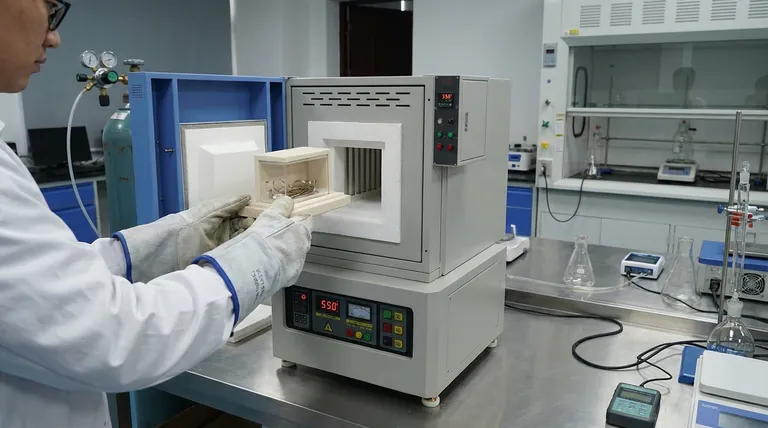
The muffle furnace functions as a precision thermal reactor designed to facilitate the phase transformation of Fe73.5-xB9Si14Cu1Nb2.5Mx alloys from an amorphous state to a nanocrystalline structure. To achieve this, the furnace must maintain a strictly controlled temperature range between 460°C and 640°C while isolating the material in an inert argon environment to prevent surface degradation.
Core Takeaway The success of nanocrystallization hinges on a dual-control strategy: precise thermal regulation triggers the precipitation of $\alpha$-Fe nanocrystals, while a localized argon atmosphere preserves the chemical integrity of the reactive transition metals within the thin ribbons.
The Functional Role: Inducing Phase Transformation
Targeting the Nanocrystalline Phase
The primary function of the muffle furnace in this context is to drive the crystallization kinetics of the alloy.
The furnace is used to heat the amorphous precursor to a specific window, typically 460°C to 640°C.
Precipitation of Alpha-Fe
Within this temperature range, the heat treatment induces the precipitation of $\alpha$-Fe nanocrystals from the amorphous matrix.
This structural evolution is the critical factor that defines the final magnetic performance of the material.
Environmental Requirements: The Inert Atmosphere
The Oxidation Challenge
Fe73.5-xB9Si14Cu1Nb2.5Mx alloys contain multiple transition metals (Iron, Copper, Niobium) and metalloids (Boron, Silicon) that are highly reactive at elevated temperatures.
Because these alloys are typically processed as thin ribbons, they possess a high surface-area-to-volume ratio, making them exceptionally vulnerable to rapid oxidation.
The Argon Solution
To neutralize the threat of oxidation, the furnace environment must be strictly inert.
The standard protocol involves placing the alloy inside a protective box filled with argon gas during the annealing process.
This argon barrier prevents oxygen from interacting with the ribbon surface, ensuring the chemical composition remains unaltered during the thermal cycle.
Operational Risks and Trade-offs
Thermal Deviation
Ideally, the temperature must be high enough to initiate crystallization but controlled enough to prevent excessive grain growth.
Operating outside the 460°C–640°C window risks failing to achieve the desired nanocrystalline structure or altering the magnetic properties unfavorably.
Atmospheric Compromise
Even a minor breach in the protective argon atmosphere can lead to immediate surface scaling or internal oxidation.
This degradation compromises the "soft" magnetic properties that the nanocrystallization process is intended to enhance.
Making the Right Choice for Your Goal
To maximize the efficacy of your heat treatment process, consider these specific priorities:
- If your primary focus is Microstructural Precision: Ensure your furnace calibration is strictly verified to hold steady temperatures between 460°C and 640°C to guarantee consistent $\alpha$-Fe precipitation.
- If your primary focus is Surface Integrity: Prioritize the seal quality of your protective box and the purity of your argon supply to eliminate any trace of oxygen during the annealing cycle.
Mastering the balance between thermal precision and atmospheric isolation is the key to unlocking the full magnetic potential of this alloy.
Summary Table:
| Requirement Category | Specification / Parameter | Functional Role |
|---|---|---|
| Temperature Range | 460°C to 640°C | Triggers $\alpha$-Fe nanocrystal precipitation |
| Atmosphere Type | Inert Argon Gas | Prevents oxidation of reactive transition metals |
| Material Form | Amorphous Thin Ribbons | High surface-to-volume ratio requires strict protection |
| Critical Output | Nanocrystalline Structure | Determines final soft magnetic performance |
Optimize Your Nanocrystallization with KINTEK Precision
Achieving the perfect magnetic profile for Fe73.5-xB9Si14Cu1Nb2.5Mx alloys demands uncompromising thermal accuracy and atmospheric control. Backed by expert R&D and manufacturing, KINTEK offers high-performance Muffle, Tube, Rotary, Vacuum, and CVD systems designed to meet these rigorous standards.
Whether you need precise thermal regulation for $\alpha$-Fe precipitation or advanced gas-tight chambers for inert argon processing, our lab high-temp furnaces are fully customizable to your unique research needs.
Ready to elevate your material science outcomes? Contact us today to find your custom solution!
References
- Subong An, Jae Won Jeong. Fine-Grained High-Permeability Fe73.5−xB9Si14Cu1Nb2.5Mx (M = Mo or W) Nanocrystalline Alloys with Co-Added Heterogeneous Transition Metal Elements. DOI: 10.3390/met14121424
This article is also based on technical information from Kintek Furnace Knowledge Base .
Related Products
- High Temperature Muffle Oven Furnace for Laboratory Debinding and Pre Sintering
- 1200℃ Muffle Oven Furnace for Laboratory
- 1400℃ Muffle Oven Furnace for Laboratory
- 1800℃ High Temperature Muffle Oven Furnace for Laboratory
- 1700℃ High Temperature Muffle Oven Furnace for Laboratory
People Also Ask
- What thermal phenomena occur during polymer binder burnout in ceramic green bodies? Lab Furnace Guide
- What role does a high-temperature muffle furnace play in STFO synthesis? Achieve Pure Perovskite Results
- Why is controlled heat treatment in a muffle furnace necessary for calcined clay? Achieve Optimal Pozzolanic Activity
- How does a high-temperature muffle furnace facilitate the formation of LaNbxAl1−xO3+δ perovskite structures? Key Roles
- What role does a high-temperature muffle furnace play in the formation of biochar catalysts? Master Catalyst Synthesis


















