
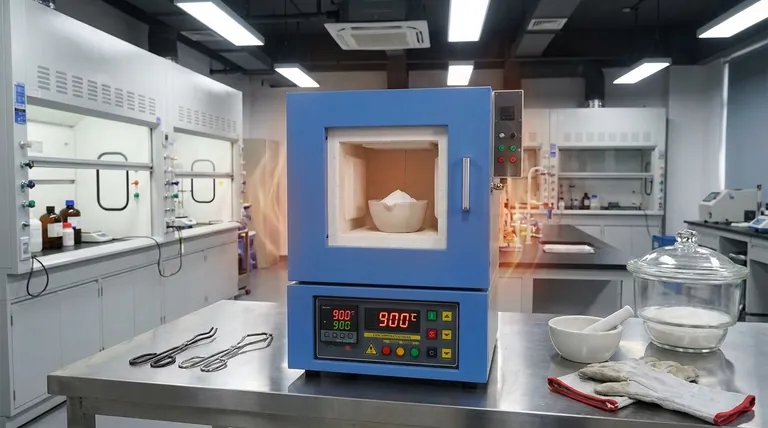
The high-temperature muffle furnace functions as a critical purification vessel during the processing of Gallium Nitride (GaN) precursor resins.
Operating at 900 degrees Celsius in an air atmosphere for approximately 6 hours, its specific purpose is to execute pyrolysis. This thermal treatment systematically eliminates organic components from the polymer matrix, leaving behind a chemically distinct intermediate product.
The furnace does not produce the final Gallium Nitride semiconductor directly; rather, it prepares the material for synthesis. Its role is to use high-temperature oxidation to convert a carbon-rich polymer into a high-purity white oxide powder, which is the essential prerequisite for the subsequent ammoniation reaction.
The Mechanism of Purification
Elimination of the Polymer Matrix
The raw GaN precursor resin is a complex polymer containing organic materials that are detrimental to the final semiconductor's purity.
The muffle furnace utilizes the air atmosphere to facilitate high-temperature oxidation. By maintaining heat at 900°C, the furnace effectively "burns off" these organic components, ensuring that carbon residues are removed from the material.
Creation of Oxide Intermediates
As the organic matrix is removed, the chemical structure of the material changes fundamentally.
The process converts the dark or complex polymer resin into white oxide intermediate products. This physical change—specifically the transition to a white powder—is a visual indicator that the organics have been successfully oxidized and the material is ready for the next stage of processing.
Operational Parameters
Temperature and Duration Consistency
The specific protocol requires a sustained temperature of 900 degrees Celsius for a duration of roughly 6 hours.
This time-temperature profile is calculated to ensure complete pyrolysis throughout the bulk of the material, preventing unoxidized cores within the powder particles.
The Function of the Air Atmosphere
Unlike processes that require inert vacuums or nitrogen environments, this step specifically demands an air environment.
The oxygen present in the air is the active agent that reacts with the carbon in the resin, allowing for the formation of the necessary oxide precursors.
Understanding the Process Context
The Distinction Between Oxide and Nitride
It is vital to understand that the output of this furnace process is not yet Gallium Nitride.
The muffle furnace produces an oxide powder. This powder acts as the "clean slate" precursor that will later be subjected to ammoniation to finally achieve the nitride structure.
Efficiency vs. Purity
The 6-hour duration at high heat represents a significant energy investment.
However, shortening this dwell time or lowering the temperature risks incomplete oxidation. Residual organics left in the matrix at this stage would compromise the purity and performance of the final GaN material.
Making the Right Choice for Your Goal
To maximize the effectiveness of the calcination process, consider the following based on your production objectives:
- If your primary focus is material purity: strictly adhere to the 900°C setpoint and 6-hour dwell time to ensure the total removal of carbon-heavy organic components.
- If your primary focus is process flow: ensure your downstream equipment is ready for ammoniation, as the white oxide powder produced is an intermediate step, not a final product.
The muffle furnace is the gatekeeper of quality, transforming a raw polymer into a pristine reactive powder.
Summary Table:
| Feature | Specification/Detail |
|---|---|
| Core Process | Pyrolysis & High-Temperature Oxidation |
| Operating Temperature | 900°C |
| Processing Duration | ~6 Hours |
| Atmosphere Required | Air (Oxygen-rich) |
| Intermediate Product | High-purity white oxide powder |
| Primary Goal | Elimination of organic polymer matrix and carbon residues |
Elevate Your Semiconductor Research with KINTEK
Precision is non-negotiable when producing high-purity oxide intermediates for Gallium Nitride synthesis. KINTEK’s high-performance muffle furnaces provide the thermal stability and atmospheric control required for rigorous 900°C calcination protocols.
Backed by expert R&D and world-class manufacturing, KINTEK offers a comprehensive range of Muffle, Tube, Rotary, Vacuum, and CVD systems. Whether you are refining GaN precursors or developing advanced ceramic materials, our lab high-temp furnaces are fully customizable to meet your unique research needs.
Ready to optimize your material purity? Contact our technical experts today to find the perfect furnace solution for your laboratory.
References
- Laser induced white emission and photocurrent of GaN nanoceramics. DOI: 10.1038/s41598-025-14109-6
This article is also based on technical information from Kintek Furnace Knowledge Base .
Related Products
- 1700℃ High Temperature Muffle Oven Furnace for Laboratory
- 1800℃ High Temperature Muffle Oven Furnace for Laboratory
- 1200℃ Muffle Oven Furnace for Laboratory
- 1400℃ Muffle Oven Furnace for Laboratory
- High Temperature Muffle Oven Furnace for Laboratory Debinding and Pre Sintering
People Also Ask
- What is the primary function of a high-temperature laboratory muffle furnace in chemical synthesis? Achieve Precision.
- How does a high-temperature laboratory muffle furnace affect material properties? Transform Anodic Oxide Films Fast
- What role does a muffle furnace play in BCZY712 electrolyte powder production? Achieve Perfect Phase Purity
- How does a muffle furnace impact Ni/MgAl2O4 catalysts? Optimize Stability and Catalytic Performance
- What is the role of a high-temperature muffle furnace in guava leaf carbonization? Master Precise Pyrolysis Control



















