
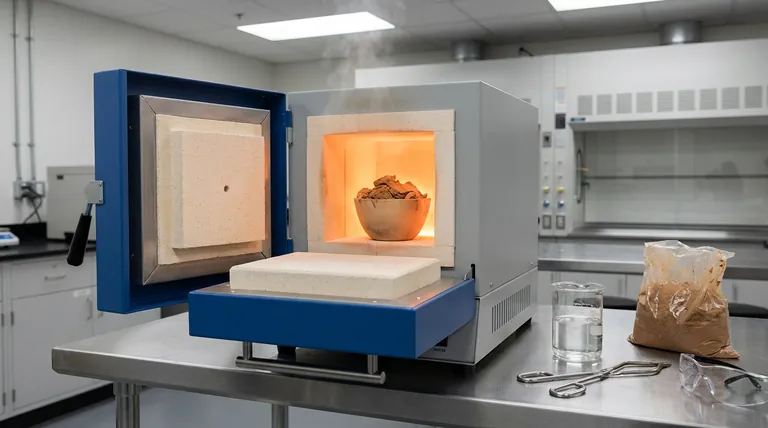
The primary role of a high-temperature muffle furnace in this context is thermal activation via calcination. Specifically, it subjects raw clay to controlled temperatures, typically around 750°C, to fundamentally alter its mineralogical structure. This thermal step is a mandatory precursor that renders the material chemically susceptible to acid treatment.
Core Takeaway The furnace is not merely drying the clay; it is driving a phase change from crystalline kaolinite to amorphous metakaolin. This structural disruption breaks down strong atomic bonds, ensuring the aluminosilicate framework can be effectively stripped during the subsequent acid leaching process.
The Mechanism of Thermal Activation
Triggering Dehydroxylation
The furnace provides the consistent heat energy required to trigger dehydroxylation.
This is a chemical process where hydroxyl groups (–OH) are expelled from the clay minerals as water vapor. This typically occurs as the temperature stabilizes near 750°C.
Phase Transformation to Metakaolin
Through dehydroxylation, the furnace converts the clay from its raw state (often kaolinite) into metakaolin.
This transformation is critical because metakaolin is an amorphous material. Unlike the rigid raw clay, this amorphous phase lacks a strictly ordered long-range structure.
Disruption of Crystalline Layers
The original raw clay possesses a stable, crystalline layered structure that is naturally resistant to chemical attack.
The thermal treatment effectively disrupts this layering. By breaking the crystalline order, the furnace exposes the aluminum and silicon atoms, making them accessible for chemical reaction.
Preparing for Acid Leaching
Increasing Chemical Accessibility
The ultimate goal of using the furnace is to facilitate the acid leaching stage that follows.
Because the aluminosilicate framework has been structurally weakened by heat, the acid can penetrate the material more easily. This allows for the efficient removal of metal ions and the creation of the desired porous structure.
Removal of Impurities
Beyond structural changes, the muffle furnace utilizes its oxidizing atmosphere to purify the material.
As noted in peat clay processing, temperatures around 600°C effectively burn off organic impurities. This ensures the final activated clay is chemically pure and highly reactive.
Understanding the Trade-offs
Temperature Precision is Critical
While high-temperature furnaces can reach sintering temperatures (800°C–1000°C) used for ceramics or superconductors, over-firing is a risk in acid activation.
If the temperature is too high, the material may begin to sinter or densify, reducing porosity. This essentially reverses the benefits of activation, making the clay resistant to acid rather than reactive to it.
Energy Consumption vs. Reactivity
Higher temperatures generally result in faster reaction rates, but they incur higher energy costs.
Operators must balance the duration of the burn with the temperature. A precise thermal profile is necessary to maximize the amorphous content without wasting energy or degrading the material through sintering.
Making the Right Choice for Your Goal
To maximize the effectiveness of your acid-activated clay, tailor your thermal treatment strategy to your specific objectives:
- If your primary focus is Maximum Reactivity: Prioritize a temperature near 750°C to ensure complete conversion to metakaolin without inducing sintering.
- If your primary focus is Material Purity: Ensure the furnace maintains an oxidizing atmosphere with sufficient dwell time (e.g., at 600°C) to fully eliminate organic contaminants.
Success depends on using the furnace not just to heat the clay, but to precisely engineer its crystalline disorder.
Summary Table:
| Process Stage | Action of Muffle Furnace | Structural/Chemical Result |
|---|---|---|
| Dehydroxylation | Controlled heating to ~750°C | Expulsion of hydroxyl groups as water vapor |
| Phase Change | Conversion of crystalline Kaolinite | Creation of amorphous, reactive Metakaolin |
| Purification | Oxidizing atmosphere at ~600°C | Removal of organic impurities and contaminants |
| Activation | Disruption of crystalline layers | Increased chemical accessibility for acid leaching |
| Control | Precise temperature regulation | Prevention of over-sintering and porosity loss |
Precision is paramount when engineering crystalline disorder for clay activation. Backed by expert R&D and manufacturing, KINTEK offers high-performance Muffle, Tube, Rotary, Vacuum, and CVD systems designed to provide the thermal stability your research demands. Whether you need standard lab high-temp furnaces or a fully customizable solution for your unique materials science needs, we deliver the tools to maximize your material reactivity. Contact KINTEK today to discuss your specific application and optimize your thermal activation process!
References
- Laurance Erasto, Esther Lugwisha. Absorbance enhancement of a treated Tanzanian kaolin for removal of synthetic dyes from contaminated water. DOI: 10.4314/ijbcs.v17i6.34
This article is also based on technical information from Kintek Furnace Knowledge Base .
Related Products
- 1700℃ High Temperature Muffle Oven Furnace for Laboratory
- 1800℃ High Temperature Muffle Oven Furnace for Laboratory
- 1200℃ Muffle Oven Furnace for Laboratory
- 1400℃ Muffle Oven Furnace for Laboratory
- High Temperature Muffle Oven Furnace for Laboratory Debinding and Pre Sintering
People Also Ask
- What is the primary function of a high-temperature laboratory muffle furnace in chemical synthesis? Achieve Precision.
- How does a high-temperature laboratory muffle furnace affect material properties? Transform Anodic Oxide Films Fast
- What role does a muffle furnace play in BCZY712 electrolyte powder production? Achieve Perfect Phase Purity
- How does a muffle furnace impact Ni/MgAl2O4 catalysts? Optimize Stability and Catalytic Performance
- What role does a muffle furnace play in sintering photocathodes? Enhance Electrode Conductivity & Catalytic Activity



















