
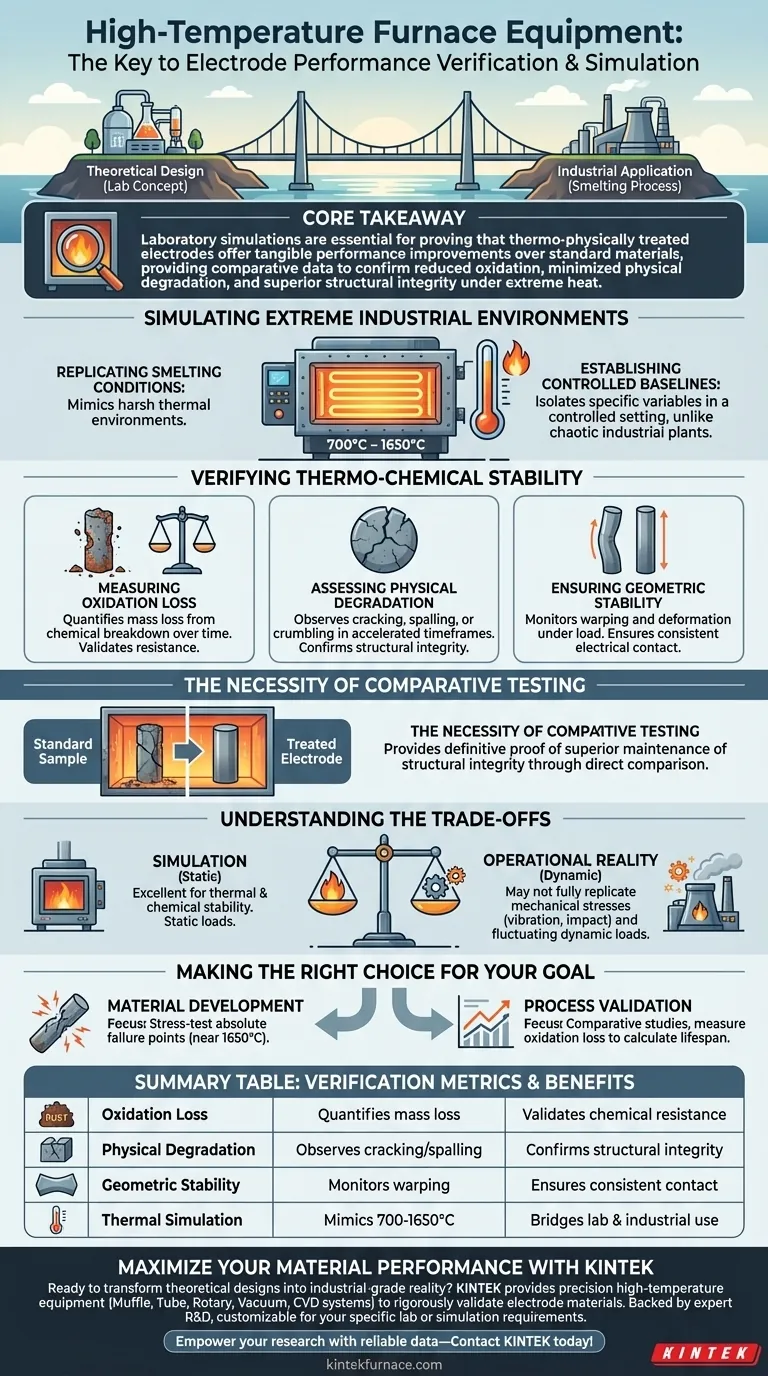
High-temperature furnace equipment acts as the critical validation stage in the development of electrode materials, bridging the gap between theoretical design and industrial application. By generating precise temperatures ranging from 700°C to 1650°C, these laboratory-grade units simulate the harsh thermal environments of smelting processes to rigorously test the thermo-chemical stability and physical resilience of modified electrodes.
Core Takeaway Laboratory simulations are essential for proving that thermo-physically treated electrodes offer tangible performance improvements over standard materials. These furnaces provide the comparative data necessary to confirm reduced oxidation, minimized physical degradation, and superior structural integrity under extreme heat.

Simulating Extreme Industrial Environments
Replicating Smelting Conditions
To accurately predict how an electrode will perform in a real-world foundry, testing must occur under similar thermal stress.
Laboratory-grade furnaces are capable of reaching temperatures between 700°C and 1650°C.
This broad range allows researchers to mimic the specific extreme thermal environments found in various smelting processes.
Establishing Controlled Baselines
Unlike the chaotic environment of an active industrial plant, a laboratory furnace offers a controlled setting.
This allows for the isolation of specific variables, ensuring that performance data is attributed strictly to the material properties of the electrode.
Verifying Thermo-Chemical Stability
Measuring Oxidation Loss
One of the primary failure modes for electrodes in high heat is oxidation.
High-temperature furnaces allow researchers to quantify exactly how much mass an electrode loses due to oxidation when exposed to heat over time.
This validates whether modified materials successfully resist chemical breakdown better than untreated counterparts.
Assessing Physical Degradation
Heat causes materials to crack, spall, or crumble.
Simulation testing provides a window to observe physical degradation in accelerated timeframes.
If a treated electrode remains intact while a control sample degrades, the efficacy of the treatment is verified.
Ensuring Geometric Stability
An electrode must maintain its shape to function correctly in an arc furnace or smelting pot.
Testing verifies geometric stability, ensuring the material does not warp or deform under thermal load.
This confirms that the electrode will maintain the necessary electrical and physical contact points during actual operation.
The Necessity of Comparative Testing
Validating Thermo-Physical Treatments
The primary goal of using this equipment is often comparative analysis.
Researchers place thermo-physically treated electrodes alongside standard samples to observe relative performance.
The equipment provides definitive proof of whether the modification results in superior maintenance of the electrode's structural integrity.
Understanding the Trade-offs
Simulation vs. Operational Reality
While high-temperature furnaces are excellent for testing thermal and chemical stability, they are simulations.
They may not perfectly replicate dynamic mechanical stresses, such as vibration or physical impact, present in an active industrial smelter.
Static vs. Dynamic Loads
Furnace testing is typically a static thermal load.
Real-world applications often involve fluctuating electrical currents and dynamic interactions with slag or raw materials, which pure thermal simulation might not fully capture.
Making the Right Choice for Your Goal
How to Apply This to Your Project
- If your primary focus is Material Development: Prioritize testing at the upper limits (near 1650°C) to stress-test the absolute failure points of your modified coatings or treatments.
- If your primary focus is Process Validation: Use the furnace to perform comparative studies, strictly measuring oxidation loss rates between treated and untreated samples to calculate potential lifespan improvements.
Ultimately, high-temperature simulation transforms theoretical material improvements into verified, quantifiable performance data.
Summary Table:
| Verification Metric | Testing Significance | Key Benefit |
|---|---|---|
| Oxidation Loss | Quantifies mass loss over time | Validates chemical resistance and durability |
| Physical Degradation | Observes cracking, spalling, or crumbling | Confirms structural integrity under stress |
| Geometric Stability | Monitors warping and deformation | Ensures consistent electrical contact |
| Thermal Simulation | Mimics 700°C to 1650°C environments | Bridges gap between lab and industrial use |
Maximize Your Material Performance with KINTEK
Ready to transform theoretical designs into industrial-grade reality? KINTEK provides the precision high-temperature equipment needed to rigorously validate your electrode materials. Backed by expert R&D and manufacturing, we offer a comprehensive range of Muffle, Tube, Rotary, Vacuum, and CVD systems—all fully customizable to meet your specific lab or simulation requirements. Whether you are focusing on material development at 1650°C or validating process stability, our furnaces deliver the controlled environments you need to succeed.
Empower your research with reliable data—Contact KINTEK today to discuss your project!
Visual Guide
References
- K. A. Krylov, V. M. Dydin. Thermophysical Treatment of Petroleum Coke-Based Electrode Paste as a New Promising Approach to Integrating the Oil Refining and Metallurgical Industries for Carbon-Graphite Electrode Production. DOI: 10.5829/ije.2026.39.02b.05
This article is also based on technical information from Kintek Furnace Knowledge Base .
Related Products
- 1400℃ High Temperature Laboratory Tube Furnace with Alumina Tube
- 1800℃ High Temperature Muffle Oven Furnace for Laboratory
- 1700℃ High Temperature Laboratory Tube Furnace with Alumina Tube
- 1700℃ High Temperature Muffle Oven Furnace for Laboratory
- 1700℃ Controlled Inert Nitrogen Atmosphere Furnace
People Also Ask
- How does zone-melting in tube furnaces synthesize bismuth micro-wires? Master Single-Crystal Thermoelectric Growth
- How are high-temp tube furnaces used to measure diffusion coefficients per Fick's law? Master Precision Annealing
- How are high-temperature laboratory tube furnaces applied in long-term vacuum homogenization heat treatments for intermetallic samples?
- How do high-temperature laboratory tube furnaces ensure environmental stability? Precision Thermal Reduction Tips
- How are high-temperature tube furnaces applied in testing ceramic-supported alloy membranes? Insights



















