
The primary function of a laboratory high-temperature furnace in cook-off synthesis is to serve as a thermal initiator.
In this specific process, the furnace does not slowly bake the material; rather, it provides a stable, high-heat environment (typically around 700 °C) that rapidly brings a precursor mixture to its specific ignition point. Once this critical temperature is reached, the furnace’s job is effectively done, as the materials undergo a self-sustaining, violent redox reaction known as deflagration.
Core Takeaway The furnace acts as a precise trigger mechanism, not a long-term heating vessel. Its role is to supply the activation energy required to ignite the chemical precursors, initiating an instantaneous, exothermic explosion that drives the actual synthesis of the doped carbon material.
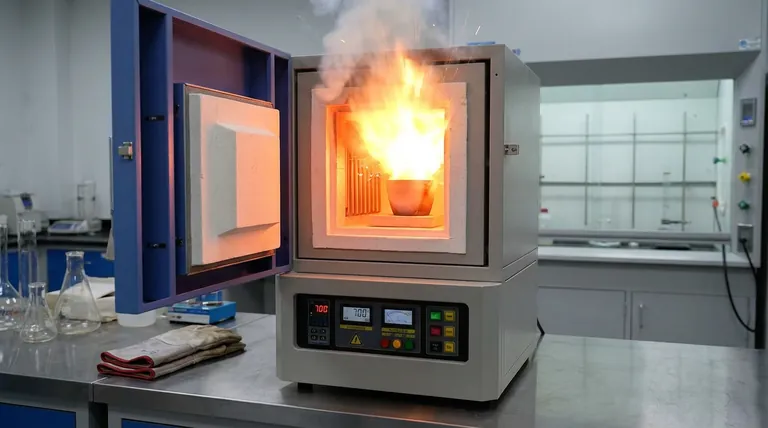
The Mechanics of Cook-off Synthesis
Creating the Preheating Zone
The furnace establishes a consistent thermal baseline.
By maintaining a steady temperature (often 700 °C), the furnace ensures that the reaction vessel—usually a crucible—is subjected to immediate, intense heat upon insertion.
Reaching the Ignition Point
The objective is speed.
The precursor mixture—often containing activated carbon, sulfur powder, urea, boric acid, and potassium nitrate—must be heated rapidly.
The furnace facilitates a quick rise in temperature to the specific flashpoint where the oxidizers and fuel in the mixture react.
Triggering Deflagration
The defining feature of "cook-off" synthesis is the violent redox reaction.
Unlike standard calcination, which is slow and steady, this process relies on a sudden release of chemical energy.
The furnace provides the external heat necessary to "cook off" the mixture, causing it to ignite and deflagrate (burn rapidly).
Material Transformation
The real work happens during the split-second of ignition.
The instantaneous high heat generated by the reaction itself—not just the furnace—forces heteroatoms (like nitrogen, sulfur, or boron) into the carbon lattice.
Simultaneously, this thermal spike improves the surface graphitization of the carbon substrate, enhancing the final catalyst's conductivity and stability.
Operational Considerations and Safety
Managing Thermal Shock
Because the reaction generates extreme local temperatures and gas pressure, the choice of containment is critical.
High-purity alumina crucibles are essential in this environment.
They possess the chemical stability to prevent impurity contamination and the thermal shock resistance to withstand the violence of the deflagration without cracking.
The Trade-off: Control vs. Intensity
Cook-off synthesis trades precise, gradual control for rapid, high-energy structural changes.
While a tube furnace might offer programmed, multi-stage heating for delicate operations (such as annealing), the cook-off method utilizes the furnace solely as a blast furnace-style trigger.
This results in highly active materials but requires rigorous safety protocols due to the explosive nature of the redox reaction.
Making the Right Choice for Your Goal
To maximize the effectiveness of your synthesis, consider the following regarding furnace operation:
- If your primary focus is triggering the reaction: Ensure your furnace has high thermal mass and recovery, allowing it to maintain 700 °C even when a cold crucible is introduced.
- If your primary focus is material purity: Verify that your containment (crucibles) can withstand the internal exothermic spike without degrading, as the furnace temperature is only the baseline.
Ultimately, the furnace is the match that lights the fuse, enabling the chemical energy of the precursors to forge the final catalyst.
Summary Table:
| Feature | Cook-off Synthesis Role | Standard Calcination Role |
|---|---|---|
| Primary Function | Thermal Initiator (Trigger) | Long-term Heating Vessel |
| Temperature Goal | Reach Ignition Point (700°C) | Gradual Thermal Transformation |
| Heating Speed | Rapid / Instantaneous | Slow / Programmed |
| Energy Source | Internal Exothermic Reaction | External Furnace Heat |
| Material Result | Rapid Lattice Doping | Uniform Crystalline Growth |
Accelerate your material innovation with KINTEK’s precision thermal solutions. Whether you need the rapid recovery of a Muffle Furnace for cook-off synthesis or the programmed control of Tube, Rotary, Vacuum, and CVD systems, our expert R&D and manufacturing teams deliver customizable, high-temp lab furnaces tailored to your unique research needs. Contact us today to find the perfect furnace for your laboratory and experience the KINTEK advantage in reliability and performance.
References
- Ruiquan Zhang, Maocong Hu. Heteroatom-Doped Carbon-Based Catalysts Synthesized through a “Cook-Off” Process for Oxygen Reduction Reaction. DOI: 10.3390/pr12020264
This article is also based on technical information from Kintek Furnace Knowledge Base .
Related Products
- 1400℃ High Temperature Laboratory Tube Furnace with Alumina Tube
- 1700℃ High Temperature Laboratory Tube Furnace with Alumina Tube
- 1800℃ High Temperature Muffle Oven Furnace for Laboratory
- 1700℃ High Temperature Muffle Oven Furnace for Laboratory
- 1200℃ Muffle Oven Furnace for Laboratory
People Also Ask
- How does zone-melting in tube furnaces synthesize bismuth micro-wires? Master Single-Crystal Thermoelectric Growth
- How are high-temperature laboratory tube furnaces applied in long-term vacuum homogenization heat treatments for intermetallic samples?
- How do high-temperature laboratory tube furnaces ensure environmental stability? Precision Thermal Reduction Tips
- How are high-temp tube furnaces used to measure diffusion coefficients per Fick's law? Master Precision Annealing
- How are high-temperature tube furnaces applied in testing ceramic-supported alloy membranes? Insights



















