
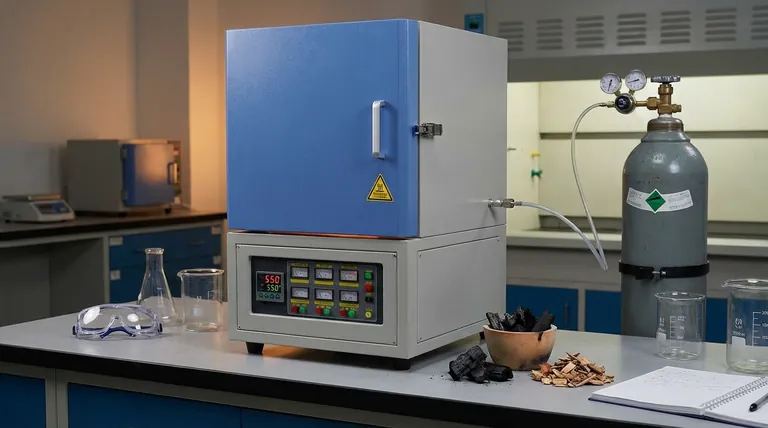
A muffle furnace functions as a precision thermal reactor, converting organic waste into biochar by maintaining a stable, high-temperature environment—typically between 450°C and 600°C—under oxygen-limited conditions. By utilizing a controlled heating rate, such as 20°C/min, the furnace ensures uniform thermal distribution, which is critical for driving off volatile components without combusting the material.
Core Takeaway The muffle furnace facilities slow pyrolysis by decoupling temperature control from combustion. It allows you to heat biomass to specific thermal decomposition points without burning it, transforming raw organic waste into a stable, porous carbon framework known as biochar.
The Mechanics of Thermal Control
Precision Heating Profiles
The primary advantage of a muffle furnace is its ability to execute a specific heating ramp. By raising the temperature at a steady rate (e.g., 20°C/min), the equipment ensures that the organic waste is heated evenly throughout.
This controlled ramp prevents "thermal shock" and ensures that the outer layers of the biomass do not carbonize too quickly before the core reaches the target temperature.
Achieving Target Temperatures
For slow pyrolysis, the furnace typically holds the material between 450°C and 600°C.
At these temperatures, the energy is sufficient to break the chemical bonds of the biomass. This triggers the release of moisture and volatile organic compounds, leaving behind the carbon-rich residue.
Thermal Uniformity
Inside the muffle chamber, the heating elements are isolated from the sample, or the chamber is designed to radiate heat evenly.
This thermal uniformity is essential for consistent batch quality. It ensures that every piece of organic waste in the chamber undergoes the same degree of carbonization, leading to predictable yields.
Managing the Reaction Atmosphere
Preventing Combustion
The defining characteristic of pyrolysis is thermal decomposition in the absence of oxygen.
If air were allowed to flow freely over the hot biomass, the material would simply burn to ash. A muffle furnace enables an oxygen-limited or anaerobic environment.
The Role of Inert Gas
To achieve this anaerobic state, advanced muffle furnace setups often include a gas inlet to purge the chamber with nitrogen.
This gas flow displaces oxygen, ensuring that the biomass undergoes reduction rather than oxidation. This preserves the fixed carbon skeleton required for high-quality biochar.
Determining Biochar Quality
Constructing the Pore Structure
The specific conditions maintained by the muffle furnace directly dictate the physical architecture of the final product.
By controlling the release of volatiles, the furnace helps form a rich porous structure. This porosity is the key feature that makes biochar valuable as a soil amendment or filtration medium.
Regulating Carbonization Degree
The "holding time" (e.g., maintaining 600°C for 30 minutes) determines how thoroughly the material is carbonized.
Longer holding times and higher temperatures generally increase the carbon content and surface area, but may reduce the overall mass yield. The muffle furnace allows you to fine-tune this balance.
Understanding the Trade-offs
Batch Processing Limitations
Muffle furnaces are typically batch reactors. This means you must load, heat, cool, and unload the chamber for every cycle.
While excellent for research and small-scale precision, this process is significantly slower than the continuous flow reactors used in industrial biochar production.
Energy Consumption
Maintaing high temperatures for extended periods requires significant energy input.
Because the furnace heats the entire chamber—including the air or gas inside—rather than just the biomass, the energy efficiency per kilogram of biochar produced is generally lower than direct-heating methods.
Making the Right Choice for Your Goal
To maximize the utility of a muffle furnace for your specific biochar application, consider the following operational targets:
- If your primary focus is Soil Application: Aim for a temperature range of 450°C to 500°C to maximize yield and retain some functional groups that aid in nutrient retention.
- If your primary focus is Filtration or Adsorption: Operate at higher temperatures (600°C to 700°C) to maximize surface area and porosity, even though your total yield will decrease.
- If your primary focus is Process Consistency: strictly monitor the heating rate; a consistent ramp of 20°C/min is often more critical for reproducible pore structure than the final holding temperature.
The muffle furnace is the standard tool for establishing the baseline quality of your biochar, bridging the gap between raw organic waste and a functional carbon material.
Summary Table:
| Parameter | Typical Setting/Value | Impact on Biochar |
|---|---|---|
| Temperature Range | 450°C - 600°C | Determines carbonization degree and surface area |
| Heating Rate | ~20°C/min | Ensures uniform thermal distribution and pore formation |
| Atmosphere | Oxygen-limited (Inert) | Prevents combustion/ashing; preserves carbon skeleton |
| Holding Time | Variable (e.g., 30+ mins) | Balances total mass yield vs. fixed carbon content |
| Final Structure | Highly Porous | Enhances soil amendment and filtration capabilities |
Elevate Your Research with KINTEK Precision Furnaces
Ready to transform organic waste into high-quality biochar? KINTEK provides the specialized equipment needed for exacting thermal decomposition.
Backed by expert R&D and manufacturing, we offer Muffle, Tube, Rotary, Vacuum, and CVD systems—all fully customizable to meet your unique lab or pilot-scale requirements. Whether you are optimizing pore structure for filtration or maximizing yield for soil science, our systems deliver the thermal uniformity and atmosphere control you demand.
Contact KINTEK today to find your perfect high-temp solution!
References
- Nathan Howell, Bridget Guerrero. Utilization of cotton gin waste biochars for agronomic benefits in soils. DOI: 10.1007/s13399-024-05545-x
This article is also based on technical information from Kintek Furnace Knowledge Base .
Related Products
- 1400℃ Muffle Oven Furnace for Laboratory
- 1700℃ High Temperature Muffle Oven Furnace for Laboratory
- 1800℃ High Temperature Muffle Oven Furnace for Laboratory
- 1200℃ Muffle Oven Furnace for Laboratory
- High Temperature Muffle Oven Furnace for Laboratory Debinding and Pre Sintering
People Also Ask
- How does a high-temperature laboratory muffle furnace affect material properties? Transform Anodic Oxide Films Fast
- What is the primary function of a high-temperature laboratory muffle furnace in chemical synthesis? Achieve Precision.
- What is the role of a laboratory high-temperature muffle furnace in H13 steel treatment? Optimize Tool Performance
- What are the primary objectives of using a muffle furnace in zirconia synthesis? Achieve precision phase control.
- How is a laboratory high-temperature muffle furnace utilized to achieve the specific crystalline structure of LaFeO3 catalysts?



















