
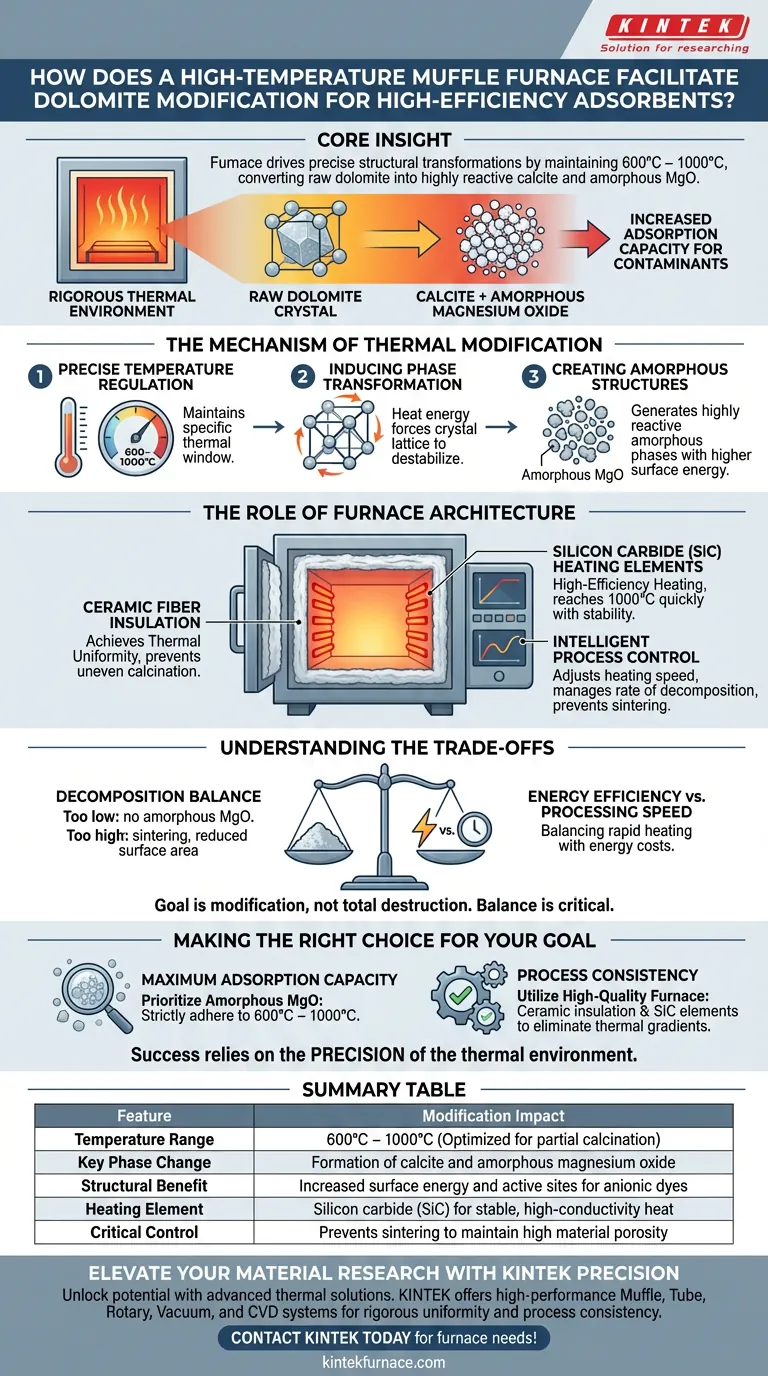
A high-temperature muffle furnace facilitates dolomite modification by creating a rigorously controlled thermal environment essential for partial calcination. By subjecting the material to constant heating between 600°C and 1000°C, the furnace drives precise structural transformations that convert raw dolomite into a highly reactive adsorbent.
Core Insight: The muffle furnace is not merely a heating source; it is an instrument of structural engineering. It facilitates the partial decomposition of dolomite into calcite and amorphous magnesium oxide, a phase change that directly correlates to a significant increase in adsorption capacity for contaminants like anionic dyes.
The Mechanism of Thermal Modification
Precise Temperature Regulation
The modification of dolomite is highly sensitive to temperature. The muffle furnace allows you to maintain a specific thermal window, typically 600°C to 1000°C.
Inducing Phase Transformation
Within this temperature range, the heat energy forces the dolomite crystal lattice to destabilize. This is not a total disintegration, but a controlled partial conversion.
Creating Amorphous Structures
The process generates amorphous magnesium oxide alongside calcite. Unlike crystalline structures, amorphous phases often possess higher surface energy and reactivity, which is critical for binding contaminants.
The Role of Furnace Architecture
Achieving Thermal Uniformity
Muffle furnaces utilize advanced ceramic fiber insulation to minimize heat loss. This ensures that the thermal environment surrounding the dolomite sample is uniform, preventing uneven calcination.
High-Efficiency Heating Elements
To reach and sustain temperatures up to 1000°C, these furnaces often employ silicon carbide (SiC) heating elements. These components provide high thermal conductivity and stability, allowing the system to reach the target temperature quickly.
Intelligent Process Control
Modern muffle furnaces feature intelligent heating functions that adjust the heating speed. This control is vital for managing the rate of decomposition, ensuring the dolomite structure changes predictably without sintering into a non-porous mass.
Understanding the Trade-offs
The Balance of Decomposition
Temperature control is critical because the goal is modification, not total destruction. If the temperature is too low, the amorphous magnesium oxide will not form; if it is too high or held too long, the material may sinter, reducing its surface area and adsorption capability.
Energy Efficiency vs. Processing Speed
High-temperature processing is energy-intensive. While high-efficiency insulation and "energy-saving modes" help, operating at 1000°C requires significant power. You must balance the need for rapid heating with the energy costs of sustained high-temperature operations.
Making the Right Choice for Your Goal
To maximize the efficacy of your dolomite-based adsorbents, consider the following:
- If your primary focus is maximum adsorption capacity: Prioritize the generation of amorphous magnesium oxide by strictly adhering to the 600°C–1000°C window to ensure active sites are created for anionic dyes.
- If your primary focus is process consistency: Utilize a furnace with high-quality ceramic insulation and SiC elements to eliminate thermal gradients that could lead to heterogeneous product quality.
Success in dolomite modification relies less on maximum heat and more on the precision of the thermal environment.
Summary Table:
| Feature | Modification Impact |
|---|---|
| Temperature Range | 600°C – 1000°C (Optimized for partial calcination) |
| Key Phase Change | Formation of calcite and amorphous magnesium oxide |
| Structural Benefit | Increased surface energy and active sites for anionic dyes |
| Heating Element | Silicon carbide (SiC) for stable, high-conductivity heat |
| Critical Control | Prevents sintering to maintain high material porosity |
Elevate Your Material Research with KINTEK Precision
Unlock the full potential of your adsorption materials with KINTEK’s advanced thermal solutions. Backed by expert R&D and manufacturing, KINTEK offers high-performance Muffle, Tube, Rotary, Vacuum, and CVD systems designed to provide the rigorous temperature uniformity required for complex dolomite modification.
Whether you need standard lab equipment or a fully customizable high-temp furnace tailored to your unique research parameters, our systems ensure process consistency and structural integrity for every sample.
Ready to optimize your adsorbent synthesis? Contact KINTEK today to speak with our technical experts about your high-temperature furnace needs!
Visual Guide
References
- Zhaohui Li, Shangping Xu. Anionic Dye Alizarin Red S Removal Using Heat-Treated Dolomite. DOI: 10.3390/cryst14020187
This article is also based on technical information from Kintek Furnace Knowledge Base .
Related Products
- 1700℃ High Temperature Muffle Oven Furnace for Laboratory
- 1800℃ High Temperature Muffle Oven Furnace for Laboratory
- 1400℃ Muffle Oven Furnace for Laboratory
- 1200℃ Muffle Oven Furnace for Laboratory
- High Temperature Muffle Oven Furnace for Laboratory Debinding and Pre Sintering
People Also Ask
- What is the primary function of a high-temperature laboratory muffle furnace in chemical synthesis? Achieve Precision.
- How does a high-temperature laboratory muffle furnace affect material properties? Transform Anodic Oxide Films Fast
- What role does a muffle furnace play in BCZY712 electrolyte powder production? Achieve Perfect Phase Purity
- What is the role of a high-temperature muffle furnace in guava leaf carbonization? Master Precise Pyrolysis Control
- How does the two-stage sintering process contribute to the synthesis of MeCuFeO3 perovskite? Optimize crystal purity.



















