
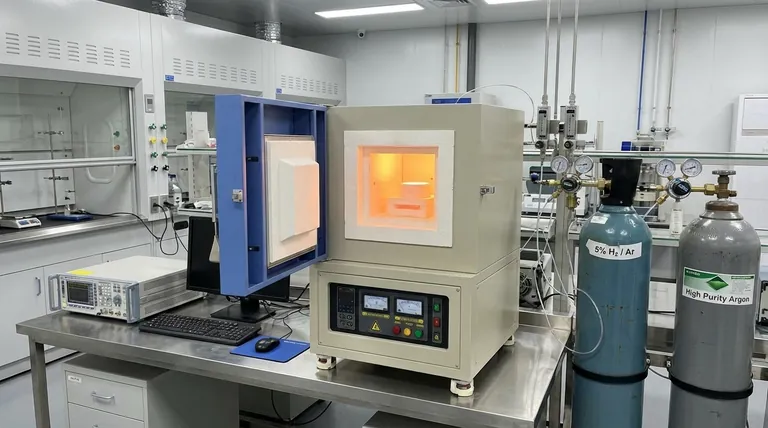
To achieve the exsolution of nickel particles, a high-temperature reduction furnace must provide a strictly controlled high-purity reducing atmosphere, typically composed of 5% Hydrogen in Argon (H2/Ar), combined with precise gradient heating between 600°C and 800°C. These specific conditions force nickel cations out of the perovskite lattice structure, causing them to reduce and migrate to the surface to form metallic nanoparticles.
The process of exsolution is governed by the stability of the furnace environment. It is the combination of atmospheric purity and thermal precision that determines the nucleation rate, density, and ultimate size of the nickel particles.
Creating the Reducing Environment
The Necessity of High-Purity Gas
The furnace must introduce a high-purity reducing atmosphere, most commonly a mixture of 5% H2 balanced with Ar.
This specific gas composition lowers the oxygen partial pressure in the chamber.
Driving Cation Migration
This reducing environment is the catalyst for the chemical change.
It destabilizes the nickel cations residing within the perovskite lattice. Consequently, these cations are forced to reduce (gain electrons) and migrate from the bulk of the material to the surface.
Precision Heating Requirements
The Critical Temperature Window
The furnace must be capable of delivering precise gradient heating within a specific range of 600°C to 800°C.
Temperatures below this range may not provide sufficient energy for cation mobility. Temperatures exceeding this range risk structural degradation or excessive particle coarsening.
Stability Controls Nucleation
Temperature stability within the chamber is not just a safety feature; it is a synthesis parameter.
The stability of the heat profile directly impacts the nucleation rate. A stable temperature ensures that the nickel particles form at a consistent rate across the material surface.
Understanding the Trade-offs
Distribution Density vs. Particle Size
The physical conditions in the furnace involve a balance between how many particles form and how large they grow.
Variations in atmosphere purity or temperature fluctuations can alter the distribution density. While high heat drives migration, lack of control can lead to uneven particle clumping rather than a fine, uniform dispersion.
The Risk of Impurities
If the furnace cannot maintain high atmosphere purity, the exsolution process is compromised.
Contaminants in the gas stream can interfere with the reduction of nickel cations. This results in poor particle formation or unwanted surface reactions that inhibit the catalytic potential of the exsolved nickel.
Optimizing Your Exsolution Strategy
To ensure you achieve the desired particle morphology, align your furnace parameters with your specific material goals.
- If your primary focus is maximizing particle density: Prioritize the precision of the thermal gradient to ensure a rapid and uniform nucleation rate across the surface.
- If your primary focus is controlling particle size: Focus on the strict maintenance of the 600°C to 800°C window and the purity of the 5% H2/Ar atmosphere to prevent uncontrolled growth or coarsening.
By treating the furnace atmosphere and thermal gradient as active reagents rather than passive conditions, you gain control over the microstructure of your material.
Summary Table:
| Parameter | Requirement | Impact on Exsolution |
|---|---|---|
| Atmosphere | 5% H2 in Argon (High Purity) | Lowers oxygen partial pressure to drive cation migration |
| Temperature Range | 600°C to 800°C | Provides activation energy for reduction and surface mobility |
| Heating Method | Precise Gradient Heating | Controls nucleation rate and ensures uniform particle density |
| Environment Stability | High Thermal & Gas Stability | Prevents particle coarsening and structural degradation |
Elevate Your Material Research with KINTEK
Precision is the difference between successful particle exsolution and structural failure. KINTEK provides industry-leading Tube, Vacuum, and CVD furnace systems engineered to deliver the exact 5% H2/Ar atmospheres and stable 600°C-800°C gradients your perovskite research demands.
Backed by expert R&D and manufacturing, our high-temperature lab furnaces are fully customizable to meet your unique synthesis needs. Achieve uniform nickel distribution and superior catalytic performance today.
Contact KINTEK Experts for a Custom Solution
References
- Min Xu, John T. S. Irvine. Synergistic growth of nickel and platinum nanoparticles via exsolution and surface reaction. DOI: 10.1038/s41467-024-48455-2
This article is also based on technical information from Kintek Furnace Knowledge Base .
Related Products
- High Temperature Muffle Oven Furnace for Laboratory Debinding and Pre Sintering
- 1700℃ High Temperature Muffle Oven Furnace for Laboratory
- 1800℃ High Temperature Muffle Oven Furnace for Laboratory
- 1400℃ High Temperature Laboratory Tube Furnace with Alumina Tube
- 1700℃ Controlled Inert Nitrogen Atmosphere Furnace
People Also Ask
- What thermal phenomena occur during polymer binder burnout in ceramic green bodies? Lab Furnace Guide
- What role does a high-temperature muffle furnace play in STFO synthesis? Achieve Pure Perovskite Results
- Why is controlled heat treatment in a muffle furnace necessary for calcined clay? Achieve Optimal Pozzolanic Activity
- How does a high-temperature muffle furnace facilitate the formation of LaNbxAl1−xO3+δ perovskite structures? Key Roles
- What role does a high-temperature muffle furnace play in the multi-stage synthesis of Li0.5MnFe1.5O4? Key to Pure Spinel



















