
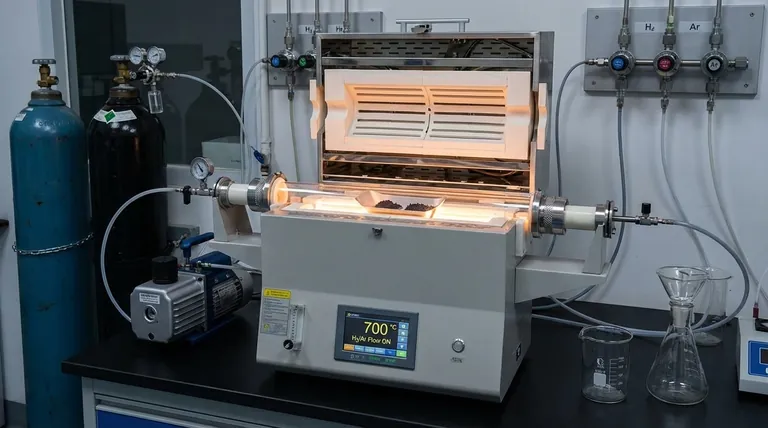
A tube furnace establishes a precise high-temperature reducing environment that is essential for synthesizing core-shell catalysts. Specifically, it provides a controlled atmosphere of Hydrogen and Argon (H2/Ar) alongside a high thermal baseline—typically around 700 °C—to simultaneously drive metal reduction and structural encapsulation.
The tube furnace does not simply heat the material; it acts as a reaction chamber that induces Strong Metal-Support Interactions (SMSI). By coupling precise thermal energy with a reducing gas flow, it forces the support material to migrate and encapsulate the metal core, creating the defining core-shell architecture.
The Role of the Reducing Atmosphere
Driving Chemical Reduction
The primary function of the tube furnace during this stage is to introduce a stable reducing agent.
A mixture of Hydrogen (H2) and inert Argon (Ar) is typically employed. This environment actively strips oxygen from metal precursors, such as reducing cobalt particles to their metallic state.
Preventing Re-oxidation
The furnace’s sealing capabilities are critical for maintaining the purity of this atmosphere.
By strictly controlling the gas flow and excluding ambient oxygen, the furnace ensures that once the metal particles are reduced, they remain in a metallic state without re-oxidizing or aggregating unpredictably.
Thermal Energy and Structural Evolution
Inducing the SMSI Effect
The high operating temperature, specifically cited at 700 °C for cobalt-based systems, is not arbitrary.
This specific thermal energy is required to trigger the Strong Metal-Support Interaction (SMSI). This effect changes the electronic state of the catalyst and is the driving force behind the unique properties of the final material.
Promoting Layer Migration
Heat provided by the furnace facilitates physical movement at the microscopic level.
Under these conditions, the support layer (such as BaAl2O4) gains enough energy to migrate over the surface of the metallic core (Cobalt). This migration forms the physical "shell" that encapsulates the core, completing the core-shell structure.
Precision and Uniformity
Ensuring Uniform Reduction
A tube furnace provides a distinct advantage regarding the consistency of the thermal field.
The precision of the temperature control ensures that reduction occurs uniformly across the entire batch. This prevents localized "hot spots" that could lead to uneven shell formation or incomplete reduction of the core.
Generating Tensile Strain
The physical conditions within the furnace directly influence the lattice strain of the catalyst.
The combination of uniform reduction and the physical constriction of the encapsulating shell creates a desired tensile strain on the surface of the core. This strain modifies the surface geometry, optimizing the catalyst for specific chemical reactions.
Understanding the Trade-offs
Temperature Sensitivity
Achieving the SMSI effect requires hitting a narrow thermal window.
If the temperature is too low, the support layer will not migrate, and no shell will form. If the temperature is excessively high beyond the optimal point (e.g., significantly above 700 °C for this specific system), you risk sintering the metal particles, which destroys the active surface area.
Atmospheric Balance
The ratio of H2 to Ar must be carefully calibrated.
Insufficient hydrogen results in incomplete reduction of the core metal. Conversely, an aggressive pure hydrogen environment without the argon buffer can sometimes lead to overly rapid reduction, causing structural collapse rather than the controlled migration required for a perfect core-shell interface.
Making the Right Choice for Your Goal
To optimize the reduction stage for your specific catalyst, consider these parameters:
- If your primary focus is inducing Strong Metal-Support Interactions (SMSI): Prioritize reaching the specific high-temperature threshold (e.g., 700 °C) required to mobilize your support layer for encapsulation.
- If your primary focus is preventing particle aggregation: Ensure your tube furnace has high-integrity sealing to maintain a consistent inert/reducing gas ratio throughout the entire dwell time.
Ultimately, the tube furnace acts as a precision tool that converts thermal energy into specific structural changes, turning simple precursors into complex, high-performance core-shell heterojunctions.
Summary Table:
| Physical Condition | Role in Catalyst Synthesis | Impact on Core-Shell Structure |
|---|---|---|
| H2/Ar Atmosphere | Acts as a stable reducing agent | Strips oxygen from precursors; prevents re-oxidation |
| 700 °C Thermal Baseline | Triggers Strong Metal-Support Interaction (SMSI) | Drives support layer migration to form the encapsulating shell |
| Uniform Thermal Field | Ensures consistent reduction across the batch | Prevents localized hot spots and uneven shell formation |
| High-Integrity Sealing | Maintains atmosphere purity | Ensures metal particles remain in a metallic state without aggregating |
| Lattice Tension Control | Influences physical constriction | Generates tensile strain to optimize surface geometry for reactions |
Elevate Your Catalyst Synthesis with KINTEK Precision
Achieving the perfect core-shell architecture requires absolute control over thermal migration and atmospheric purity. KINTEK provides high-performance Tube, Vacuum, and CVD systems designed specifically for sensitive reduction stages.
Backed by expert R&D and manufacturing, our customizable furnaces ensure the uniform heating and precise gas control necessary to induce SMSI effects without risking particle sintering.
Ready to optimize your lab's high-temperature processes? Contact KINTEK experts today to find the ideal furnace solution for your unique research needs.
Visual Guide

References
- Pei Xiong, Molly Meng‐Jung Li. Efficient Low‐temperature Ammonia Cracking Enabled by Strained Heterostructure Interfaces on Ru‐free Catalyst. DOI: 10.1002/adma.202502034
This article is also based on technical information from Kintek Furnace Knowledge Base .
Related Products
- Vacuum Sealed Continuous Working Rotary Tube Furnace Rotating Tube Furnace
- 1400℃ High Temperature Laboratory Tube Furnace with Alumina Tube
- 1700℃ High Temperature Laboratory Tube Furnace with Alumina Tube
- 1200℃ Split Tube Furnace Laboratory Quartz Tube Furnace with Quartz Tube
- Vertical Laboratory Quartz Tube Furnace Tubular Furnace
People Also Ask
- What is the purpose of rotary tube furnaces? Achieve Uniform Heat Treatment for Powders and Granules
- What are the key advantages of using a rotary tube furnace? Achieve Dynamic, Uniform Heating for Powders
- How does the amount of material processed vary between batch and continuous rotary tube furnaces? Scale Your Production Efficiently
- What are the advantages of rotary tube furnaces in fuel compatibility? Boost Efficiency and Cut Costs
- What is the temperature range of some rotary tube furnaces? Achieve Uniform Heating Up to 1200°C



















